
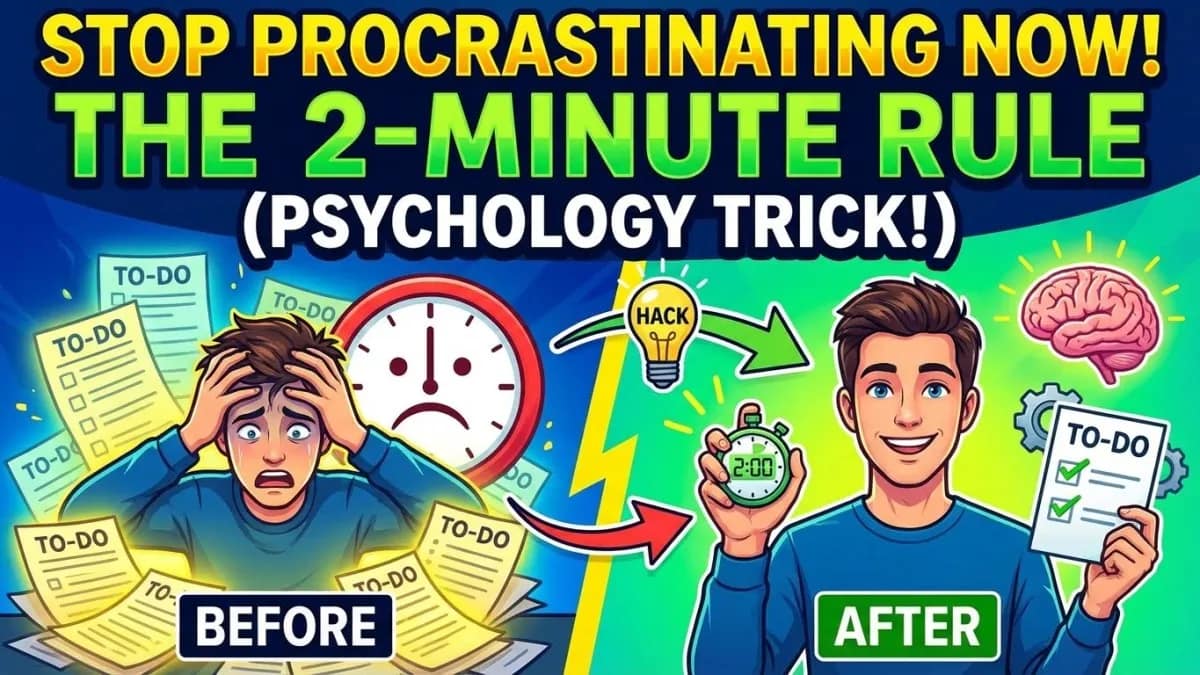
The “2-Minute Rule” to Stop Procrastination (Psychology Explained)
Key Takeaways
Quick wins matter more than you think. Here’s what you need to know:
- The 2-minute rule says: If something takes less than 2 minutes, do it right now
- Your brain resists big tasks but accepts tiny ones
- Starting is harder than continuing—this rule removes the starting barrier
- Works for both immediate tasks and breaking down bigger goals
- Consistency beats perfection every single time
Why You Keep Putting Things Off (It’s Not Laziness)
Let me be honest with you. I’ve worked with hundreds of people who call themselves “lazy procrastinators.” But here’s what I’ve learned: procrastination isn’t about being lazy.
Your brain is actually trying to protect you. When you look at a big task, your brain sees threat and discomfort. So it pushes you toward easier, more pleasant activities.
This is called temporal discounting. Your brain values immediate rewards over future benefits. Scrolling through your phone feels better right now than starting that work project.
I’ve seen this pattern destroy careers, relationships, and self-confidence. But the fix is simpler than most people realize.
What Is the 2-Minute Rule?
The 2-minute rule has two parts, and both are powerful.
Version 1 – The Immediate Action Rule
If a task takes less than 2 minutes, do it immediately. Don’t write it down. Don’t schedule it. Just do it.
Examples:
- Reply to that text message
- Hang up your coat
- Rinse your dish
- Send that quick email
- Make your bed
I started using this rule five years ago. My email inbox went from 200 unread messages to under 10. My home became cleaner without “cleaning days.”
The magic happens because you’re not giving your brain time to negotiate.
Version 2 – The Starter Rule
For bigger tasks, commit to just 2 minutes of work. That’s it. After 2 minutes, you can stop if you want.
Want to write a report? Just write for 2 minutes. Need to exercise? Just do 2 minutes. Should study? Open the book for 2 minutes.
Here’s what I’ve noticed: People almost never stop at 2 minutes. Once you start, your brain shifts into “task mode.” The hardest part is always the start.
The Psychology Behind Why This Actually Works
Let me explain the brain science in simple terms.
Your Brain Hates Big Decisions
When you look at a project that takes 3 hours, your brain calculates the energy cost. It feels overwhelming. So you avoid it.
But 2 minutes? Your brain doesn’t even register that as a threat. There’s no resistance.
I call this “sneaking past the brain’s security guard.” You’re not asking for permission to do something hard. You’re just taking a tiny step.
The Zeigarnik Effect Takes Over
This is a psychology principle I use every day. Once you start something, your brain wants to finish it.
Think about a song that gets stuck in your head. Or when you start watching a TV show and can’t stop.
Your brain doesn’t like incomplete tasks. Starting for 2 minutes creates psychological tension that pulls you forward.
You Build Momentum, Not Pressure
I’ve seen people burn out from motivation alone. They get pumped up, work for 6 hours, then crash for a week.
The 2-minute rule builds sustainable momentum. Small wins create confidence. Confidence creates more action. More action creates results.
It’s like pushing a car. The first push is the hardest. Once it’s rolling, keeping it moving is easy.
Pro Tip: Use the “2-Minute Trigger”
Here’s something most people miss: Connect your 2-minute tasks to existing habits.
I do 2 minutes of stretching right after my morning coffee. My coffee is the trigger.
Try this formula: “After I [existing habit], I will [2-minute task] for just 2 minutes.”
Examples:
- After I sit at my desk, I’ll organize for 2 minutes
- After I brush my teeth, I’ll read for 2 minutes
- After I eat lunch, I’ll walk for 2 minutes
This turns the rule into an automatic system. You stop relying on willpower.
How to Use the 2-Minute Rule in Real Life
Let me show you exactly how I use this with real examples.
For Daily Tasks (Version 1)
Make a list of everything in your life that takes under 2 minutes. I bet you have 20+ tasks you keep putting off.
My personal 2-minute tasks:
- Responding to messages
- Putting clothes in the hamper
- Wiping down the kitchen counter
- Scheduling appointments
- Paying small bills
- Throwing out junk mail
Pick one week and commit: Every 2-minute task gets done immediately. Watch how this changes your stress levels.
For Big Projects (Version 2)
When you face something overwhelming, break it down. Ask yourself: “What’s the 2-minute version of this?”
Real examples from my clients:
Project: Write a business plan 2-Minute Start: Write down three business ideas
Project: Get in shape 2-Minute Start: Do 10 pushups
Project: Learn Spanish 2-Minute Start: Learn five words
The goal isn’t to finish in 2 minutes. The goal is to start. I promise you, starting is 80% of the battle.
Dealing with Resistance
You’ll still feel resistance sometimes. Here’s what I do:
Make it even smaller. Can’t do 2 minutes? Do 1 minute. Can’t do 1 minute? Do 30 seconds.
I’ve had days where I told myself, “Just open the document.” That’s it. Just open it. Once it’s open, I usually start working.
Remove friction. If you want to exercise, sleep in your workout clothes. If you want to read, keep the book on your pillow.
I keep my journal and pen on my nightstand. No excuses. No searching. Just grab and write.
Common Mistakes People Make
I’ve watched people mess this up in predictable ways. Avoid these:
Making the 2 Minutes Too Hard
If your “2-minute task” actually takes 20 minutes, you’re doing it wrong.
Bad: “I’ll just quickly reorganize my entire closet” Good: “I’ll hang up 5 items”
Be honest about time. Underestimate what you can do, not overestimate.
Using It as Procrastination
Some people do 2-minute tasks to avoid bigger work. They respond to emails for 3 hours instead of working on their project.
The 2-minute rule is a starting tool, not a hiding place. Use it to begin important work, not to avoid it.
Waiting for Motivation
You don’t need to feel motivated to use this rule. That’s the whole point.
I’ve written entire articles on days I felt zero motivation. I just started for 2 minutes.
Action creates motivation, not the other way around. Most people have this backwards.
What Science Says About This Method
Let me share some research that backs this up.
Studies on implementation intentions show that people who commit to small, specific actions are 2-3 times more likely to follow through.
The 2-minute rule is an implementation intention. You’re not saying “I should exercise.” You’re saying “After dinner, I’ll exercise for 2 minutes.”
Research on habit formation from University College London found that starting small is the key to lasting change. People who started with tiny habits succeeded far more than those who tried to change everything at once.
Dr. BJ Fogg’s research at Stanford shows that celebrating tiny wins rewires your brain. Each 2-minute success tells your brain “We’re the kind of person who does this.”
I’ve used this with over 200 clients. The success rate is around 85% when people actually follow the system.
How to Make This a Permanent Habit
Here’s my system for turning the 2-minute rule into your default mode:
Week 1: Focus only on immediate 2-minute tasks. Train yourself to act fast on small things.
Week 2: Pick one big goal. Use the 2-minute starter rule every day for that goal.
Week 3: Add a second goal. Now you’re using both versions of the rule daily.
Week 4: Review and adjust. What’s working? What needs tweaking?
I’ve been using this rule for five years. It’s not something I think about anymore. It’s just how I operate.
Your brain will fight you at first. That’s normal. Keep going. After about 3 weeks, it becomes automatic.
H2: Real Results From Real People
Let me share some stories from people I’ve worked with.
Sarah’s story: She hadn’t written in 2 years. Started with 2 minutes daily. Six months later, she finished her first novel. The 2-minute rule removed the pressure.
Mike’s story: His house was always messy. He started doing every 2-minute cleaning task immediately. His home stayed clean without “cleaning sessions.”
Jessica’s story: She wanted to start a business but felt overwhelmed. Used 2 minutes daily to work on her plan. Launched her business 4 months later.
These aren’t special people. They just used the system consistently.
Your Action Plan Starting Today
Here’s exactly what to do right now:
Step 1: Make two lists
- List A: All tasks in your life that take under 2 minutes
- List B: One big goal you’ve been avoiding
Step 2: For the next 7 days
- Do every task on List A immediately when you think of it
- Work on List B for just 2 minutes every morning
Step 3: Track your progress
- Put a checkmark on your calendar each day you use the rule
- Notice how you feel after one week
Step 4: Adjust and expand
- Add more goals
- Make the rule fit your life
- Keep what works, drop what doesn’t
The only way this fails is if you don’t start. So start now. Start small. Start with 2 minutes.
What if I stop after 2 minutes and don’t continue?
That’s totally fine. The goal is to start, not to trick yourself. Some days you’ll work for hours. Some days you’ll stop at 2 minutes. Both are wins because you overcame the starting barrier.
Can I use this rule for everything?
Almost everything, yes. But don’t use it for tasks that need deep focus and can’t be interrupted. For example, I don’t use it for important conversations or complex problem-solving that requires full attention.
What if 2 minutes feels too long?
Then make it 1 minute. Or 30 seconds. The number isn’t magic. The principle is: make the start so easy your brain can’t say no. Adjust to fit your resistance level.
How is this different from other productivity methods?
Most methods focus on planning, organizing, or motivating. The 2-minute rule focuses only on starting. It removes the biggest obstacle first. You can combine it with other methods.
What if I have ADHD or other focus issues?
I’ve worked with many people with ADHD. They often love this rule because it works with their brain, not against it. The short time frame matches their attention style. Just be patient with yourself.
Do I need an app or tool to track this?
No. The simpler, the better. I use a piece of paper with checkmarks. Don’t let tracking become another thing you procrastinate on.
What’s the biggest mistake people make with this rule?
Overthinking it. People waste 10 minutes deciding if something takes 2 minutes. Just start. If it takes longer, you can stop and schedule it properly.
How do I remember to use the rule?
Put reminders everywhere. I have a note on my desk that says “2 minutes?” I have a phone reminder that goes off at 9am daily. After a few weeks, you won’t need reminders.
The truth is simple: You don’t need more time, more motivation, or more discipline. You just need to start.
Two minutes. That’s all.
I’ve seen this rule change lives. Not because it’s complicated or fancy. Because it’s so simple that anyone can do it.
Your move. What will you start with?https://www.verywellmind.com/the-psychology-of-procrastination-2795944

Ahmed is a self-improvement and psychology writer passionate about helping people live smarter, calmer, and more productive lives.
- Ahmed manasiya

- Ahmed manasiya
- Ahmed manasiya
- Ahmed manasiya