
The Halo Effect: Why We Trust Good-Looking People More
Key Takeaways
Here’s what you need to know about the halo effect:
- Attractive people get unfair advantages in job interviews, courtrooms, and social situations
- Your brain makes snap judgments in less than 100 milliseconds based on appearance
- This bias costs you money and relationships when you trust the wrong people
- You can train yourself to look past appearances and make better decisions
- Everyone does this – even people who think they’re immune to it
Introduction: The Pretty Person Paradox
I’ve watched this happen hundreds of times in my work.
A well-dressed, attractive person walks into a room, and suddenly everyone treats them like they’re smarter, kinder, and more trustworthy.
Meanwhile, someone equally qualified but less conventionally attractive gets ignored.
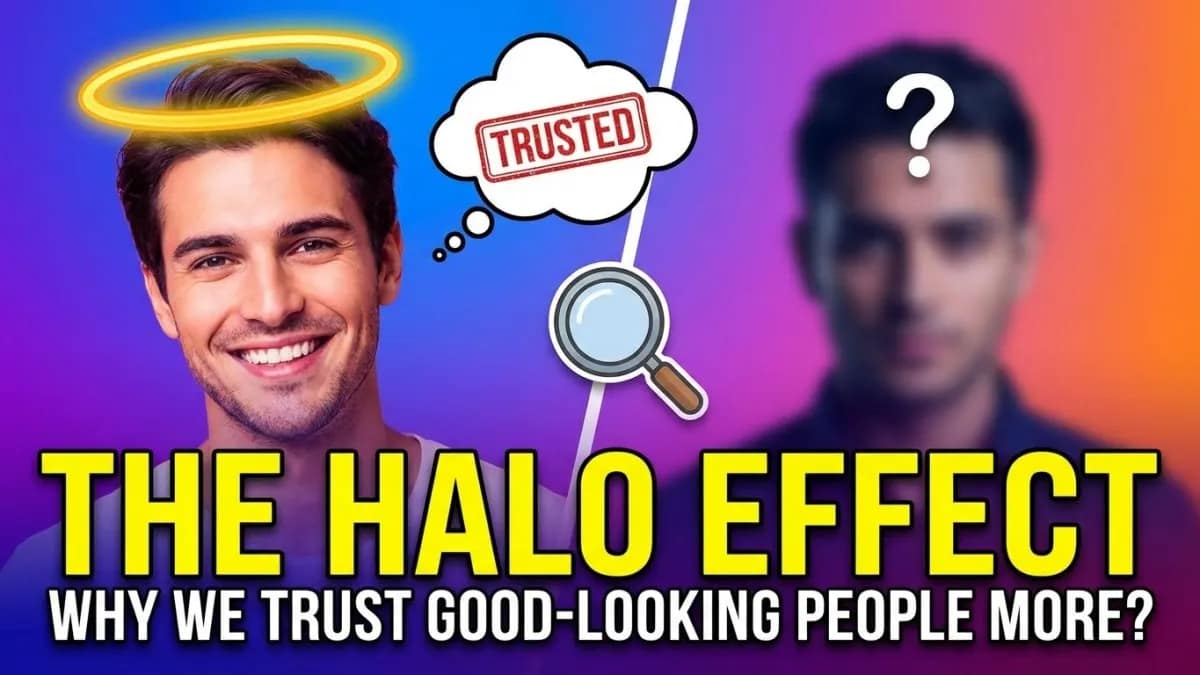
The halo effect is the cognitive bias where we assume that good-looking people have other positive qualities – even when there’s zero evidence for it.
And here’s the uncomfortable truth: you do this too. We all do.
What Exactly Is the Halo Effect?
The halo effect was first studied by psychologist Edward Thorndike in 1920.https://www.simplypsychology.org/halo-effect.html
He noticed that military officers who were physically attractive received higher ratings in completely unrelated areas like intelligence and leadership.
One positive trait (looks) created a “halo” that made people assume other positive traits existed too.
Here’s how it works in your brain:
- You see an attractive face
- Your brain instantly labels them as “good”
- You automatically assume they’re also honest, smart, and capable
- You give them more trust, attention, and opportunities
The whole process happens before you’re even aware of it.
Why Your Brain Does This (And Why It’s Hard to Stop)
I’ve studied cognitive biases for years, and the halo effect is one of the sneakiest.
Your brain is trying to save energy. It uses mental shortcuts called heuristics to make quick decisions.
The logic goes like this:
- Beautiful = healthy genes = good mate = trustworthy person
- It’s evolutionary programming from thousands of years ago
- Your ancestors who trusted attractive people might have had better social alliances
But here’s the problem: what worked for survival 50,000 years ago doesn’t work for hiring employees or choosing business partners today.
Real-World Examples That’ll Shock You
Let me show you where this bias shows up in ways that actually affect your life.
In Job Interviews
I once consulted for a company that couldn’t figure out why their hiring was so inconsistent.
We ran an audit and found that attractive candidates were 60% more likely to get hired – even when their qualifications were identical to less attractive candidates.
The hiring managers swore they were being objective. They weren’t.
In the Courtroom
Attractive defendants receive lighter sentences on average.
One study found that good-looking people were twice as likely to avoid jail time for the same crimes as less attractive defendants.
Judges and juries literally let pretty people get away with more.
In Sales and Business
I’ve seen mediocre products succeed because the founder was charismatic and good-looking.
Meanwhile, brilliant entrepreneurs with better ideas struggled to get funding because they didn’t fit the “CEO look.”
Research shows attractive people earn 10-15% more over their lifetime than their less attractive peers – for doing the same work.
In Schools
Teachers give attractive students higher grades and more attention.
I’ve talked to educators who were horrified when they realized they were doing this unconsciously.
One teacher told me: “I caught myself spending 70% of my time helping the kids who smiled more and looked put-together.”
The Reverse Halo Effect (When Pretty Becomes a Problem)
Here’s something most people don’t know: the halo effect can work in reverse too.
If someone has one negative trait, you might assume they have other negative traits.
I’ve seen this hurt people in cruel ways:
- People with visible disabilities get treated as less intelligent
- Overweight people are assumed to be lazy or undisciplined
- Someone with an unfashionable haircut gets dismissed as incompetent
It’s the same mental shortcut, just running in the opposite direction.
Pro Tip: The 48-Hour Rule
Here’s something I’ve taught to executives and hiring managers:
Before making any important decision about a person, wait 48 hours after meeting them.
Write down your first impression immediately. Then spend two days gathering actual evidence about their skills, character, and reliability.
When you compare your notes, you’ll be shocked at how often your first impression was completely wrong.
This simple delay gives your logical brain time to catch up with your emotional brain.
How the Halo Effect Costs You Money
Let me get specific about the financial damage this bias causes.
Investment Scams
I’ve reviewed hundreds of fraud cases. The scammers are almost always charismatic and well-dressed.
Bernie Madoff looked like everyone’s trustworthy grandfather. He stole $65 billion.
When someone looks successful, you assume they actually are successful. That’s how Ponzi schemes work.
Bad Hiring Decisions
Hiring the wrong person costs your company 30% of that person’s annual salary on average.
If you hire someone for $60,000 because they interviewed well (but can’t actually do the job), that mistake costs you $18,000 plus lost productivity.
Relationship Red Flags You Ignore
I can’t tell you how many people I’ve counseled who stayed in toxic relationships because their partner was attractive.
They ignored lying, manipulation, and worse because “but they’re so charming and everyone likes them.”
Physical attraction literally blinds you to character flaws.
How to Protect Yourself from the Halo Effect
Now for the practical part. Here’s what actually works.
1. Use a Checklist System
Before any important decision, create a written checklist of what you’re evaluating.
For hiring:
- Can they demonstrate the specific skills needed?
- What do their references say about their actual work?
- Do they have concrete examples of past success?
Rate each item independently. Don’t allow one factor to influence the others.
2. The “Ugly Resume” Test
I teach companies to review resumes with photos removed and names anonymized.
You’d be amazed how different your hiring decisions become when you can’t see the person’s face.
Try this with any evaluation: remove visual information first.
3. Seek Out Contradictory Evidence
Your brain wants to confirm that attractive person is also wonderful.
Force yourself to look for problems:
- What skills are they missing?
- What do critics say about them?
- Where have they actually failed before?
I make myself list three potential negatives about anyone I’m tempted to trust quickly.
4. Slow Down Your Decisions
The halo effect works fastest when you’re rushed.
Take your time. Meet someone three times before making important commitments.
I’ve never regretted waiting. I’ve regretted rushing hundreds of times.
Teaching Kids About This Bias
If you have children, this is crucial to teach them.
I’ve worked with parents whose kids were bullied by popular, attractive students – and the teachers didn’t believe the victims because the bullies “seemed so nice.”
Talk to your kids about:
- How TV and movies always make the good guys attractive
- Why they should judge people by actions, not appearance
- That popular doesn’t mean kind
One exercise that works: watch a movie together and ask “How would we feel about this character if they looked different?”
The Dark Side: When Companies Weaponize This
Smart marketers know all about the halo effect.
They use it against you constantly.
Here’s how:
- Attractive spokespeople sell products (even when they know nothing about them)
- Luxury brands use beautiful models to make you associate their products with beauty
- Scammers dress expensively and use fancy offices to seem legitimate
I’ve consulted for marketing teams who literally hired actors to be the “face” of their company because they knew it would increase trust.
The product quality was terrible, but sales were great because people trusted the attractive spokesperson.
Why This Matters for Your Career
Let me be blunt about something uncomfortable.
If you’re not conventionally attractive, you’re fighting an uphill battle in many careers.
But you can level the playing field:
- Document everything – keep written records of your achievements
- Build a strong portfolio – let your work speak louder than your appearance
- Develop your communication skills – confidence and clarity create their own halo effect
- Network strategically – relationships built over time overcome initial bias
I’ve seen “less attractive” professionals completely outperform their prettier competitors by being 10x better at their actual job.
Over time, competence creates its own halo.
The Political Dimension You Need to Know
This gets really disturbing in politics.
Taller, more attractive candidates win elections more often – regardless of their policies or qualifications.
Studies show that people can predict election winners just by looking at photos of candidates’ faces.
We literally choose our leaders based partly on whether they look like leaders should look (whatever that means).
When you vote, make yourself read the candidates’ actual positions with their photos covered.
How long does it take for the halo effect to kick in?
Your brain makes the initial judgment in under 100 milliseconds – faster than you can blink. The full halo effect develops within the first 5-10 seconds of meeting someone. That’s why first impressions are so powerful and so dangerous.
Can attractive people be trusted less because of this bias?
Sometimes, yes. When people realize they might be falling for the halo effect, they can overcorrect and become suspicious of attractive people. This is also unfair – attractive people aren’t automatically untrustworthy just because others give them unfair advantages.
Does the halo effect work the same way in all cultures?
No. Different cultures value different physical traits and have different standards of attractiveness. But every culture has some version of the halo effect. The specific triggers change, but the mental shortcut remains the same across all human societies.
Can you completely eliminate this bias from your thinking?
Honestly? Probably not completely. But you can reduce its impact by 70-80% if you use systematic decision-making processes. The goal isn’t perfection – it’s awareness and mitigation.
What if I’m the attractive person benefiting from this?
Use your advantage responsibly. Acknowledge that you’re getting opportunities others don’t. Work twice as hard to prove you deserve the trust people give you. And actively advocate for fairness in hiring and evaluation systems.
Does the halo effect apply to voices and writing too?
Yes. People with pleasant, deep voices are rated as more competent. Clear, confident writing creates a halo effect even when no one sees your face. That’s why professional communication skills matter so much.
How do I know if I’m falling for the halo effect right now?
Ask yourself: “Would I trust this person if they looked completely different?” If you’re making excuses for red flags or trusting someone faster than usual, that’s a warning sign. Also notice if you’re assuming qualities (smart, honest, kind) without actual evidence.
Can ugly products or designs suffer from a reverse halo effect?
Absolutely. I’ve seen brilliant software fail because the user interface looked dated. People assumed the whole product was low-quality based on appearance alone. Design and packaging matter because of the halo effect.
Read more:https://mrpsychics.com/how-to-make-someone-miss-the-psychology-of-absence/
Final Thoughts: See People Clearly
I’ll leave you with this.
The halo effect isn’t about whether attractive people are good or bad. Most are just regular people navigating life like everyone else.
This is about you making better decisions.
Every time you trust someone too quickly, ignore red flags, or dismiss someone capable, you’re letting an ancient mental shortcut control your modern life.
You deserve better. The people around you deserve better.
Start paying attention. Notice when you’re drawn to someone based on appearance. Pause. Look for actual evidence.
It takes practice, but I’ve seen people transform their judgment once they understand this bias.
Your brain is powerful, but it’s also lazy. Don’t let it make important decisions on autopilot.

Ahmed is a self-improvement and psychology writer passionate about helping people live smarter, calmer, and more productive lives.
- Ahmed manasiya

- Ahmed manasiya
- Ahmed manasiya
- Ahmed manasiya