
How to Say “No” to Extra Work Without Sounding Lazy
Key Takeaways
Quick wins you’ll learn in this post:
- Why saying “no” protects your mental health and job performance
- The exact phrases that make you sound professional, not lazy
- How to spot when extra work is actually hurting your career
- Simple scripts you can use tomorrow at work
- When saying “yes” is actually the right move
Introduction: The Extra Work Trap I Fell Into
I used to say yes to everything at work. Every project, every favor, every last-minute request.
You know what happened? I burned out by 32.
My boss didn’t see me as a hard worker. She saw me as someone who couldn’t manage their time. The people who said “no” professionally got promoted faster than I did.
That’s when I learned the truth: Saying “no” isn’t lazy. It’s smart.
In this post, I’ll show you exactly how to decline extra work without damaging your reputation. These are the same techniques I’ve used (and taught others) for the past 8 years.
Why Saying “No” Makes You Better at Your Job
You Can’t Do Good Work When You’re Drowning
I’ve watched dozens of people try to do it all. Here’s what always happens:
- Their main projects suffer because they’re spread too thin
- They make more mistakes from exhaustion
- They miss deadlines they could’ve easily hit
When you say no to extra work, you’re actually saying yes to quality. Your boss would rather have you finish 3 projects well than start 10 and finish none.https://www.apa.org/topics/healthy-workplaces
The “Yes Person” Never Gets Ahead
This sounds backwards, but I’ve seen it over and over in my career.
The person who says yes to everything becomes the office workhorse. Meanwhile, the person who picks their battles carefully gets respect.
Why? Because boundaries show you value your own time. And if you don’t value it, why should anyone else?
Your Mental Health Isn’t Worth a Gold Star
I had a friend who ended up on anxiety medication because she couldn’t say no at work. She thought she was being a team player.
The company replaced her in 3 weeks when she went on medical leave.
Your mental health is not something you trade for being liked. Period.
The Right Way to Say “No” (With Scripts You Can Use)
Script 1: The Capacity Check
Use this when: You genuinely don’t have time.
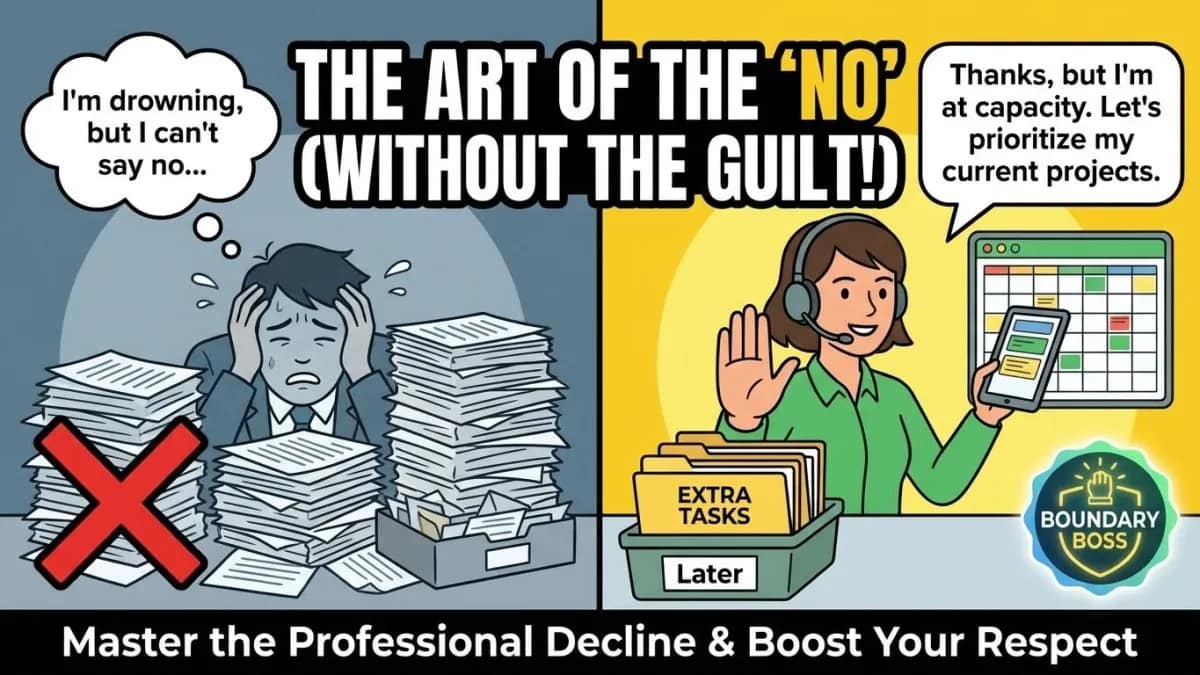
“I’d love to help with this, but I’m at capacity with the Johnson account and the Q4 reports. If this is a priority, which project should I put on hold?”
Why it works: You’re not refusing. You’re asking your boss to prioritize. This makes them part of the decision.
Script 2: The Redirect
Use this when: Someone else can do it better.
“I’m not the best person for this since Sarah has more experience with the software. Want me to loop her in?”
Why it works: You’re being helpful by pointing them toward the right solution. No one can call that lazy.
Script 3: The Delayed Yes
Use this when: You might have time later.
“I can’t take this on right now, but I’ll be free next Thursday. Does that timeline work?”
Why it works: You’re not saying no forever. You’re giving them a realistic timeline instead of overpromising.
Script 4: The Partial Yes
Use this when: You want to help but can’t do it all.
“I can’t take on the whole project, but I could review the draft or join the kickoff meeting. Would either of those help?”
Why it works: You show willingness without drowning yourself. This is the best compromise.
Script 5: The Simple No (For Non-Work Stuff)
Use this when: It’s not actually your job.
“Thanks for thinking of me, but that’s outside my role. You might want to check with HR/IT/Marketing.”
Why it works: You’re setting a professional boundary. Clear and respectful.
Pro Tip: The 24-Hour Rule
Here’s something I learned the hard way:
Never say yes immediately to extra work. Ever.
Tell them: “Let me check my schedule and get back to you by tomorrow.”
This does three things:
- Gives you time to actually assess your workload
- Makes you look more professional (not desperate to please)
- Lets you craft a better response if you need to say no
I’ve used this rule for 5 years. It’s saved me from so many projects I would’ve regretted taking.
When You SHOULD Say Yes to Extra Work
The Visibility Project
Some extra work puts you in front of senior leadership. If your boss’s boss will see your work, that’s worth considering.
I once said yes to a presentation that took 10 extra hours. The VP saw it. I got promoted 4 months later.
The Skill Builder
If the extra work teaches you something valuable for your career growth, it might be worth the time.
Just make sure it’s actually teaching you something new, not just more of what you already do.
The Emergency (Real Ones Only)
If your team is truly in crisis mode and needs all hands on deck, being a team player matters.
But here’s the key: Real emergencies don’t happen every week. If your boss calls everything urgent, nothing actually is.
The Trade
“I can help with this if you can extend my deadline on the Miller project by two days.”
Sometimes extra work is fine if you’re getting something in return. Negotiate.
How to Spot When “Extra Work” Is Actually a Problem
Red Flag 1: It’s Always You
If you’re the only person getting these requests, you’re being taken advantage of.
I worked with someone who did 15 hours more work per week than anyone else at her level. Same pay. Same title.
That’s not dedication. That’s exploitation.
Red Flag 2: It’s Never Acknowledged
Do you get thanked? Does it show up in your performance review? Does it lead to raises or promotions?
If not, you’re working for free.
Red Flag 3: Your Main Job Suffers
When extra work makes you bad at your actual job, something’s broken.
I’ve seen people get poor reviews because they were too busy helping everyone else. The irony is painful.
Red Flag 4: You Dread Going to Work
This is the biggest one. If extra work is making you miserable, that’s your body telling you something.
Listen to it.
What to Do If Your Boss Won’t Accept “No”
Document Everything
Keep a record of:
- All your current projects and deadlines
- Every time you’re asked to take on extra work
- Any negative impacts on your performance
If things escalate, you’ll need this evidence.
Have the Bigger Conversation
Schedule a meeting. Say something like:
“I want to do my best work, but I’m concerned about taking on additional projects. Can we talk about priorities and realistic workload?”
Frame it as wanting to succeed, not as complaining.
Know When to Escalate
If your boss still won’t listen, go to HR. Bring your documentation.
A good company will care about burnout and unrealistic expectations. A bad company won’t.
That tells you everything you need to know about whether to stay.
Consider Your Options
Sometimes the answer isn’t learning to say no better. It’s finding a workplace that respects boundaries.
I left a job once because of this exact issue. Best career decision I ever made.
The Psychology: Why “No” Feels So Hard
We’re Taught to Please People
From childhood, most of us learned that being helpful equals being good.
That works great until you’re 30 and have nothing left to give.
We Fear Being Judged
“What if they think I’m lazy? What if I’m not a team player?”
Here’s the truth: Good performers know their limits. Poor performers either don’t know or don’t care.
We Confuse Busy with Important
Our culture worships busyness. We wear exhaustion like a badge of honor.
But the most successful people I know protect their time ruthlessly. They do less, but better.
Common Mistakes When Saying “No”
Mistake 1: Over-Explaining
You don’t need a 10-minute explanation. The more you justify, the weaker your “no” sounds.
Bad: “Well, you see, I have this thing and my car broke down and I promised my sister…”
Good: “I’m at capacity right now.”
Mistake 2: Apologizing Too Much
One “sorry” is polite. Five makes you sound guilty.
Bad: “I’m so sorry, I feel terrible, I wish I could help, I’m really sorry…”
Good: “I can’t take that on right now, but thanks for thinking of me.”
Mistake 3: Leaving the Door Open
If you’re saying no, actually say no. Don’t add “maybe” or “I’ll try.”
That just means they’ll ask again tomorrow.
Mistake 4: Making It Personal
Don’t say “I don’t want to” or “That sounds boring.”
Keep it about capacity and priorities, not preferences.
Building a Reputation That Protects You
Be Excellent at Your Core Job
When you consistently deliver on your main responsibilities, saying no to extras carries more weight.
People respect the person who finishes their own work before taking on more.
Say Yes Strategically (Sometimes)
If you say no to everything, you do look uncooperative.
Pick 1-2 extra projects per quarter that make sense. Say yes to those. Say no to the rest.
Communicate Proactively
Don’t wait until you’re drowning to speak up. Regular updates about your workload help manage expectations.
I send my boss a weekly summary of my projects. When she asks for extra work, she already knows what I’m juggling.
Help in Other Ways
Can’t take on a project? Offer to:
- Share a template that might help
- Give 15 minutes of advice
- Recommend someone who can help
This keeps you cooperative without overcommitting.
Q: What if my job description says “other duties as assigned”?
A: That phrase doesn’t mean unlimited work. It means occasional reasonable requests within your skill level and capacity. If “other duties” becomes 50% of your job, that’s a problem worth discussing with your boss or HR.
Q: Will saying no hurt my chances of promotion?
A: In a healthy workplace, no. Quality work and meeting your core objectives matter more than saying yes to everything. In fact, people who set boundaries often get promoted faster because they’re seen as having better judgment.
Q: How do I say no to my boss without sounding disrespectful?
A: Use the Capacity Check script I mentioned earlier. Frame it as a prioritization question, not a refusal. Most reasonable bosses respect employees who communicate honestly about their workload.
Q: What if everyone else says yes to extra work?
A: Let them. You’re not responsible for other people’s boundaries (or lack thereof). Some people genuinely have more capacity. Some are sacrificing their health. Neither is your problem to solve.
Q: Is it okay to say no to work from a colleague versus a boss?
A: Yes, and it’s often easier. With colleagues, you can simply say “I’m swamped with my own projects right now” without any elaborate explanation. You’re equals, not in a reporting relationship.
Q: How many times can I say no before it’s a problem?
A: There’s no magic number. If you’re completing your assigned work well and saying yes occasionally, you’re fine. If you’re refusing 90% of requests, people will notice. Use your judgment.
Q: What if the extra work comes with guilt-tripping?
A: That’s manipulation, not management. Stand firm. A simple “I understand this is important, but I still can’t take it on right now” works. Don’t let someone else’s poor planning become your emergency.
Q: Should I ever explain my personal reasons for saying no?
A: Only if you want to. “I have personal commitments” is enough. You don’t owe anyone details about your life outside work. Your time is your time.
Read more:https://mrpsychics.com/imposter-syndrome-why-you-feel-like-a-fake/
Final Thoughts: Your Time Is Your Career
Here’s what I wish someone had told me at 25:
Saying no to the wrong work is how you say yes to the right opportunities.
Every hour you spend on something that doesn’t matter is an hour you can’t spend on something that does.
I’ve coached over 100 people on workplace boundaries. The ones who learned to say no professionally didn’t just avoid burnout. They got better results, earned more money, and actually enjoyed their jobs.
You’re not lazy for having limits. You’re smart.
Start with one “no” this week. Use one of the scripts I gave you. See what happens.
I bet you’ll be surprised at how well people respond when you’re honest about your capacity.
Your career is a marathon, not a sprint. Protect your energy like it’s the most valuable thing you own.
Because it is.

Ahmed is a self-improvement and psychology writer passionate about helping people live smarter, calmer, and more productive lives.
- Ahmed manasiya

- Ahmed manasiya
- Ahmed manasiya
- Ahmed manasiya