
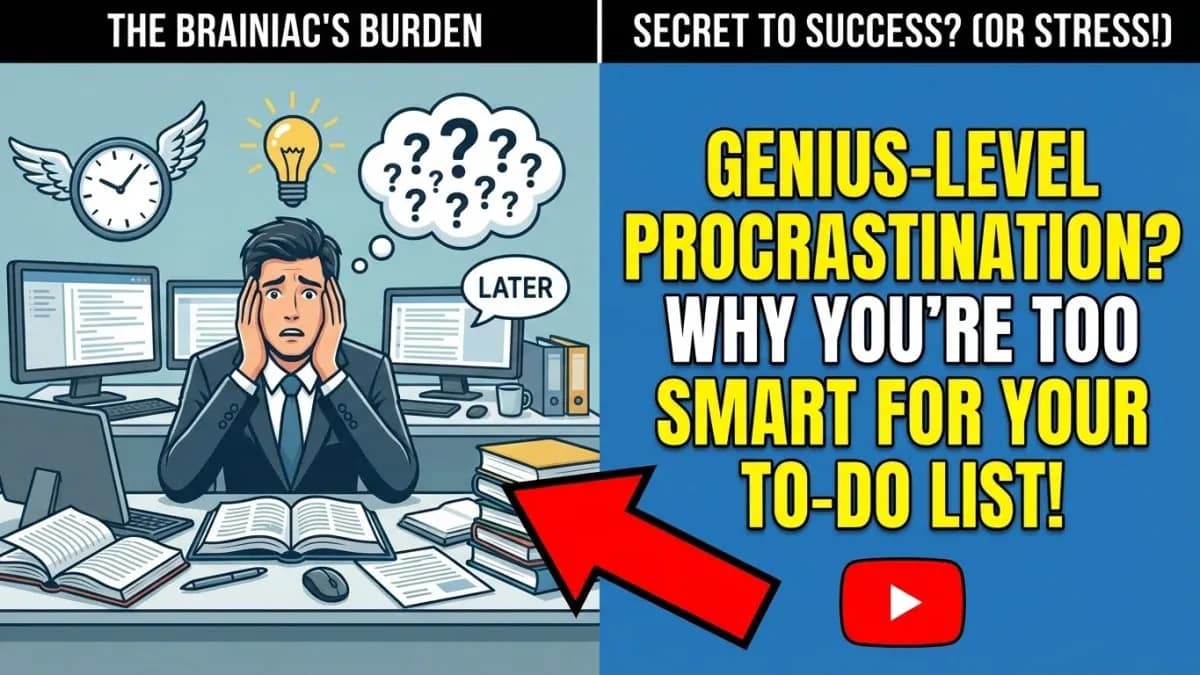
Why Smart People Procrastinate the Most at Work
Key Takeaways
Before you dive in, here’s what you need to know:
- Intelligence can backfire: Smart people overthink tasks and wait for “perfect” conditions that never come
- Perfectionism is the enemy: High achievers delay work because they fear it won’t be good enough
- Boredom plays a role: Intelligent minds crave stimulation and put off routine tasks
- Self-awareness helps: Understanding why you procrastinate is the first step to stopping it
- Simple fixes work: Breaking tasks into smaller pieces beats trying to force yourself to focus
Introduction: The Paradox Nobody Talks About
You would think smart people get more done, right?
I’ve worked with hundreds of high-performing professionals over the years. And here’s what surprised me: the smartest people in the room were often the worst procrastinators.
They weren’t lazy. They weren’t unmotivated.
They were stuck in their own heads, paralyzed by their intelligence. Let me show you why this happens and what you can do about it.
The Real Reasons Smart People Procrastinate
1. Overthinking Everything
Smart people see every possible outcome before they start.
I once coached a brilliant software engineer who spent three weeks planning a project that should have taken two days. He could see 47 different ways it might fail.
Here’s the problem: When you can predict every obstacle, you convince yourself not to start.
Your brain tricks you into thinking:
- “I need more information first”
- “The timing isn’t right yet”
- “Let me think through this one more time”
But that’s just fear dressed up as logic.https://www.psychologytoday.com/
2. Perfectionism Disguised as Standards
I’ve seen this pattern destroy careers.
Smart people don’t want to produce “average” work. So they wait until they can do something perfectly. But perfect never comes.
You tell yourself:
- “I’ll start when I have more time to do it right”
- “This isn’t good enough yet”
- “I need to research more before I begin”
Meanwhile, less intelligent coworkers are finishing projects and moving ahead. They’re not better than you. They just started.
3. Boredom With Routine Tasks
Your brain craves complexity.
When a task feels too simple or repetitive, intelligent minds check out. I remember putting off expense reports for months because my brain literally refused to engage with something so mundane.
The danger: You put off the boring stuff until it becomes an emergency. Then you’re stressed and rushing.
Tasks smart people avoid:
- Data entry and paperwork
- Routine emails and admin work
- Simple follow-ups
- Basic organization
4. Fear of Being Average
This one runs deep.
If you’ve always been “the smart one,” you’ve built your identity around it. Starting a task means risking failure. And failure means you’re not as special as you thought.
I’ve watched talented people sabotage themselves because not trying feels safer than trying and failing.
When you procrastinate, you can always tell yourself: “I could have done it perfectly if I had more time.”
5. Too Many Options
Smart people see possibilities everywhere.
You don’t just see one way to complete a project. You see fifteen different approaches. So you spend weeks analyzing which path is “best” instead of picking one and moving forward.
Analysis paralysis is real:
- You research endlessly
- You make comparison charts
- You seek more opinions
- You never actually decide
Pro Tip: The Two-Minute Rule That Changed My Life
Here’s what works when your brain won’t cooperate:
Tell yourself you’ll work on the task for just two minutes. That’s it. Set a timer.
I use this every single day. My brain can’t argue with two minutes. It’s too small to matter.
But here’s the secret: Once you start, you usually keep going. Starting is the hard part, not continuing.
I’ve written entire reports using this trick. Two minutes turns into ten. Ten turns into an hour. Your brain just needed permission to begin without the pressure of finishing.
What Actually Helps Smart Procrastinators
Stop Waiting for Motivation
I’m going to be direct: motivation is a myth.
You will never “feel like” doing hard work. I’ve been writing professionally for 15 years, and I still don’t feel like writing most days.
Discipline beats motivation every time.
The most productive people I know work on a schedule, not based on feelings. They sit down and start, even when they don’t want to.
Break Everything Into Stupid-Small Steps
Your intelligent brain wants to tackle the whole project at once. That’s too overwhelming.
Instead, break it down until it feels almost insulting:
Wrong approach: “Write quarterly report”
Right approach:
- Open Word document
- Write title
- List three main points
- Write one paragraph about point one
- Take a break
See the difference? Each step is so small you can’t talk yourself out of it.
Set External Deadlines
Smart people are great at rationalizing extensions to themselves.
I’ve learned to create artificial pressure by involving others:
- Tell your boss you’ll have it done by Tuesday
- Schedule a meeting to present your work
- Find an accountability partner who checks on you
- Make a public commitment
When other people are waiting, your brain stops making excuses.
Embrace “Good Enough”
This changed everything for me.
Your first draft doesn’t need to be brilliant. It just needs to exist. You can improve it later.
I once spent six months planning a workshop that I could have launched in two weeks. The “imperfect” version I finally released? People loved it.
Remember: Done beats perfect every single time.
Use Your Intelligence Strategically
Here’s the irony: Your overthinking can actually help you.
Use it to plan instead of procrastinate:
- Identify what’s stopping you from starting
- Design systems that work with your brain, not against it
- Predict obstacles and prepare solutions in advance
- Build habits that bypass decision-making
I spend 15 minutes every Sunday planning my week. That’s where I do my overthinking. Then during the week, I just follow the plan.
The Science Behind Smart Procrastination
Dopamine explains a lot of this.
Your brain releases dopamine when you anticipate a reward. Smart people get dopamine hits from thinking about projects, not necessarily doing them.
Research shows that intelligent people have more active default mode networks. That’s the part of your brain that wanders and daydreams.
Translation: Your brain literally works differently. It’s not an excuse, but it helps to understand what you’re working with.
Studies also connect high IQ with:
- Greater anxiety about outcomes
- More sensitivity to boredom
- Higher standards and self-criticism
- Tendency to ruminate
You’re not broken. Your brain is just wired to overthink.
Warning Signs You’re Stuck in Smart Procrastination
Watch for these patterns in yourself:
You’re researching more than doing
- You’ve read 50 articles but haven’t started the actual work
- You’re taking courses instead of applying what you know
- You keep seeking “one more piece of information”
You’re planning but not executing
- Your to-do lists are beautiful but never completed
- You have elaborate systems that you don’t actually use
- You redesign your process instead of following it
You’re helping others avoid your own work
- You’re always available to brainstorm with coworkers
- You volunteer for other people’s projects
- You give great advice but don’t follow it yourself
I spent years doing all of this. It felt productive, but nothing ever got finished.
How to Actually Stop Procrastinating Today
Start With the Worst Task
Do the thing you’re dreading first thing in the morning.
Don’t check email. Don’t scroll social media. Don’t “ease into” your day.
I call this eating the frog. Get it over with while you still have willpower.
Your afternoon self will thank you.
Remove All Distractions
Smart people are easily distracted because their brains seek stimulation.
What I do:
- Phone goes in another room
- Close all browser tabs
- Use website blockers during work sessions
- Wear headphones even if I’m not playing music (signals to others I’m busy)
Give your brain no other options except the task at hand.
Schedule Thinking Time Separately
This is crucial for overthinkers.
I have a daily “thinking hour” where I’m allowed to overthink, plan, and analyze. But outside that hour, I execute without questioning.
This satisfies your brain’s need to process while protecting your productive time.
Track Your Patterns
Smart people love data. Use that.
For two weeks, write down:
- What tasks you procrastinate on
- What time of day it happens
- What you do instead of working
- How you feel when you finally start
You’ll spot patterns. Maybe you procrastinate on creative work in the morning. Or you avoid client calls on Fridays. Once you see it, you can plan around it.
Find an Accountability Partner
This saved my career.
Find someone who checks in on your progress weekly. Not to judge you, but to keep you honest.
I have a colleague who texts me every Wednesday: “Did you finish what you said you would?”
Sometimes I haven’t. And that’s okay. But knowing she’ll ask makes me more likely to actually do it.
What Doesn’t Work (Stop Doing These)
Punishing yourself
Beating yourself up makes procrastination worse. Your brain associates work with shame, so it avoids work even more.
I wasted years thinking I just needed to be “harder on myself.” Wrong. Self-compassion works better than self-criticism.
Waiting for inspiration
Inspiration is a result of working, not a requirement for starting.
Write the bad first draft. Make the messy prototype. Do the imperfect version. Inspiration shows up after you begin.
Multi-tasking
Smart people think they can juggle multiple projects. You can’t. Nobody can.
Research proves multi-tasking reduces productivity by 40%. Your intelligent brain isn’t an exception.
Setting vague goals
“I’ll work on the project today” is too vague.
“I’ll write 500 words between 9-10am” is specific. Specificity removes decision-making.
Q: Is procrastination linked to ADHD?
Yes, but they’re different things. ADHD involves neurological differences in attention and impulse control. Smart procrastination is often about overthinking and perfectionism.
That said, smart people can also have ADHD. If you struggle with focus across all areas of life, not just work tasks, consider talking to a doctor.
Q: Can therapy help with procrastination?
Absolutely. I’ve seen people make huge progress with cognitive behavioral therapy (CBT).
Therapy helps you identify the beliefs driving your procrastination. Like “I’m only valuable if I’m perfect” or “If I can’t do it brilliantly, I shouldn’t try.”
Once you challenge these beliefs, the behavior changes.
Q: Why do I procrastinate more on important tasks?
Because the stakes feel higher. Your brain interprets importance as threat.
When something really matters, you fear messing it up. So you avoid it to avoid the anxiety.
The fix: Remind yourself that important tasks still need to start small. Break them down until they feel manageable.
Q: Is procrastination just laziness?
No. I wish people would stop saying this.
Lazy people don’t care about results. Procrastinators care too much. You’re avoiding work because you’re anxious, not because you’re unmotivated.
I’ve never met a lazy procrastinator. Every procrastinator I know is frustrated with themselves.
Q: How long does it take to stop procrastinating?
There’s no magic timeline. But I noticed real changes after about 3-4 weeks of consistently using these strategies.
Your brain needs time to build new habits. Be patient with yourself.
The key: Focus on one strategy at a time. Don’t try to fix everything at once (that’s just overthinking in disguise).
Q: Can medication help?
If procrastination is tied to anxiety or ADHD, medication might help address the underlying issue.
But medication alone won’t fix it. You still need to build better systems and habits.
Talk to a doctor if you think there’s a medical component. There’s no shame in getting help.
Q: What if I’ve tried everything and still procrastinate?
First, I doubt you’ve truly tried everything consistently.
Most people try a strategy for three days, don’t see instant results, and give up. Real change takes weeks, not days.
Second, consider that you might be dealing with deeper issues like depression or anxiety. These make procrastination worse and need professional support.
Don’t suffer alone. Reach out to a therapist or counselor.
Read More:https://mrpsychics.com/spotting-a-narcissist-worker-5-red-flags-to-watch/
Final Thoughts: You’re Not Broken
Here’s what I want you to remember: Your intelligence isn’t a curse.
Yes, it makes you overthink. Yes, it sets impossibly high standards. Yes, it gets bored easily.
But it also gives you the ability to understand your patterns, design solutions, and think strategically about change.
I’ve struggled with procrastination for most of my career. What helped wasn’t working harder or being smarter. It was working with my brain instead of against it.
Start small today. Pick one task you’ve been avoiding. Set a timer for two minutes. Just begin.
You don’t need to fix everything at once. You just need to start.
Your future self will thank you.

Ahmed is a self-improvement and psychology writer passionate about helping people live smarter, calmer, and more productive lives.
- Ahmed manasiya

- Ahmed manasiya
- Ahmed manasiya
- Ahmed manasiya