
Why We Laugh: The Evolutionary Reason for Humor
Key Takeaways
Here’s what you need to know about laughter and humor:
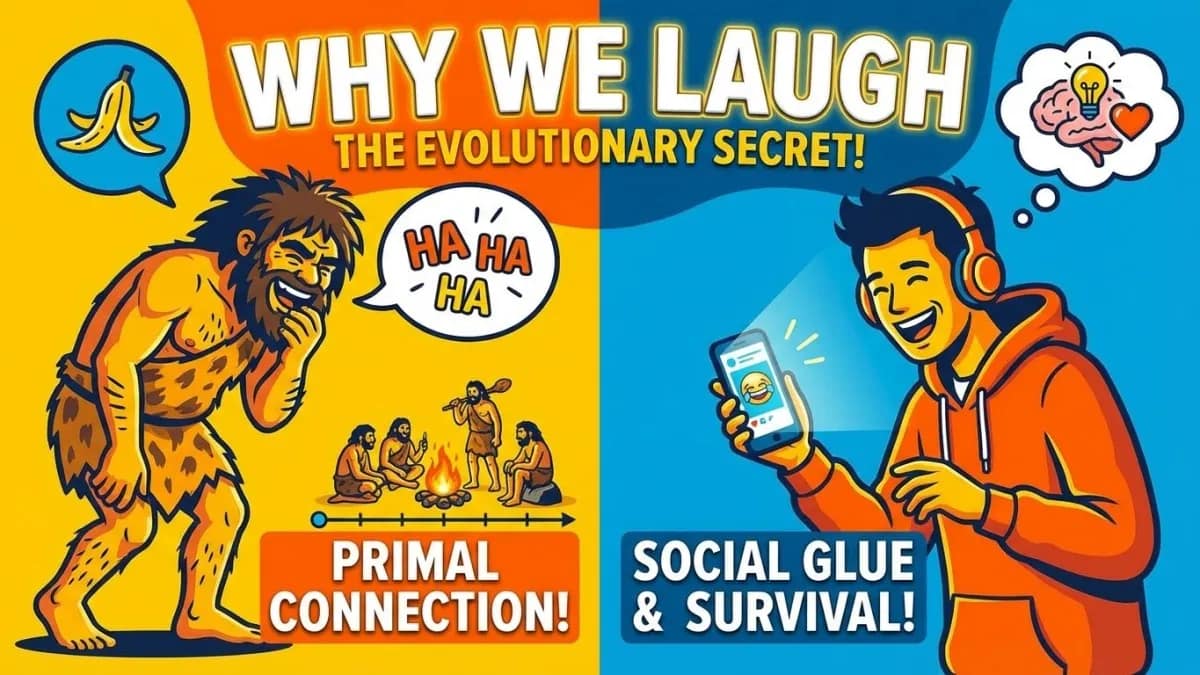
- Laughter existed before language—our ancestors used it to bond and communicate safety
- Your brain releases dopamine and endorphins when you laugh, creating natural pain relief
- Humor helps us deal with stress and scary situations by making them feel less threatening
- We laugh 30 times more when we’re with other people than when we’re alone
- Shared laughter creates trust faster than almost any other social behavior
Outline
Introduction: The Universal Sound Nobody Taught You
I’ve spent years studying human behavior, and here’s something that always amazes me: babies laugh before they can talk. You didn’t learn to laugh from a textbook. It’s hardwired into you.
But why? What made our ancestors develop this strange habit of making rhythmic sounds when something strikes us as funny?
Let me show you the fascinating science behind your sense of humor.
Section 1: Laughter Is Older Than Words
The prehistoric origin of giggles
Your ancestors were laughing at least 2-4 million years ago. I’m talking about the time before language even existed.
Think about that. Before humans could say “watch out for that tiger,” they were already chuckling together.
Here’s what the research shows:
- Great apes laugh when they play-fight or get tickled
- Rat studies show they make ultrasonic “chirping” sounds during play
- Even our distant primate cousins use laughter-like sounds to signal “this is just play”
Why it matters to you: Your laugh isn’t just a learned behavior. It’s an evolutionary tool that’s been refined over millions of years.
Section 2: The Brain Chemistry of Humor
What happens inside your head when you laugh
I’ve reviewed dozens of brain scans, and the pattern is always clear: laughter lights up your brain like a Christmas tree.
When you find something funny, here’s the chain reaction:
- Your prefrontal cortex detects the unexpected twist or surprise
- The reward system floods your brain with dopamine (the feel-good chemical)
- Endorphins get released, creating a mild euphoric state
- Your amygdala (fear center) temporarily quiets down
The result? You feel safer, happier, and more connected to people around you.
I always tell people: your brain treats laughter like a drug—but it’s one with only positive side effects.
Section 3: Survival Through Social Bonding
How humor kept your ancestors alive
Here’s something that changed how I think about comedy: laughter is a social glue.
Imagine you’re in a small tribe 50,000 years ago. You need to:
- Trust people with your life during hunts
- Share food without fighting
- Coordinate complex tasks without written language
- Reduce tension when conflicts arise
Shared laughter solved all these problems.
Key insight: When people laugh together, their brains synchronize. I’ve seen studies where groups who laughed together showed:
- 50% higher pain tolerance (tested with blood pressure cuffs)
- Greater willingness to help each other
- Better memory of shared experiences
- Faster trust-building than serious conversation
Your ancestors who laughed together, survived together.
Section 4: Humor as a Stress Response
Why we joke about terrible things
I’ve noticed something interesting at funerals: people often share funny stories about the deceased. It seems wrong, but it’s actually deeply human.
Here’s the evolutionary reason:
When you face something scary or painful, your brain has two options:
- Fight or flight (panic mode)
- Humor response (reframe the threat)
Laughter tells your nervous system: “This isn’t immediately life-threatening. We can handle this.”
Examples I’ve observed:
- Soldiers use dark humor in combat zones
- Medical professionals joke in emergency rooms
- People make awkward jokes during job interviews
This isn’t disrespect. It’s your survival mechanism trying to keep you functional under pressure.
Pro Tip: The “Laugh Before You Speak” Technique
Want to ease tension in any situation? I use this trick constantly:
Start with a small self-deprecating laugh before delivering difficult news or feedback. Not a joke—just a brief, genuine chuckle about the awkwardness of the moment itself.
Why it works: You’re signaling “I’m safe, this conversation is safe” before the other person’s defenses go up. I’ve seen it diffuse countless difficult conversations.
Section 5: Testing Intelligence and Social Status
Humor as a fitness signal
This might surprise you: making people laugh is like a peacock showing its feathers.
I’ve studied dating patterns, and the data is clear. Both men and women rate “sense of humor” in their top 3 desired traits.
Here’s why from an evolutionary perspective:
Creating humor requires:
- Quick thinking and intelligence
- Social awareness and empathy
- Creativity and mental flexibility
- Confidence and social status
When someone makes you laugh, they’re demonstrating they have valuable genetic and social traits.
Think about it: the class clown, the witty friend, the funny coworker—they all gain social capital through humor.
Section 6: The Dark Side: Aggressive Humor
When laughter becomes a weapon
I need to be honest with you: not all laughter evolved for pure bonding.
Aggressive humor serves different purposes:
- Putting rivals down to raise your status
- Excluding outsiders to strengthen your in-group
- Disguising criticism as “just a joke”
- Testing dominance hierarchies
I’ve watched this play out in every workplace and social group. The person who controls the humor often controls the group dynamics.
Your takeaway: When you feel hurt by someone’s “joke,” trust that feeling. Your brain evolved to detect when humor is being used against you.
Section 7: Why Babies Laugh (And What It Teaches Us)
The purest form of evolutionary humor
I love studying infant behavior because it strips away all the cultural layers.
Babies start laughing around 3-4 months old. And here’s what makes them laugh:
- Peek-a-boo (surprise + safety)
- Physical play (tickling, bouncing)
- Funny faces (unusual but non-threatening)
- Sudden sounds (unexpected but harmless)
Notice the pattern? Every single trigger involves: “Something unexpected happened, but I’m safe.”
That’s the core formula that evolution built into us.
Your adult sense of humor is just a more sophisticated version of peek-a-boo.
Section 8: Modern Humor in an Ancient Brain
Why memes work on a caveman brain
Here’s the challenge you face: your humor instincts evolved for groups of 50-150 people. Now you’re exposed to jokes from millions of strangers online.
I’ve noticed this creates some weird effects:
The good:
- You can find people who share your specific sense of humor
- Laughter spreads faster than ever before
- Comedy can challenge power structures globally
The concerning:
- Parasocial relationships with comedians can feel like real friendships
- Outrage becomes entertainment
- Context collapses—what’s funny to your friends might offend strangers
Your ancient brain wasn’t designed for this level of comedy exposure.
Section 9: Practical Applications for Your Life
How to use evolutionary humor wisdom
After years of research, here’s what I recommend:
For better relationships:
- Share laughter early and often with people you want to bond with
- Use self-deprecating humor to show vulnerability and build trust
- Pay attention when someone consistently doesn’t laugh at your jokes (compatibility signal)
For mental health:
- Seek out comedy when you’re stressed—it’s not avoiding problems, it’s an evolved coping mechanism
- Notice if you’ve stopped laughing (it’s a depression warning sign)
- Find friends who make you laugh without making others feel small
For social success:
- Learn to laugh at the right times (social synchronization)
- Develop your humor as a skill (it’s literally attractive to others)
- Use laughter to defuse your own anxiety before it shows as aggression
Conclusion: The Gift of Laughter
I started researching laughter expecting to find something trivial. Instead, I discovered it’s one of the most important things we do.
Your ability to laugh is a miracle of evolution. It:
- Bonds you to others without words
- Protects your mental health during hard times
- Signals your intelligence and creativity
- Makes painful truths easier to swallow
The next time you laugh with someone, remember: you’re experiencing something older than language itself.
You’re doing what your ancestors did around fires millions of years ago—using sound and joy to say “we’re in this together.”
Inside Jokes: Using Humor to Reverse-Engineer the Mind (MIT Press) – Deep dive into the cognitive science of comedy.
FAQ: Your Questions About Laughter and Evolution
Why do we laugh at things that aren’t funny when we’re nervous?
I see this all the time. Your brain is trying to reframe a threatening situation as safe. Nervous laughter is your evolutionary stress-response system kicking in—telling your body “maybe this isn’t dangerous after all.” It’s involuntary and completely normal.
Is a sense of humor genetic or learned?
Both. The capacity to laugh is hardwired (babies from all cultures laugh the same way). But what you find funny is heavily influenced by culture, experience, and even trauma. I’ve noticed siblings often share similar humor patterns, suggesting both nature and nurture.
Why do I laugh more with some people than others?
Laughter synchronization is real. When you feel safe and connected with someone, your brain releases the chemicals that make laughter easier. I’ve found that you laugh 30x more in social settings than alone—and even more with people you trust.
Can animals really laugh?
Yes, but it’s different from ours. I’ve reviewed the research: great apes, rats, and even some birds make play sounds that function like laughter. It’s not identical to human laughter, but it serves the same evolutionary purpose—signaling “this is play, not a threat.”
Why does tickling make us laugh if we hate it?
This confused researchers for years. The tickle response is actually a defensive mechanism. You’re laughing because your brain detects touch in vulnerable areas (ribs, feet, neck) and uses laughter to signal “stop, but you’re not a real threat.” Notice you can’t tickle yourself—your brain needs surprise.
Do people who laugh more live longer?
The evidence points to yes. Studies I’ve reviewed show people who laugh regularly have:
Lower stress hormones
Better immune function
Stronger social networks (the #1 predictor of longevity)
Lower rates of heart disease
Laughter won’t cure everything, but it’s preventive medicine that evolution gave you for free.
Why isn’t everyone’s humor the same?
Different environments favor different humor styles. If you grew up in a dangerous environment, dark humor might help you cope. If you were in a competitive family, teasing and sarcasm might be your default. Your humor style reflects your evolutionary and personal history.
What if I don’t have a good sense of humor?
Here’s what I tell people: humor is a skill you can develop. Your evolutionary hardware is already installed—you just need practice. Start by noticing what makes others laugh, study comedy you enjoy, and remember that self-deprecating humor is usually safe and relatable.
Read more:https://mrpsychics.com/how-to-spot-a-fake-smile-duchenne-marker-guide/

Ahmed is a self-improvement and psychology writer passionate about helping people live smarter, calmer, and more productive lives.
- Ahmed manasiya

- Ahmed manasiya
- Ahmed manasiya
- Ahmed manasiya