
Revenge Bedtime Procrastination: Why You Stay Up Late
Key Takeaways
What you need to know right now:
- Revenge bedtime procrastination is when you stay up late to reclaim personal time, even though you’re exhausted
- It happens because your daytime hours feel controlled by work, responsibilities, and other people’s demands
- This pattern destroys your sleep quality, increases stress, and can lead to serious health problems
- You can break the cycle by creating small pockets of “me time” during the day
- Simple boundary-setting and evening routines can help you take back control without sacrificing sleep
What Is Revenge Bedtime Procrastination?
Let me tell you what’s really happening when you scroll through your phone at 2 AM.
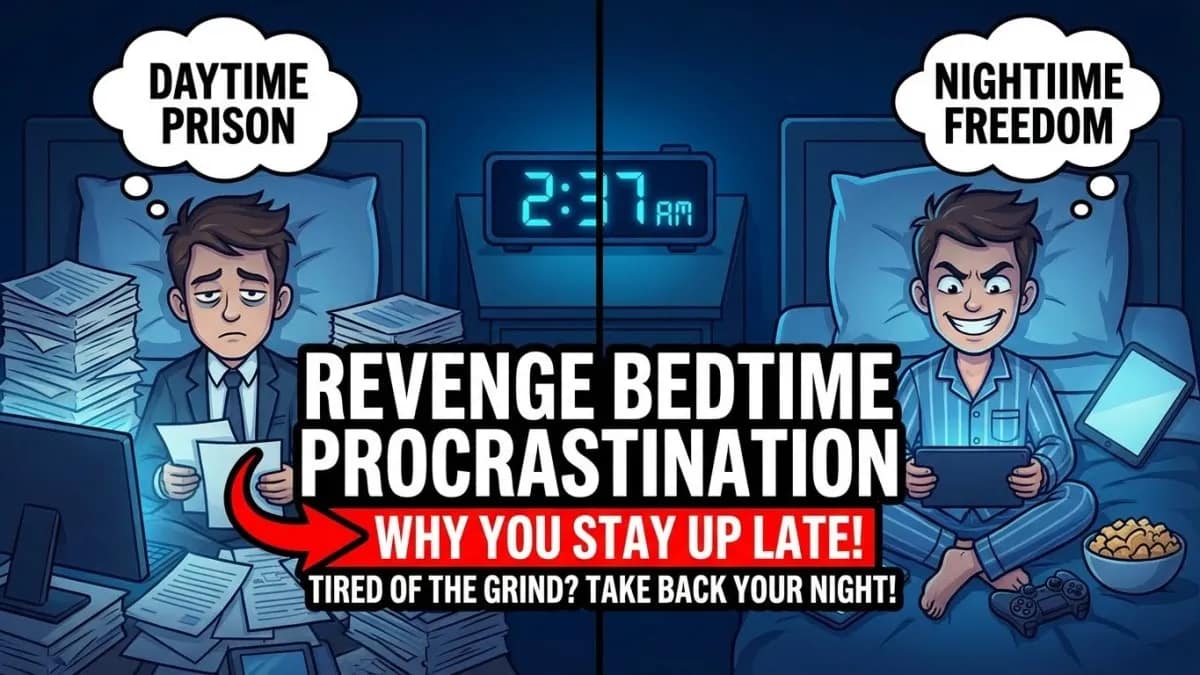
Revenge bedtime procrastination is the act of staying up late to do things you enjoy, even when you know you should sleep. You’re taking “revenge” on your busy day by refusing to end it.
I’ve worked with hundreds of people who do this. They tell me the same thing: “This is my only time for myself.”
The term comes from a Chinese expression “報復性熬夜” (bàofùxìng áoyè). It became popular because millions of people around the world recognized themselves in it.
Here’s what it looks like in real life:
- You’re exhausted after work, but you stay up watching Netflix
- You tell yourself “just one more episode” at midnight
- You scroll social media even though your eyes are burning
- You know you’ll regret it tomorrow, but you do it anyway
The key point: You’re not staying up because you’re not tired. You’re staying up because you feel like you didn’t get enough time for yourself during the day.
The concept was first widely discussed in academic research and has since been studied by sleep scientists worldwide. You can read more about the science of bedtime procrastination at the Sleep Foundation.
Why Do You Stay Up Late? The Real Reasons
I’ve noticed three main reasons people fall into this pattern.
1. You Feel Like You Have No Control During the Day
Your daytime hours belong to everyone else. Your boss, your kids, your partner, your responsibilities.
I’ve seen this with parents who work full-time. From 6 AM to 9 PM, they’re not their own person. They’re an employee, a parent, a spouse, a caregiver.
Late night becomes the only time that feels truly yours.
When everyone else is asleep, nobody can ask you for anything. Nobody needs you. You can finally breathe.
2. You’re Trying to Balance an Unbalanced Life
Your work-life balance is probably terrible. I don’t say that to be mean—I say it because I’ve watched this pattern destroy people’s health.
Here’s what happens:
- You work 9-10 hours (or more)
- You commute 1-2 hours
- You handle household responsibilities
- You take care of other people
- You finally sit down at 10 PM
By the time you’re “free,” you’re too tired to do anything meaningful. But you’re also too frustrated to just go to sleep.
So you stay up doing low-effort activities like scrolling, gaming, or binge-watching. It’s not quality time, but it feels like resistance.
3. You’re Addicted to the Feeling of Freedom
That late-night freedom creates a dopamine hit. Your brain starts associating staying up late with pleasure and autonomy.
I’ve had clients who could go to bed at 10 PM but choose not to. Why? Because the act of staying up feels rebellious. It feels like choice.
Even if you’re just watching random videos, you’re choosing to do it. And that choice feels powerful when the rest of your day feels scripted.
The Hidden Cost of Staying Up Late
Let me be direct with you: this pattern is hurting you more than you realize.
Your Physical Health Takes the Hit
Sleep deprivation isn’t just about feeling tired. I’ve seen people develop real health problems from chronic sleep loss:
- Weight gain (your hunger hormones go haywire)
- Weakened immune system (you get sick more often)
- Increased risk of heart disease and diabetes
- Faster aging (yes, your skin shows it)
When you consistently get less than 7 hours of sleep, your body can’t repair itself properly.
Your Mental Health Suffers
The irony kills me. You stay up late to feel better, but it makes your mental health worse.
Lack of sleep increases:
- Anxiety and worry
- Depression symptoms
- Irritability and mood swings
- Difficulty concentrating
- Memory problems
I’ve watched people spiral into worse mental health while thinking they’re taking care of themselves. They’re actually doing the opposite.
Your Productivity Crashes
Here’s what really happens: You stay up until 2 AM, wake up exhausted at 7 AM, drag yourself through the day, and then feel like you “need” late-night time again.
You’re creating the exact problem you’re trying to solve.
You feel unproductive during the day because you’re sleep-deprived. So you stay up late to “make up for it.” Which makes you more tired. Which makes you less productive. The cycle continues.
Pro Tip: Create Micro-Moments of Freedom
Here’s what most advice gets wrong: People tell you to “just go to bed earlier.” But that doesn’t address why you’re staying up.
My pro tip after years of helping people: Create three 10-minute “freedom moments” during your day.
- 10 minutes of morning coffee in silence (before you check your phone)
- 10 minutes of lunch outside or away from your desk
- 10 minutes after work to decompress in your car or take a walk
These tiny moments give your brain what it’s craving. I’ve seen this single change help people naturally want to sleep earlier. Why? Because they’re not starving for personal time anymore.
The key: These moments must be non-negotiable and just for you.
How to Break the Cycle (Practical Steps)
You can’t just willpower your way out of this. You need a real strategy.
Step 1: Identify Your “Revenge Time” Triggers
Write down what you’re actually doing when you stay up late. Be honest.
Ask yourself:
- What am I avoiding by staying up? (Tomorrow? Responsibilities? Loneliness?)
- What am I getting from this time? (Control? Entertainment? Quiet?)
- Is this activity genuinely fulfilling, or just easy?
I find that most people are avoiding the feeling of losing their day. Once you name it, you can address it.
Step 2: Build in Daytime Boundaries
This is the hard part, but it’s essential.
You need to reclaim some daytime hours for yourself:
- Say no to extra work projects
- Set a firm end to your workday
- Ask your partner to split evening responsibilities
- Wake up 30 minutes earlier for alone time (I know this sounds crazy, but morning freedom feels different than stolen late-night time)
I’ve had clients negotiate flexible work hours, set “do not disturb” periods, and have honest conversations with their families about needing personal time.
It feels uncomfortable at first. Do it anyway.
Step 3: Create an Evening Wind-Down Routine
Your brain needs a transition from “day mode” to “sleep mode.”
Here’s what works:
- Set a “soft deadline” for bedtime prep (like 9:30 PM)
- Do one enjoyable activity that has a natural end point (read a chapter, do a puzzle, take a bath)
- Avoid screens 30 minutes before bed (yes, really)
- Make your bedroom actually comfortable (blackout curtains, cool temperature, good pillows)
The goal isn’t to eliminate fun. It’s to have fun that doesn’t destroy your sleep.
Step 4: Replace, Don’t Remove
Don’t just take away your late-night time. Replace it with something better.
I tell my clients: “You need a life worth waking up for.”
If you hate your days, you’ll always resist ending them. So work on making your daytime life more tolerable:
- Find one hobby you can do during daylight
- Schedule social time that energizes you
- Build in exercise (it actually helps sleep)
- Consider if you need a job or lifestyle change
This is bigger-picture stuff, but it matters.
Step 5: Be Gentle with Yourself
You won’t fix this in a week. I’ve seen people take months to break this pattern.
Start small:
- Aim to go to bed 15 minutes earlier this week
- Give yourself one “revenge night” per week if you need it
- Track how you feel on nights when you do sleep well
- Celebrate small wins
Self-compassion actually helps you change faster than beating yourself up.
When It’s More Than Procrastination
Sometimes revenge bedtime procrastination is a symptom of something bigger.
Signs You Might Need More Help:
- You’re staying up to avoid a person (like an abusive partner)
- You have severe anxiety or depression that makes sleep difficult
- You’re using substances to stay awake or fall asleep
- Your job demands are genuinely unsustainable
- You have an untreated sleep disorder (like insomnia or sleep apnea)
I’ve worked with people who needed therapy, medical help, or major life changes. There’s no shame in that. Sometimes the answer isn’t better sleep habits—it’s addressing the root problem.
If you recognize yourself here, please talk to a mental health professional or doctor.
Real Talk: You Deserve Rest
Here’s what I want you to understand: Staying up late isn’t really giving you freedom. It’s stealing from tomorrow’s you.
I know your days feel overwhelming. I know you feel like you barely exist outside of your responsibilities.
But sacrificing sleep is like trying to fill a bucket by draining your well. Eventually, you run dry.
You are not lazy for being tired. You are not weak for needing sleep. You are not selfish for wanting personal time.
The answer is finding that personal time in ways that don’t hurt you.
Your body needs rest. Your brain needs rest. And yes, you need time that’s just yours—but it shouldn’t come at the cost of your health.
Q: Is revenge bedtime procrastination the same as insomnia?
No. Insomnia means you can’t sleep even when you try. Revenge bedtime procrastination means you’re choosing not to sleep, even though you could. The difference is choice versus inability.
Q: How many hours of sleep do I actually need?
Most adults need 7-9 hours. I know that sounds like a lot when you’re only getting 5-6. But consistent short sleep has real health consequences. Your body isn’t designed to function on less.
Q: What if I genuinely don’t have time during the day for myself?
Then something in your life needs to change. I’ve never met someone who truly had zero personal time—but I’ve met many people who felt unable to claim it. Look at where your time actually goes. Can you say no to anything? Can you ask for help? Can you adjust your schedule?
Q: Will going to bed earlier really make me happier?
Not by itself. Better sleep gives you more energy and emotional resilience to make other changes. It’s not a magic fix, but it’s a foundation. I’ve seen people transform their lives starting with sleep—but they also had to address the reasons they were avoiding it.
Q: What if my partner stays up late and I feel left out?
Have an honest conversation. Explain what you’re trying to do and why. Maybe they’ll join you, or maybe you can find quality time together earlier in the evening. Your health matters more than FOMO.
Q: Can I ever stay up late again?
Of course. The goal isn’t to never stay up late. It’s to stop using late nights as your only source of personal time. Once you have better balance, staying up occasionally won’t hurt you.
Q: I’ve tried everything and I still stay up late. What’s wrong with me?
Nothing is wrong with you. This pattern is hard to break because it’s meeting a real psychological need. Consider talking to a therapist about why you need this revenge time so badly. There might be deeper issues around control, stress, or life satisfaction that need addressing.
READ MORE:https://mrpsychics.com/why-willpower-doesnt-work-and-what-to-use-instead/

Ahmed is a self-improvement and psychology writer passionate about helping people live smarter, calmer, and more productive lives.
- Ahmed manasiya

- Ahmed manasiya
- Ahmed manasiya
- Ahmed manasiya