
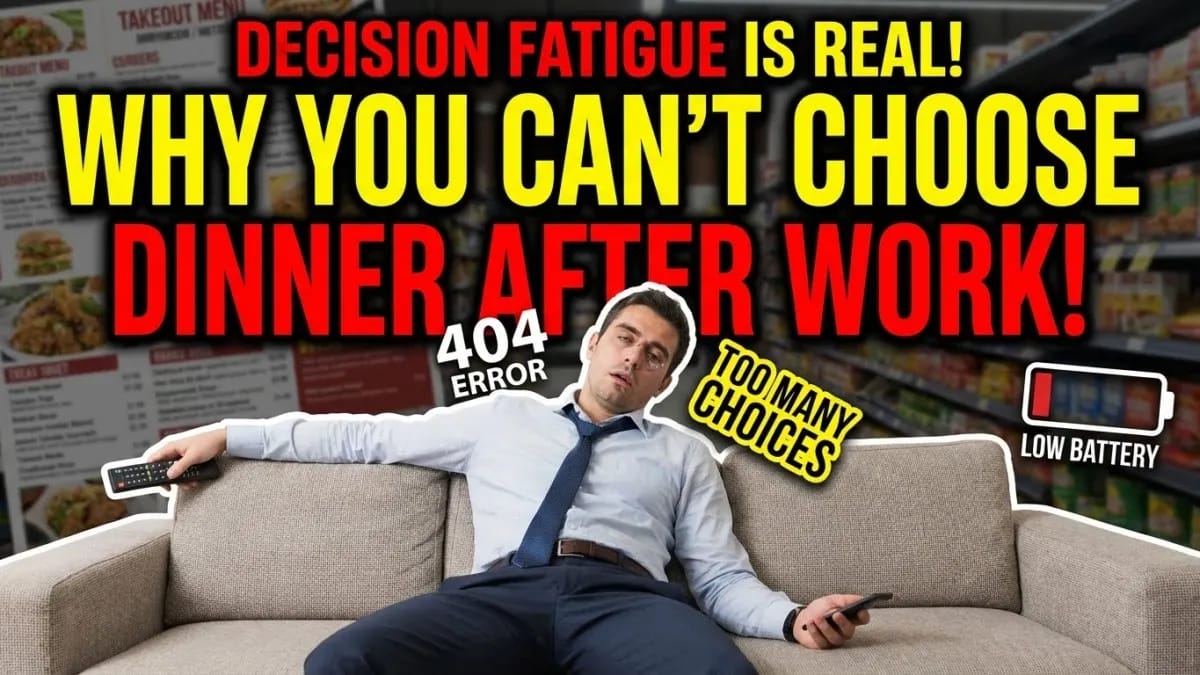
Decision Fatigue: Why You Can’t Choose Dinner After Work
Key Takeaways
Here’s what you need to know about decision fatigue:
- Your brain makes thousands of decisions daily, draining your mental energy like a battery
- Decision fatigue hits hardest in the evening, making simple choices feel impossible
- Small choices (like what to eat) pile up and exhaust your willpower
- You can fight back by creating routines and limiting daily decisions
- Planning ahead protects your mental energy for things that actually matter
Introduction: The 6 PM Paralysis
You just got home from work.
Your partner asks: “What do you want for dinner?”
And suddenly, you can’t think. Everything sounds terrible. Nothing sounds good. You just spent 8 hours making decisions, and now you can’t even pick between pizza and pasta.
I’ve been there. We all have.
This isn’t laziness. It’s decision fatigue, and it’s draining your mental energy every single day.
Let me show you why this happens and how to fix it.
What Is Decision Fatigue?
Decision fatigue is when your ability to make good choices gets worse after making many decisions.
Think of your brain like a phone battery. Every decision you make drains a little power. By evening, you’re running on 5%.
Here’s what I’ve seen happen to people with severe decision fatigue:
- They pick the easiest option (usually unhealthy food or saying “I don’t care”)
- They avoid deciding altogether and feel paralyzed
- They make impulsive choices they regret later
- They get irritable when asked simple questions
The science backs this up. Studies show that judges give harsher sentences before lunch and more lenient ones after eating. Their decision-making quality drops as the day goes on.
Why You Can’t Choose Dinner After Work
Your Brain Is Already Empty
By the time you leave work, you’ve already made hundreds of decisions:
- What to wear this morning
- Which route to take to work
- How to respond to that email
- Whether to attend that meeting
- What to prioritize on your to-do list
Each choice chips away at your mental energy.
I’ve watched clients track their daily decisions. Most people make over 200 choices before lunch. No wonder dinner feels impossible.
Evening Is Peak Depletion Time
Your willpower and decision-making share the same mental resource.
After a full day of:
- Solving problems at work
- Managing relationships
- Controlling your emotions
- Staying focused on tasks
You have nothing left for “What sounds good to eat?”
This is why you default to takeout, even when you wanted to cook healthy meals.
Food Decisions Are Surprisingly Complex
Choosing dinner isn’t actually simple. Your tired brain has to consider:
- What ingredients do you have?
- How much time do you have to cook?
- What did you eat yesterday?
- What does your partner want?
- Is it healthy enough?
- Will you regret this later?
Six questions for one meal. Your drained brain says “no thanks.”
The Hidden Cost of Too Many Choices
The Paradox of Choice
More options don’t make you happier. They make decisions harder.
I’ve seen people spend 30 minutes scrolling through food delivery apps, unable to pick anything. Too many choices create paralysis.
When you have 50 restaurant options, your brain has to:
- Compare all 50 choices
- Imagine each outcome
- Weigh pros and cons
- Deal with fear of picking “wrong”
It’s exhausting.
Barry Schwartz’s research on the paradox of choice:https://www.ted.com/talks/barry_schwartz_the_paradox_of_choice
Small Decisions Add Up Fast
You might think “It’s just dinner, not a big deal.”
But you also decided:
- What to have for breakfast
- What to have for lunch
- What snacks to eat
- What to drink throughout the day
Four food decisions before dinner even starts.
Add in clothing choices, work decisions, and daily logistics? You’re making thousands of micro-decisions daily.
Pro Tip: The “Rule of Three” Strategy
Here’s something I teach all my clients: Never give yourself more than three options for recurring decisions.
For dinner, pick your three go-to meals for each night of the week:
- Monday: Pasta, stir-fry, or sandwiches
- Tuesday: Tacos, soup, or chicken
- Wednesday: Pizza, salad bowls, or leftovers
This cuts decision-making by 90%. You’re not choosing from infinite options. You’re picking from three.
I started doing this five years ago. I haven’t experienced dinner paralysis since. It sounds limiting, but it’s actually freeing.
Signs You’re Experiencing Decision Fatigue
Watch for these warning signs:
Mental Signs:
- You feel mentally foggy or can’t think clearly
- Simple questions annoy you
- You keep saying “I don’t know” or “I don’t care”
- You can’t weigh pros and cons anymore
Behavioral Signs:
- You avoid making decisions and procrastinate
- You make impulsive choices to end the discomfort
- You default to the easiest option every time
- You feel relief when someone else decides for you
Emotional Signs:
- You feel irritable when asked to choose
- You experience decision-making as stressful
- You feel guilty about your choices later
- You’re exhausted even though you didn’t do physical work
I’ve experienced all of these. The worst part? You often don’t realize it’s happening until you’re completely drained.
How Decision Fatigue Affects Your Life
Your Health Suffers
When you’re too tired to decide, you pick convenient food over healthy food.
I’ve watched people with great intentions:
- Skip the gym because they can’t decide what workout to do
- Order fast food because cooking requires too many choices
- Eat the same unhealthy meal repeatedly (it requires zero decisions)
Your evening choices shape your health. And decision fatigue is sabotaging you.
Your Relationships Take a Hit
“I don’t care, you pick” sounds harmless.
But your partner hears: “I’m not engaged” or “This doesn’t matter to me.”
I’ve seen decision fatigue cause real friction in relationships. One person always has to decide. They feel burdened. The other feels guilty but too drained to help.
Your Money Disappears
Decision fatigue makes you spend more.
When you’re too tired to meal plan, you:
- Order expensive takeout
- Buy convenience foods at premium prices
- Waste groceries you were too tired to use
- Impulse-buy because you can’t evaluate if it’s worth it
I calculated this once for a client. Decision fatigue cost them $400 per month in unnecessary food spending.
How to Beat Decision Fatigue
Strategy 1: Automate Routine Decisions
Remove decisions before they drain you.
Here’s what works:
- Create a weekly meal rotation (same meals each week)
- Prep a “capsule wardrobe” so any combination works
- Set up automatic bill payments
- Use the same morning routine every day
I wear basically the same outfit every day (3 colors, same style). It sounds boring. But I save that mental energy for decisions that matter.
Strategy 2: Make Important Decisions Early
Your brain is freshest in the morning.
Schedule your day strategically:
- Morning: Big decisions, creative work, planning
- Afternoon: Routine tasks, meetings, emails
- Evening: Low-decision activities, relaxation
Never try to make financial or life decisions after 6 PM. Your tired brain will pick poorly.
Strategy 3: Batch Your Decisions
Instead of deciding dinner every night, decide once for the whole week.
Spend 20 minutes on Sunday planning:
- All seven dinners
- Your grocery list
- Prep work you can do ahead
One decision session replaces seven stressful evening decisions.
I do this every weekend. Monday-through-Friday me is incredibly grateful.
Strategy 4: Reduce Your Options
Cut down the choices you face:
- Unsubscribe from marketing emails (fewer shopping decisions)
- Limit streaming services to 1-2 (fewer viewing decisions)
- Keep a simple grocery list template (fewer food decisions)
- Use meal delivery kits if cooking decisions drain you
Fewer options = less fatigue.
Strategy 5: Take Real Breaks
Decision fatigue happens because you never refill your mental battery.
Actually take breaks during your day:
- Step away from your desk
- Take a real lunch (not at your computer)
- Do something mindless for 10 minutes
- Get outside and move your body
I’ve seen people cut their decision fatigue in half just by taking actual lunch breaks.
Strategy 6: Eat and Rest Properly
Your brain runs on glucose.
When you’re hungry or tired:
- Decision-making gets significantly worse
- Willpower drops to zero
- Everything feels harder than it is
This is why judges give harsher sentences before lunch. Low blood sugar = bad decisions.
Eat regular meals. Sleep enough. Your decision-making depends on it.
Creating a Decision-Light Evening Routine
Here’s the routine that saved my evenings:
Before Work Ends (4-5 PM):
- Decide tomorrow’s outfit
- Confirm tomorrow’s schedule
- Clear your mind of work decisions
Right After Work:
- Change into comfortable clothes (pre-decided)
- Have a small snack (kills decision fatigue from hunger)
- Take 10 minutes to decompress (no decisions allowed)
Dinner Time:
- Follow your meal plan (already decided Sunday)
- Use simple recipes with minimal steps
- Keep backup frozen meals for emergency days
Evening:
- Do low-decision activities (reading, watching a planned show)
- Prep anything needed for tomorrow
- Wind down with a consistent bedtime routine
I follow this pattern every weekday. My evenings transformed from stressful to peaceful.
When to Seek Help
Sometimes decision fatigue signals bigger problems.
Talk to a professional if you:
- Can’t make even simple decisions for weeks
- Feel paralyzed by every choice
- Experience this alongside depression or anxiety
- Notice it’s affecting your work or relationships seriously
I’m not a therapist, but I’ve seen decision fatigue be a symptom of burnout, depression, or chronic stress.
There’s no shame in getting support. Your mental health matters more than powering through.
Q: Is decision fatigue the same as being lazy?
No. Decision fatigue is a real psychological phenomenon where your mental resources get depleted. Laziness is choosing not to do something. Decision fatigue is being unable to choose at all. I’ve seen highly motivated people experience severe decision fatigue.
Q: How long does it take to recover from decision fatigue?
Usually a good night’s sleep helps reset your decision-making ability. But chronic decision fatigue requires lifestyle changes. Most people feel better within 1-2 weeks of implementing decision-reducing strategies.
Q: Can decision fatigue cause anxiety?
Yes. The inability to make decisions creates stress, which can trigger anxiety. I’ve watched clients’ anxiety improve dramatically once they reduced daily decision load.
Q: Why is deciding dinner harder than deciding work stuff?
By evening, you’ve already used most of your decision-making energy on work. Also, work decisions often have clear parameters and deadlines. Dinner is open-ended with infinite options, making it mentally harder.
Q: Do successful people experience decision fatigue?
Absolutely. This is why many successful people wear the same outfit daily (Steve Jobs, Mark Zuckerberg). They eliminate trivial decisions to preserve mental energy for important ones.
Q: Is meal planning really worth the effort?
Yes. I’ve tracked this with dozens of people. Twenty minutes of planning saves hours of evening stress and hundreds of dollars monthly. The return on investment is massive.
Q: What if my partner and I can’t agree on dinner?
Assign decision-making days. Monday/Wednesday/Friday, one person decides. Tuesday/Thursday/Saturday, the other decides. Sunday, order from your favorite place. No discussion needed.
Q: Can decision fatigue make you gain weight?
Indirectly, yes. Decision fatigue leads to choosing convenient, often unhealthy foods. It also makes you skip workouts. Over time, this affects weight. I’ve seen clients lose weight simply by meal planning and removing food decisions.
READ MORE:https://mrpsychics.com/you-scroll-tiktok-for-hour-the-slot-machine-effect/
Final Thoughts
Decision fatigue isn’t a character flaw.
It’s your brain telling you it’s overloaded.
The dinner question is just the breaking point after a day of thousands of choices.
You can fix this. Start with one strategy from this article. Try meal planning this Sunday. Or create a simple evening routine. Or use the Rule of Three.
I promise, when you stop forcing your exhausted brain to make trivial decisions, you’ll have energy for what actually matters.
Your life. Your relationships. Your goals.
Not what to have for dinner.

Ahmed is a self-improvement and psychology writer passionate about helping people live smarter, calmer, and more productive lives.
- Ahmed manasiya

- Ahmed manasiya
- Ahmed manasiya
- Ahmed manasiya