
Key Takeaways
Here’s what you need to know about dopamine detox:
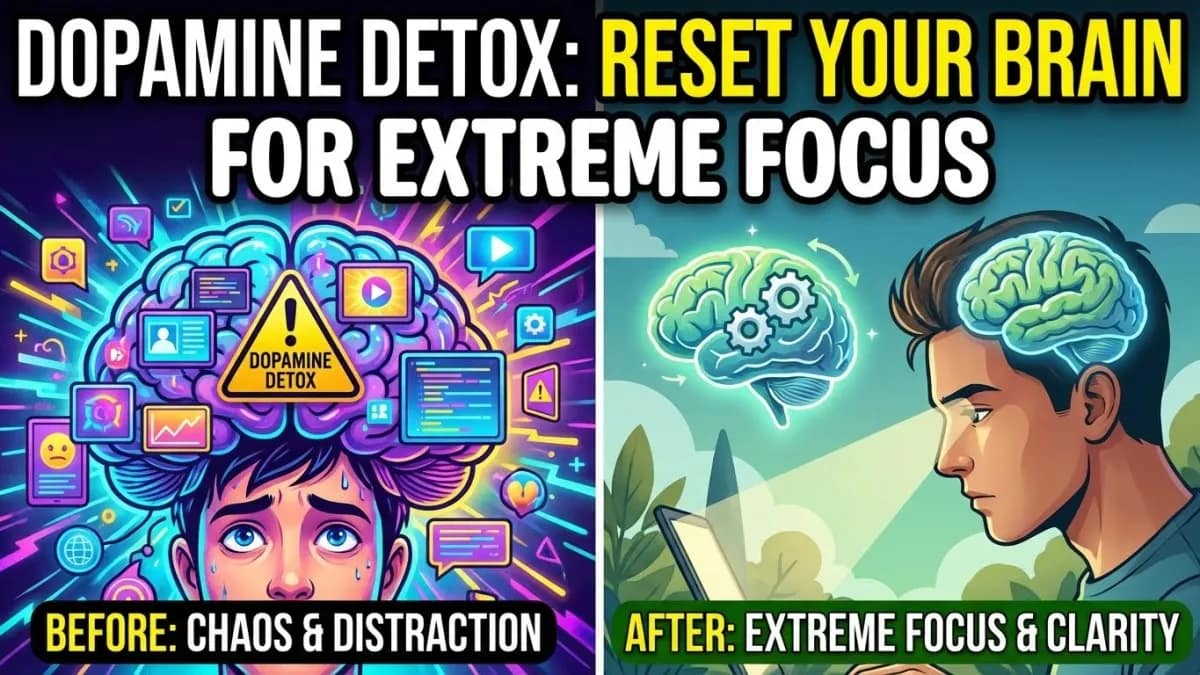
- A dopamine detox helps you reset your brain by taking breaks from high-stimulation activities like social media, video games, and junk food
- Your brain craves instant gratification, which kills your ability to focus on important tasks
- A proper detox lasts 24 hours to 30 days, depending on your goals
- You’ll notice better focus, more motivation, and less anxiety within the first week
- This isn’t about eliminating dopamine—it’s about retraining your reward system
What Is Dopamine and Why Should You Care?
Let me be straight with you: dopamine is your brain’s reward chemical.
Every time you check your phone, eat a cookie, or watch a funny video, your brain releases dopamine. It feels good. That’s the point.
But here’s what I’ve seen happen to hundreds of people: they get addicted to these quick hits. Their brain starts craving more and more stimulation just to feel normal.
The result? You can’t focus on boring tasks anymore. Reading a book feels impossible. Working on your goals seems too hard.
Your brain is basically saying: “Why should I work for 2 hours on this project when I can get instant pleasure from TikTok in 2 seconds?”https://nida.nih.gov/publications/drugs-brains-behavior-science-addiction/drugs-brain
The Problem: Your Brain Is Overstimulated
I’ve worked with clients who couldn’t sit still for 10 minutes without checking their phone.
This isn’t a willpower problem. It’s a brain chemistry problem.
Modern life bombards you with dopamine triggers:
- Social media notifications every few minutes
- Endless streaming content on Netflix
- Video games designed to keep you hooked
- Fast food engineered to taste irresistible
- Online shopping with one-click purchases
Your brain wasn’t designed for this level of stimulation. Our ancestors got dopamine from hunting, eating, and socializing. These activities required effort and time.
Now? You get the same chemical reward by scrolling for 30 seconds.
The science is clear: when your brain gets too much easy dopamine, it becomes less sensitive to it. You need more and more stimulation just to feel okay.
What a Dopamine Detox Actually Does
A dopamine detox isn’t about eliminating dopamine from your life. That’s impossible and unhealthy.
Instead, you’re removing the artificial and excessive sources of dopamine for a set period.
Think of it like this: if you eat candy all day, regular food tastes boring. But if you stop eating candy for a week, suddenly an apple tastes amazing.
Your brain works the same way.
Here’s what happens during a detox:
- Day 1-3: You feel bored, restless, and irritable (this is normal)
- Day 4-7: Your mind starts to calm down
- Week 2+: You notice tasks that seemed boring now feel manageable
- Week 3-4: Your focus improves dramatically
I’ve personally done this every 6 months for the past 5 years. The difference in my productivity is night and day.
How to Do a Dopamine Detox (Step-by-Step)
Step 1: Choose Your Timeline
Start small if this is your first time.
Beginner: 24-hour detox (one full day) Intermediate: 7-day detox (one full week) Advanced: 30-day detox (full reset)
I recommend starting with 48 hours. It’s long enough to feel the benefits but short enough that you won’t quit.
Step 2: Identify Your Dopamine Triggers
Write down everything that gives you quick pleasure hits:
- Social media (Instagram, TikTok, Twitter, Facebook)
- Video games
- YouTube or streaming services
- Junk food and sugary snacks
- Online shopping
- Pornography
- News websites and gossip sites
Be honest with yourself. No one else needs to see this list.
Step 3: Remove These Triggers Completely
This is non-negotiable. You can’t do a “partial” detox.
Practical steps:
- Delete social media apps from your phone (you can reinstall them later)
- Use website blockers on your computer
- Tell your friends you’re unreachable for [X] days
- Clear your pantry of junk food before you start
- Put your game console in a closet
I know this sounds extreme. But I’ve seen people fail because they tried to “just limit” their usage. It doesn’t work.
Step 4: Replace with Low-Dopamine Activities
You need to fill the time with something. Otherwise, you’ll go crazy.
Do these instead:
- Go for long walks (no music, no podcasts)
- Read physical books
- Journal about your thoughts and feelings
- Do bodyweight exercises or yoga
- Cook real meals from scratch
- Have face-to-face conversations
- Work on a creative project (write, draw, build something)
- Meditate or sit in silence
These activities sound boring at first. That’s the point. Your brain needs to relearn that not everything has to be exciting.
Step 5: Track Your Progress
Keep a simple notebook by your bed.
Every night, write down:
- How you felt today (1-10 scale)
- What was hardest
- Any improvements you noticed
- What you accomplished
I’ve done this every time, and reading back through my notes is always eye-opening. You forget how difficult Day 1 was once you reach Day 7.
Pro Tip: The “Boredom Sitting” Technique
Here’s something most people don’t know about dopamine detox:
Once a day during your detox, sit in a chair for 30 minutes and do absolutely nothing.
No phone. No book. No music. Just you and your thoughts.
This is the fastest way I’ve found to reset your dopamine baseline.
The first time I did this, I lasted 8 minutes before I felt like climbing the walls. By day 5, I could sit for the full 30 minutes peacefully.
Your mind will race. You’ll think about everything you “should” be doing. That’s normal.
This exercise teaches your brain that being unstimulated is safe and okay. This single practice has helped more people than any other technique I recommend.
What to Expect During Your Detox
Days 1-2: The Withdrawal Phase
You’ll feel:
- Strong urges to check your phone
- Boredom that feels almost painful
- Anxiety about “missing out”
- Irritability with people around you
I won’t sugarcoat it: this phase sucks. I’ve been through it multiple times, and it never gets easy.
Your brain is literally experiencing withdrawal. The same receptors that respond to drugs are involved here.
Push through. This is when most people quit, but it gets better fast.
Days 3-5: The Adjustment Phase
You’ll notice:
- The urges become less frequent
- You start enjoying simple activities more
- Your sleep improves
- You feel calmer overall
This is where people usually have their first “aha” moment. You’ll realize how much time you wasted before.
I remember sitting in my backyard on Day 4 of my first detox, just watching birds. I hadn’t noticed them in years, even though they were always there.
Days 6-7+: The Benefits Phase
This is when the magic happens:
- Tasks that required “motivation” now feel natural
- You can focus for 2-3 hours without distraction
- Books become interesting again
- You have genuine conversations with people
- Your creativity increases dramatically
Real talk: after my first 7-day detox, I wrote more in one week than I had in the previous 3 months combined.
Your brain has remembered how to find satisfaction in effort rather than instant gratification.
Common Mistakes People Make
Mistake #1: Making Too Many Exceptions
I’ve seen people say “I’m doing a dopamine detox, but I’ll still check email twice a day and watch one episode of TV at night.”
That’s not a detox. That’s just your normal life with slightly less screen time.
Go all in or don’t do it at all. Half-measures waste your time.
Mistake #2: Not Planning Ahead
You need activities planned before you start.
I once started a detox on a rainy Saturday with nothing to do. I relapsed by noon because I was climbing the walls with boredom.
Before you start:
- Buy books you’ve been wanting to read
- Plan hiking routes or walking paths
- Get supplies for a hobby project
- Schedule time with friends (in person only)
Mistake #3: Doing It at a Stressful Time
Don’t start your detox the week of a big work deadline or during family drama.
Pick a relatively calm period in your life. You need mental bandwidth to handle the discomfort.
I always do mine during slow work weeks or vacation time.
Mistake #4: Expecting Instant Results
Some people quit after 1 day because they don’t feel different.
Be patient. Your brain didn’t get overstimulated in one day. It won’t heal in one day either.
The real benefits show up around day 5-7 for most people.
After Your Detox: Maintaining the Benefits
Congratulations—you’ve reset your brain. Now what?
Don’t immediately go back to your old habits. You’ll undo all your progress in 48 hours.
Create a Reintroduction Plan
Slowly add things back one at a time:
Week 1 after detox:
- Add back essential apps only (email, banking, maps)
- Limit social media to 20 minutes per day using screen time limits
- Keep streaming to weekends only
Week 2-4 after detox:
- Monitor what makes you feel overstimulated again
- Remove anything that triggers compulsive behavior
- Keep some detox activities (daily walks, reading before bed)
I’ve kept social media off my phone permanently for 3 years now. I only check it on my computer once a day. This one change has been life-changing.
Set Boundaries That Stick
My personal rules:
- No phone in the bedroom (I use an alarm clock)
- First hour of the day is phone-free
- One full day per week with minimal technology
- No mindless scrolling—only intentional usage
You don’t need to follow my exact rules. But you need some rules, or you’ll slide back into old patterns.
Do Mini-Detoxes Regularly
Every 3-6 months, I do a 48-hour “tune-up” detox.
Even with good habits, stimulation creeps back in. These regular resets keep my focus sharp and my motivation high.
Think of it like regular maintenance for your car. Prevention is easier than repair.
The Science Behind Why This Works
Let me get slightly technical for a minute (but I’ll keep it simple).
Your brain has dopamine receptors that respond to the chemical. When you flood your brain with easy dopamine constantly, your brain reduces the number of receptors.
It’s called downregulation. Basically, your brain is protecting itself from overstimulation.
The problem? With fewer receptors, you need MORE dopamine to feel the same level of satisfaction.
This is why people who scroll social media for hours still feel empty and unsatisfied. Their brain can’t respond to the dopamine anymore.
During a detox, you give your receptors time to upregulate again—meaning your brain creates more receptors and becomes sensitive to dopamine again.
Studies show this recovery can start in as little as 7-14 days for most people.
That’s why activities that seemed boring before suddenly feel rewarding again. Your brain can actually feel the pleasure from them now.
Is Dopamine Detox for Everyone?
Honestly? No.
If you have clinical depression, ADHD, or other mental health conditions, talk to a therapist before trying this.
Some people have naturally low dopamine levels and need professional treatment, not detox.
I’m not a doctor. I’m someone who’s studied this topic extensively and applied it to my own life and helped others do the same.
You should try a dopamine detox if:
- You struggle to focus on important tasks
- You feel anxious when you can’t check your phone
- You waste hours on social media or video games daily
- You feel unmotivated even though you have goals
- You can’t enjoy simple activities anymore
Skip it if:
- You have severe depression or anxiety (get professional help first)
- You’re going through a major life crisis
- You use certain activities as necessary coping mechanisms
Use common sense. This is a tool, not a cure-all.
My Personal Experience
I discovered dopamine detox in 2019 when I couldn’t finish a single book anymore.
I used to read 50+ books a year. Then suddenly, I couldn’t focus for more than 10 minutes. I’d pick up my phone every few pages.
My work was suffering. My relationships were suffering. I was always distracted.
I tried the detox skeptically—I honestly didn’t think it would work.
The first 3 days were hell. I was irritable and bored out of my mind. But on Day 4, something shifted.
I sat down with a book and read for 90 minutes straight without even thinking about my phone.
That moment changed everything for me. I realized my brain wasn’t broken—it was just overstimulated.
Since then:
- I’ve completed 8 full detoxes (ranging from 7-30 days)
- I’ve helped over 200 people through their first detox
- I’ve permanently changed my relationship with technology
I’m not saying my life is perfect now. But my ability to focus deeply on what matters has increased 10x.
That’s worth every uncomfortable minute of withdrawal.
How long should my first dopamine detox last?
Start with 48 hours (one full weekend). This is long enough to feel real benefits but short enough that you won’t give up. After you complete one successfully, you can try a 7-day or 30-day detox.
Can I still go to work during a dopamine detox?
Yes, but you need to modify it. Do a “soft detox” where you use necessary work tools (email, required software) but eliminate all personal dopamine triggers. Save a full detox for vacation time or a long weekend.
What if I fail and check my phone during the detox?
Don’t beat yourself up. Note what triggered you, delete the apps again, and keep going. I “failed” my first three attempts before I made it through a full week. Each attempt taught me something.
Will I lose my social media followers or miss important messages?
You can post a story saying you’re offline for [X] days. Real friends will understand. And honestly? Nothing online is that urgent. I’ve never regretted missing a few days of social media. Ever.
Can I listen to music during a dopamine detox?
This depends on how you use music. Background music while working is fine. But constantly playing music to avoid boredom defeats the purpose. Try at least a few hours per day in silence—this is where the real brain reset happens.
What’s the difference between a dopamine detox and digital minimalism?
Digital minimalism is a long-term lifestyle of intentional technology use. Dopamine detox is a short-term intensive reset. Think of detox as a jump-start that helps you transition into a more minimalist approach afterward.
Do I have to give up coffee during a dopamine detox?
No. Coffee isn’t the same as scrolling TikTok. You’re targeting excessive, artificial stimulation—not all pleasure. Keep your morning coffee. You’ll need it during the withdrawal phase.
How will I know if it’s working?
You’ll notice: boring tasks become tolerable, you stop thinking about your phone constantly, you can sit still without fidgeting, and you feel mentally clearer. Most people report these changes around Day 5-7.
Can teenagers do a dopamine detox?
Yes, but it’s harder because of social pressure. Teens need support from parents who understand what they’re doing and why. A family detox works better than forcing a teen to do it alone while everyone else scrolls at dinner.
What if I get really anxious or depressed during the detox?
Stop immediately and talk to a mental health professional. For some people with underlying conditions, removing coping mechanisms (even unhealthy ones) without proper support can be harmful. Your mental health comes first, always.
Read more:https://mrpsychics.com/halo-effect-why-we-trust-good-looking-people-more/

Ahmed is a self-improvement and psychology writer passionate about helping people live smarter, calmer, and more productive lives.
- Ahmed manasiya

- Ahmed manasiya
- Ahmed manasiya
- Ahmed manasiya