
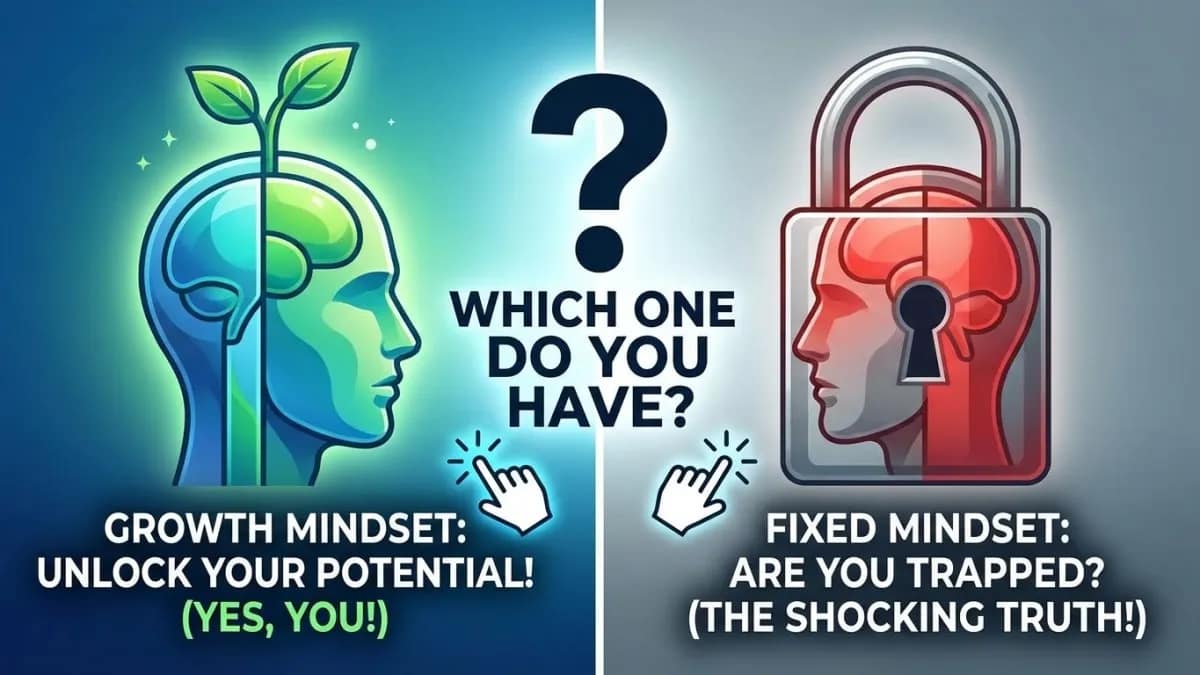
Growth Mindset vs. Fixed Mindset: Which One Do You Have?
Key Takeaways
Understanding your mindset can change your entire life. Here’s what you need to know:
- Growth mindset means you believe you can improve through effort and learning
- Fixed mindset means you think your abilities are set in stone
- Most people have a mix of both mindsets in different areas of life
- You can train yourself to develop a growth mindset
- Your mindset affects your relationships, career, and happiness
Introduction: The Two Mindsets That Shape Your Life
I’ve worked with hundreds of people over the years. And I’ve noticed something interesting.
Some people bounce back from failure. Others give up after one setback.
The difference? Their mindset.
Psychologist Carol Dweck spent decades studying this. She discovered that how you think about your abilities matters more than the abilities themselves.
Let me show you what I mean.
What Is a Fixed Mindset?
A fixed mindset is when you believe your intelligence, talents, and abilities are unchangeable. You think you’re either born with it or you’re not.
Here’s what fixed mindset sounds like:
- “I’m just not a math person”
- “I can’t draw to save my life”
- “Some people are natural leaders. I’m not one of them”
- “I’m too old to learn new things”
Signs You Have a Fixed Mindset
I’ve seen these patterns repeat again and again:
You avoid challenges because you’re scared of looking stupid. If something seems hard, you don’t even try.
You give up easily when things get tough. One bad experience and you decide it’s not for you.
You ignore feedback because criticism feels like a personal attack. Instead of learning, you get defensive.
You feel threatened by others’ success. When someone else wins, you feel like you’re losing.
You believe effort is pointless. You think “if I have to work hard at it, I’m probably not good at it.”
The Problem with Fixed Mindset
Here’s what I’ve observed in my practice:
People with a fixed mindset create their own ceiling. They stop growing before they even start.
I had a client who refused to apply for promotions. She told me, “I’m not management material.”
But the real issue? She was scared of proving herself right.
Fixed mindset keeps you stuck. It turns temporary setbacks into permanent limitations.
What Is a Growth Mindset?
A growth mindset is when you believe you can develop your abilities through dedication and hard work. Talent is just the starting point.
Here’s what growth mindset sounds like:
- “I’m not good at this yet, but I can learn”
- “This is challenging, which means I’m growing”
- “What can I learn from this mistake?”
- “If they can do it, I can figure it out too”
Signs You Have a Growth Mindset
You probably have a growth mindset if:
You embrace challenges because they help you improve. Hard things are exciting, not scary.
You persist through setbacks. Failure is just feedback, not a verdict on your worth.
You welcome criticism because it helps you get better. You ask questions like “How can I improve?”
You celebrate others’ success and learn from them. You think “if they did it, there’s a path forward.”
You see effort as the path to mastery. Working hard means you’re committed, not deficient.
The Power of Growth Mindset
I’ve watched people completely transform their lives by shifting their mindset.
One guy I worked with struggled with public speaking for years. He thought he was “just an introvert” and would never be comfortable presenting.
Then he started reframing it. “I’m learning to speak in public” instead of “I can’t do this.”
Six months later, he was leading team meetings. A year later, he spoke at a conference.
The only thing that changed was his belief about change itself.
Pro Tip: The “Yet” Technique
Here’s something I teach everyone I work with:
Add the word “yet” to your negative self-talk.
- “I don’t understand this” becomes “I don’t understand this yet“
- “I can’t do it” becomes “I can’t do it yet“
- “This doesn’t work” becomes “This doesn’t work yet“
This tiny word shifts your brain from fixed to growth mode. It reminds you that you’re in process, not at a dead end.
I’ve seen this simple trick change people’s entire approach to learning. Try it for one week and watch what happens.
The Real Difference: How Each Mindset Handles Failure
Let me show you how this plays out in real life.
When Someone with a Fixed Mindset Fails:
They think: “I’m not smart enough. I knew I couldn’t do this.”
They feel: Ashamed, defeated, like a failure.
They do: Give up, avoid similar situations, blame others or circumstances.
The result: They prove themselves right and stay stuck.
When Someone with a Growth Mindset Fails:
They think: “That didn’t work. What can I try differently?”
They feel: Disappointed but curious about what went wrong.
They do: Analyze mistakes, ask for help, try a new approach.
The result: They improve and eventually succeed.
I’ve seen this pattern play out hundreds of times. Your response to failure predicts your future success more than your talent does.
Why Your Mindset Matters More Than You Think
Your mindset isn’t just about positive thinking. It physically changes what you’re capable of.
In Your Career
People with a growth mindset are more likely to:
- Get promoted (they take on new challenges)
- Learn new skills (they’re not afraid to be beginners)
- Recover from setbacks (they don’t personalize failure)
- Ask for feedback (they want to improve)
I worked with two employees at the same company. Same education, same starting position.
Five years later, one was middle management. The other was still in the same role, complaining about being “overlooked.”
The difference? One asked “How can I grow?” The other said “This is who I am.”
In Your Relationships
Fixed mindset in relationships looks like:
- “We’re just not compatible”
- “People don’t change”
- “If they loved me, they’d know what I need”
- Giving up when things get hard
Growth mindset in relationships looks like:
- “We can work through this together”
- “We’re both learning how to be better partners”
- “Let me clearly communicate my needs”
- Seeing conflict as an opportunity to understand each other better
I’ve seen marriages saved by mindset shifts. And I’ve seen promising relationships end because both people believed “it shouldn’t be this hard.”
In Your Personal Growth
Your mindset determines whether you:
- Try new hobbies or stick to what you know
- Take risks or play it safe
- Learn from criticism or avoid it
- See aging as decline or continued growth
I’m in my 50s. I know people my age who say “I’m too old for that.”
And I know people learning languages, starting businesses, and running marathons. Same age, different mindset.
Can You Change Your Mindset?
Here’s the good news: Yes, absolutely.
Your mindset isn’t fixed (ironic, right?). I’ve helped countless people make this shift.
How to Develop a Growth Mindset
1. Notice your fixed mindset triggers
Pay attention to when you think “I can’t” or “I’m not good at this.”
Write down these moments. What situations trigger your fixed mindset?
For most people, it’s specific areas: math, technology, socializing, creative work.
2. Reframe your self-talk
When you catch fixed mindset thoughts, pause and reframe:
- “I’m bad at this” → “I’m still learning this”
- “This is too hard” → “This will take some time and effort”
- “I failed” → “I learned what doesn’t work”
3. Focus on the process, not just the outcome
Instead of “Did I win?” ask “What did I learn?”
Instead of “Am I smart?” ask “Am I getting better?”
I tell my clients to celebrate effort and strategy, not just results.
4. Embrace challenges
Start small. Pick one thing that scares you a little.
Maybe it’s speaking up in meetings. Maybe it’s learning to cook.
Do it badly at first. Give yourself permission to be a beginner.
5. Learn from criticism
When someone gives you feedback, don’t defend. Don’t explain.
Just ask: “Can you tell me more?” and “How can I improve?”
This is hard at first. I still struggle with it sometimes. But it gets easier.
6. Celebrate others’ success
When someone succeeds, study them instead of envying them.
Ask yourself: “What can I learn from their approach?”
The 30-Day Mindset Challenge
Here’s something I recommend:
For 30 days, keep a growth mindset journal.
Every day, write down:
- One challenge you faced
- One thing you learned (even from a mistake)
- One way you improved
- One piece of feedback you received
This rewires your brain to look for growth opportunities instead of threats.
Mixed Mindsets: The Truth About Real People
Let me be honest with you.
Nobody has a pure growth mindset in every area of life. I certainly don’t.
You might have a growth mindset about your career but a fixed mindset about your artistic ability.
You might believe you can improve your fitness but think you’ll “always be bad with money.”
This is completely normal.
How to Identify Your Fixed Mindset Areas
Ask yourself these questions:
- What do you avoid trying because you think you’ll be bad at it?
- Where do you get defensive when receiving feedback?
- What abilities do you think are “just not you”?
- When do you compare yourself negatively to others?
These are your fixed mindset zones.
The good news? Once you identify them, you can work on them.
I used to have a fixed mindset about technology. I thought “I’m just not a tech person.”
Then I realized I was only saying that because I was scared of looking dumb.
Now I ask questions, watch tutorials, and mess things up until I figure them out.
I’m still not a tech expert. But I’m no longer helpless.
Common Myths About Growth Mindset
Let me clear up some confusion I see all the time:
Myth 1: “Growth mindset means you can be anything”
Not true. Growth mindset doesn’t mean you can become an NBA player if you’re 5’2″.
It means you can significantly improve from where you are now.
You have more potential than you think. But you still have real limitations.
Myth 2: “Just praise effort, not results”
Not quite. Effort without progress isn’t enough.
You need effort plus the right strategies plus learning from mistakes.
I’ve seen people work incredibly hard at things the wrong way. That’s not growth mindset, that’s stubbornness.
Myth 3: “Growth mindset is just positive thinking”
Definitely not. This isn’t about pretending problems don’t exist.
It’s about believing you can tackle problems through learning and persistence.
Big difference.
Myth 4: “People with growth mindset never feel discouraged”
Wrong. I have a growth mindset and I get frustrated all the time.
The difference is what I do with that frustration. Do I quit or do I adjust?
Growth Mindset in Different Life Areas
Let me show you how this plays out in specific situations:
At Work
Fixed mindset employee:
- Hides mistakes
- Avoids new projects
- Feels threatened by talented coworkers
- Blames others when things go wrong
Growth mindset employee:
- Admits mistakes and learns from them
- Volunteers for challenges
- Learns from talented coworkers
- Takes responsibility and improves
In School or Learning
Fixed mindset student:
- Studies to “get it over with”
- Cheats to maintain good grades
- Gives up on hard subjects
- Feels smart when others fail
Growth mindset student:
- Studies to actually understand
- Sees grades as feedback
- Spends more time on hard subjects
- Feels inspired by others’ success
In Health and Fitness
Fixed mindset approach:
- “I have bad genes, so why bother?”
- Gives up after missing a few workouts
- Compares body to others and feels hopeless
Growth mindset approach:
- “I’ll work with what I have”
- Misses workouts but gets back on track
- Measures progress against past self
In Creativity
Fixed mindset:
- “I’m not creative”
- Won’t try because first attempts won’t be good
- Quits when others are better
Growth mindset:
- “I’m developing my creative skills”
- Creates bad work to eventually create good work
- Studies techniques of people who are better
Teaching Growth Mindset to Others
If you have kids, employees, or students, here’s what I’ve learned:
Don’t Say This:
- “You’re so smart!”
- “You’re a natural!”
- “You’re talented!”
Say This Instead:
- “I love how hard you worked on this”
- “Your strategy really paid off”
- “I can see how much you’ve improved”
Praise the process, not the person.
When you praise intelligence, kids develop a fixed mindset. They think “I better not try hard things that might prove I’m not smart.”
When you praise effort and strategy, they learn that improvement comes from work.
I’ve seen parents accidentally create fixed mindsets with well-meaning praise.
Your Brain on Growth Mindset: The Science
Here’s something fascinating I learned:
Your brain is neuroplastic. It physically changes based on how you use it.
When you learn something new, your brain forms new neural connections. When you practice, those connections get stronger.
You literally build your intelligence through effort.
Brain scans show that people with growth mindsets:
- Have more brain activity when facing challenges
- Learn from mistakes more effectively
- Persist longer on difficult tasks
This isn’t just psychology. It’s neuroscience.
Every time you struggle with something and push through, you’re making your brain stronger.
FAQ: Growth Mindset vs. Fixed Mindset
Q: Can you have both mindsets at the same time?
Yes, absolutely. Most people have a growth mindset in some areas and a fixed mindset in others. You might believe you can improve your cooking skills but think you’ll “never be good at math.” The key is recognizing where your fixed mindset shows up and working on those specific areas.
Q: How long does it take to change from a fixed to a growth mindset?
It’s not a one-time switch, it’s an ongoing practice. You’ll notice changes in a few weeks if you actively work on it, but developing a consistent growth mindset takes months. I tell people to expect noticeable shifts in 2-3 months and significant transformation in 6-12 months.
Q: Is growth mindset just toxic positivity?
No. Growth mindset acknowledges real challenges and failures. It’s not about pretending everything is fine. It’s about believing you can learn and improve despite difficulties. You can feel discouraged and still have a growth mindset.
Q: What if I’ve tried to change my mindset but keep falling back into old patterns?
This is completely normal. Mindset change isn’t linear. You’ll have setbacks, especially under stress. The key is to notice when you slip into fixed mindset thinking and gently redirect yourself. It’s like building a muscle—you get stronger with practice.
Q: Do some people naturally have a growth mindset?
Your mindset is shaped by experiences, especially from childhood. If your parents praised effort over intelligence and encouraged you to try new things, you probably developed more of a growth mindset. But even if you started with a fixed mindset, you can absolutely change it.
Q: Can growth mindset help with anxiety and depression?
A growth mindset can be helpful, but it’s not a replacement for professional mental health treatment. It can help you approach therapy and healing as a process of growth rather than a sign of being “broken.” But please work with a qualified therapist for mental health issues.
Q: How do I know if I’m making progress?
Track how you respond to challenges and setbacks. Are you giving up less quickly? Are you seeing failures as learning opportunities? Are you seeking out challenges instead of avoiding them? These are signs you’re developing a growth mindset.
Q: What’s the biggest mistake people make when trying to develop a growth mindset?
Expecting perfection. People get frustrated when they catch themselves in fixed mindset thinking and feel like they’ve failed. But noticing your fixed mindset moments IS progress. Be patient with yourself.
Q: Does growth mindset mean I should never quit anything?
No. Growth mindset is about being willing to struggle and learn, not about forcing yourself to do things that genuinely aren’t right for you. Quitting because something is hard is fixed mindset. Quitting because you’ve learned it’s not the right path for you is wisdom.
Q: How can I help my child develop a growth mindset?
Praise their effort, strategies, and improvement, not their intelligence or talent. Let them struggle with hard things instead of rescuing them. Share your own failures and what you learned from them. Model growth mindset yourself—they’re always watching.
READ MORE:https://mrpsychics.com/psychology-of-comfort-eating-stress-make-us-hungry/
Final Thoughts: Which Mindset Will You Choose?
Here’s what I know after years of working with people:
Your mindset is the lens through which you see every opportunity and obstacle in your life.
With a fixed mindset, every challenge is a test of your worth. Every failure is evidence that you’re not good enough.
With a growth mindset, every challenge is a chance to improve. Every failure is information.
You get to choose which lens you look through.
I’m not saying it’s easy. Changing deeply held beliefs about yourself takes work.
But I’ve seen people in their 60s completely transform their lives by shifting their mindset.
It’s never too late. You’re never too old. You’re never too far behind.
You just have to believe that you can grow. And then start growing.
What’s one area where you’re going to practice growth mindset this week?

Ahmed is a self-improvement and psychology writer passionate about helping people live smarter, calmer, and more productive lives.
- Ahmed manasiya

- Ahmed manasiya
- Ahmed manasiya
- Ahmed manasiya