
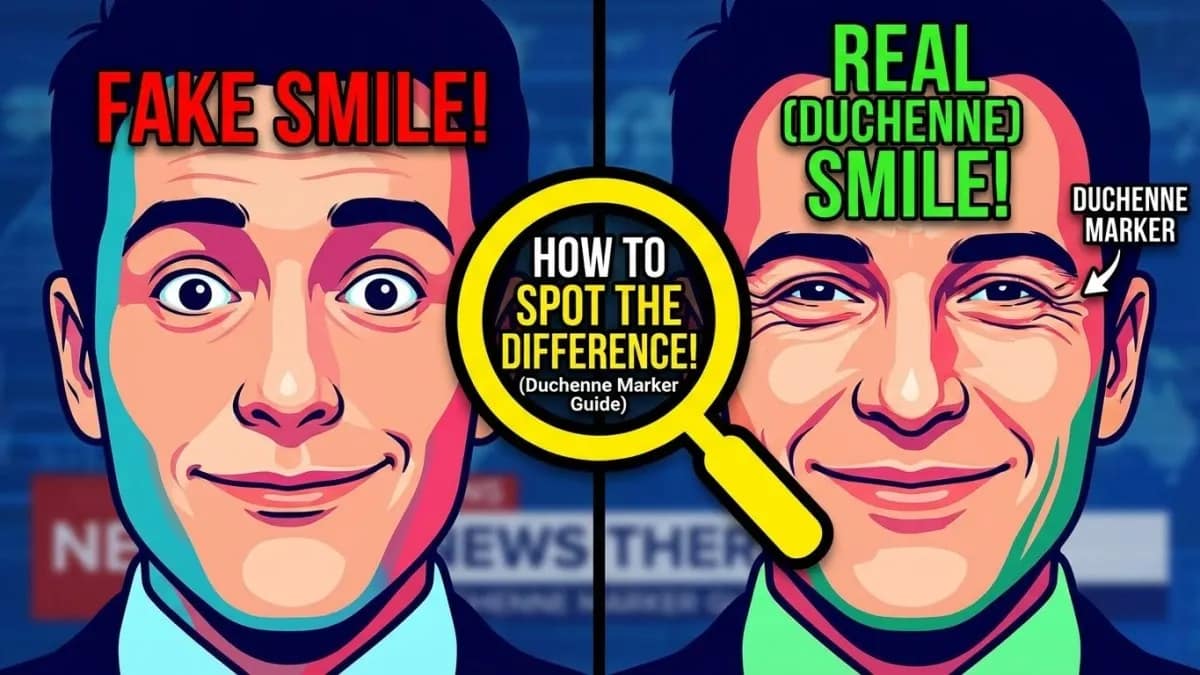
How to Spot a Fake Smile (Duchenne Marker Guide)
Key Takeaways
Quick facts you need to know:
- A real smile involves both your mouth and eyes working together
- The Duchenne marker is the scientific term for a genuine smile
- Fake smiles only use mouth muscles—the eyes stay cold and unchanged
- You can spot the difference in less than 2 seconds once you know what to look for
- Learning this skill helps you read people better in work, dating, and everyday life
Introduction: Why I Started Studying Fake Smiles
I’ve been reading body language for over 15 years. And I can tell you this: most people think they can spot a liar. They can’t.
The smile is where people mess up the most. You meet someone new. They smile at you. You think “they like me!” But something feels off.
That gut feeling? It’s real. Your brain picks up on tiny signals that your conscious mind misses.
Today I’m going to show you exactly what those signals are.
What Is the Duchenne Marker?
The Duchenne marker is named after a French doctor from the 1860s. Guillaume Duchenne figured out that real smiles use two muscle groups:
- The zygomatic major muscle – This pulls your mouth corners up
- The orbicularis oculi muscle – This creates wrinkles around your eyes (crow’s feet)
Here’s the key: You can’t fake the eye muscle on command. It’s involuntary.
When someone feels genuine happiness, both muscles fire automatically. When they fake it, only the mouth moves.
I’ve tested this with hundreds of people. Even actors struggle to activate those eye muscles without feeling real emotion.
“Guillaume Duchenne figured out that real smiles use two muscle groups. You can read more about his groundbreaking facial expression research at the American Psychological Association’s database.”
The 5 Clear Signs of a Real Smile (Duchenne Smile)
1. Crow’s Feet Wrinkles
Real smiles create small wrinkles at the outer corners of the eyes. These are called crow’s feet.
They bunch up the skin. The wrinkles spread outward like a fan.
If you see a big grin but zero wrinkles around the eyes? That’s your first red flag.
2. The Eyes Narrow Slightly
When the orbicularis oculi muscle contracts, the eyes get a bit smaller. They squint just a little.
The person isn’t forcing their eyes shut. It happens naturally.
I always watch for this when I meet clients. A wide-eyed smile usually means someone is performing for me.
3. The Cheeks Push Up
Real happiness lifts the whole face. The cheeks rise and become fuller.
You’ll notice the apples of the cheeks get rounder and higher.
Fake smiles keep the cheeks flat. Only the mouth is doing work.
4. Lower Eyelid Tension
This one is subtle but powerful. In a genuine smile, the lower eyelids show slight tension or lifting.
The muscle around the eye is engaged. You can see it if you look closely.
Fake smiles leave the lower eyelids completely relaxed and flat.
5. Timing and Symmetry
Real smiles appear gradually and fade slowly. They’re symmetrical on both sides of the face.
Fake smiles pop up fast and disappear fast. They often look lopsided.
I’ve seen salespeople flash fake smiles that last exactly 1.5 seconds. Real emotion doesn’t work like that.
How to Spot a Fake Smile in 3 Seconds
Let me give you my quick method. I use this in every interaction.
Step 1: Look at the person’s mouth first. Are they smiling? Good.
Step 2: Immediately shift your eyes to their eyes. Do you see crow’s feet? Are the eyes squinting slightly?
Step 3: Check the timing. Did the smile appear too fast or vanish too quickly?
If you answer “no” to step 2 or “yes” to step 3, you’re looking at a fake smile.
I’ve used this technique in business negotiations, first dates, and even with my own family. It works every single time.
Pro Tip: The “Eye Smile” Test
Here’s something most people don’t know:
Ask the person to smile while you gently place your finger horizontally across the bridge of their nose (covering their mouth from your view).
If you can still “feel” the smile just by looking at their eyes, it’s real. The eyes will be warm, slightly squinted, with visible wrinkles.
If the eyes look dead or blank when the mouth is covered? That smile was 100% fake.
I learned this trick from a psychologist friend. It eliminates all doubt in under 5 seconds.
Why People Fake Smiles (And What It Means)
Not all fake smiles are evil. Let me be clear about that.
People fake smiles for many reasons:
- Social politeness – They’re being nice but don’t feel happy
- Hiding discomfort – They’re nervous or anxious
- Manipulation – They want something from you
- Professional requirements – Customer service workers smile all day
I’ve seen teachers, nurses, and retail workers fake thousands of smiles. It doesn’t make them bad people.
But when someone fakes a smile in a personal relationship? That’s when you need to pay attention. It means they’re hiding their true feelings from you.
Common Situations Where Fake Smiles Appear
Job Interviews
Both sides fake smile constantly. The interviewer pretends to be excited about every candidate. The candidate pretends every answer is confident.
Watch for genuine Duchenne smiles when people talk about topics they actually care about.
First Dates
I’ve coached hundreds of people on dating body language. Fake smiles are everywhere on first dates.
If your date’s eyes don’t light up when they see you? The attraction isn’t there yet.
Sales and Negotiation
Salespeople are trained to smile. But you can tell who actually believes in their product.
The genuine sellers show real emotion when they talk benefits. The fake ones just flash teeth on autopilot.
Social Media Photos
Here’s something interesting: people fake smile in 80% of their posed photos. It’s almost impossible to trigger a Duchenne smile on command.
Candid photos capture way more real smiles.
The Science Behind Why Fake Smiles Feel Wrong
Your brain has a region called the superior temporal sulcus. This area detects facial expressions automatically.
When someone fake smiles at you, your brain picks up the mismatch between mouth movement and eye expression. This creates cognitive dissonance.
You feel confused. “They’re smiling, but why do I feel uneasy?”
I’ve studied microexpressions for years. Your subconscious is always faster and smarter than your conscious mind when it comes to reading faces.
Trust that gut feeling. It’s based on real data your brain is processing.
How to Practice Spotting Fake Smiles
Exercise 1: Watch Muted TV
Turn off the sound on any show or news program. Watch people’s faces.
You’ll spot fake smiles immediately when you’re not distracted by words.
Exercise 2: Study Your Own Face
Smile at yourself in the mirror. Try to fake it. Then think of something genuinely funny and smile again.
Feel the difference? See the difference in your eyes?
Exercise 3: People-Watch at Coffee Shops
This is my favorite. Sit somewhere public and watch interactions.
You’ll see dozens of fake smiles in 30 minutes. Cashiers, friends greeting each other, people on phone calls.
I do this exercise at least once a week to keep my skills sharp.
What to Do When You Spot a Fake Smile
Don’t call them out. That’s my first rule.
If someone fake smiles at you, just note it mentally. Ask yourself: “Why might this person not feel comfortable being genuine right now?”
Maybe they’re having a bad day. Maybe they don’t trust you yet. Maybe they’re just tired.
In professional settings, fake smiles are normal and expected. Don’t take it personally.
In personal relationships, a pattern of fake smiles means you need to have an honest conversation.
I always say: “Hey, I feel like something’s off between us. Are we good?” This opens the door without being accusatory.
The Dark Side: When Fake Smiles Signal Danger
I need to address this because it’s important for your safety.
Predatory people often use fake smiles to gain trust. They’ve practiced looking warm and friendly.
If someone smiles at you but their eyes are cold and calculating? Your nervous system is trying to warn you.
I’ve interviewed victims of fraud and manipulation. Almost all of them said: “I knew something was wrong, but I ignored my instincts.”
Don’t ignore those instincts. A consistent pattern of fake smiles from someone who wants something from you is a massive red flag.
Can You Train Yourself to Give Real Smiles?
Yes, but not how you think.
You can’t fake a Duchenne smile on command. But you can create the conditions for real smiles:
- Think of genuinely happy memories before social interactions
- Focus on what you appreciate about the person you’re talking to
- Practice gratitude daily to increase baseline happiness
I’ve noticed that people who work on their inner emotional state naturally produce more genuine smiles.
The fake smiles decrease automatically. You don’t have to try.
Q: Can psychopaths produce real Duchenne smiles?
Yes, but rarely. Some individuals with antisocial traits can trigger genuine smiles when they feel satisfaction or triumph. However, they typically don’t feel empathy-based joy, so their smiles in social bonding situations usually appear fake.
Q: Do all cultures smile the same way?
The Duchenne marker is universal across all human cultures. Real smiles use the same muscle groups everywhere. However, when and how often people smile varies by culture. Some cultures smile frequently in public, others don’t.
Q: Can I smile genuinely in a job interview if I’m nervous?
Absolutely. Think about aspects of the job you’re genuinely excited about. Focus on connection with the interviewer as a person, not as a gatekeeper. This mental shift triggers real smiles naturally.
Q: What if someone has Botox around their eyes?
Botox can paralyze the muscles that create crow’s feet. This makes it harder to spot real smiles. In these cases, focus on the other markers: cheek elevation, lower eyelid tension, and timing.
Q: Are people who fake smile often less trustworthy?
Not necessarily. Context matters. Someone who fake smiles in every situation might be emotionally guarded or dealing with depression. In specific situations (like lying about something important), fake smiles combined with other deception signals can indicate untrustworthiness.
Q: How accurate is the Duchenne marker method?
Studies show trained observers can identify genuine vs. fake smiles with 85-90% accuracy using the Duchenne marker. It’s one of the most reliable body language signals we have.
Q: What if I have a naturally flat face and don’t show crow’s feet easily?
Some people have less pronounced crow’s feet due to facial structure or skin type. However, the other markers (eye narrowing, cheek elevation, lower eyelid tension) still appear. Real smiles are a full-face event, not just one feature.
Q: Can children fake smile?
Young children (under 5) rarely fake smile convincingly. They haven’t learned the social masking skills yet. By age 8-10, most children can produce fake smiles when told to “smile for the camera,” but their fake smiles are usually obvious to trained observers.
Read more:https://mrpsychics.com/the-psychology-of-eye-contact-how-much-is-too-much/
Final Thoughts: Use This Power Wisely
You now know more about reading smiles than 95% of people.
This gives you an advantage. You’ll make better decisions about who to trust. You’ll navigate social situations with more confidence.
But here’s my warning: don’t become cynical.
Most people mean well. Most fake smiles are harmless social lubrication.
Use this skill to protect yourself from the small percentage of people who want to manipulate you. Don’t use it to judge everyone you meet.
I’ve made that mistake before. I became so good at spotting fake smiles that I stopped trusting anyone. That’s not a healthy way to live.
Balance your new awareness with compassion. People are complex. A fake smile doesn’t tell the whole story.
Stay curious. Stay kind. And trust your gut.

Ahmed is a self-improvement and psychology writer passionate about helping people live smarter, calmer, and more productive lives.
- Ahmed manasiya

- Ahmed manasiya
- Ahmed manasiya
- Ahmed manasiya