
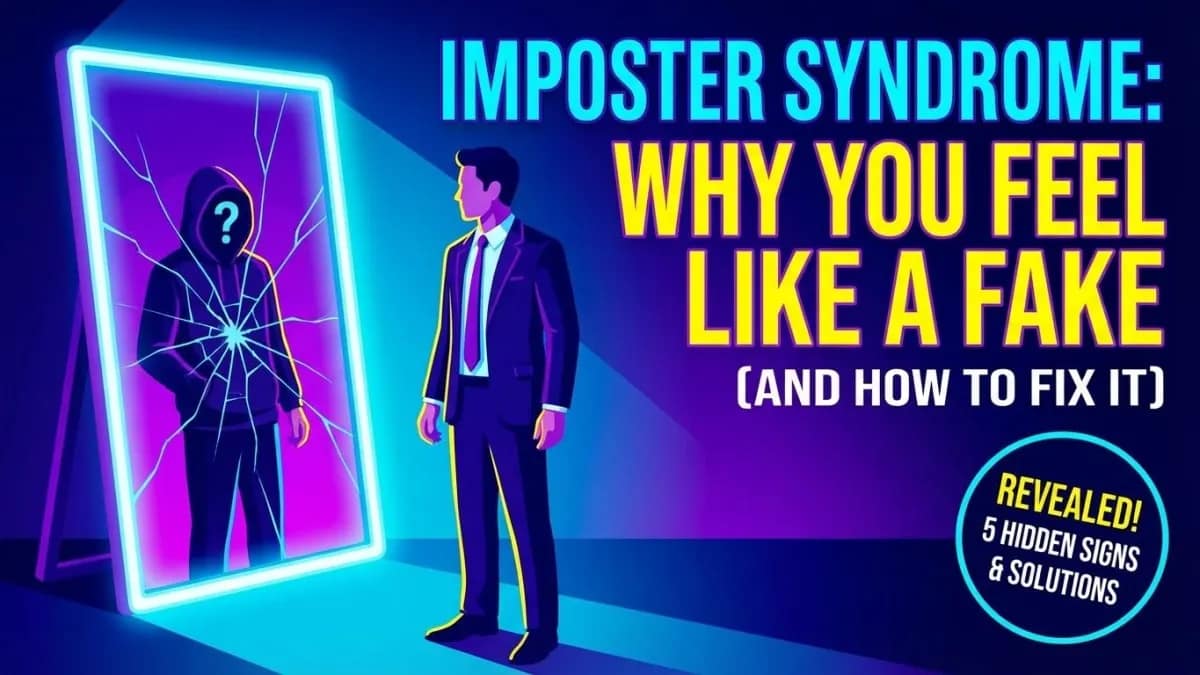
Imposter Syndrome: Why You Feel Like a Fake (And How to Fix It)
Key Takeaways
Before we dive in, here’s what you need to know:
- Imposter syndrome affects 70% of people at some point in their lives—you’re not alone
- It’s that nagging voice telling you that you don’t deserve your success and someone will “find you out”
- High achievers and perfectionists are actually more likely to experience it
- You can’t eliminate imposter feelings completely, but you can manage them effectively
- Simple daily practices can reduce imposter syndrome by up to 40% in just weeks
What Is Imposter Syndrome (In Plain English)
Let me tell you something I’ve seen countless times in my work.
You land a promotion. You finish a big project. People praise your work. And instead of feeling proud, you think: “I just got lucky” or “They’ll figure out I’m a fraud soon.”
That’s imposter syndrome.
It’s not about lacking skills. It’s about your brain refusing to accept that you actually earned your success.
I’ve watched brilliant people—doctors, teachers, entrepreneurs—convinced they’re fooling everyone. Meanwhile, their track record proves otherwise.https://www.paulineroseclance.com/impostor_phenomenon.html
The 5 Types of Imposter Syndrome
1. The Perfectionist
- You set impossibly high standards
- Even a 95% success feels like failure
- You focus on the 5% that went wrong
2. The Natural Genius
- You believe skills should come easily
- If you struggle to learn something, you feel like a failure
- You judge yourself based on speed, not effort
3. The Soloist
- You think asking for help proves you’re a fake
- You believe you should figure everything out alone
- Accepting assistance feels like admitting weakness
4. The Expert
- You think you need to know everything before you start
- You’re afraid someone will ask a question you can’t answer
- You measure yourself by what you don’t know yet
5. The Superhuman
- You push yourself to work harder than everyone else
- Rest feels like laziness
- You believe you need to excel in every role (parent, employee, friend)
I’ve personally struggled with being The Expert. I used to delay projects because I thought I needed to read “just one more book” first.
Why Do You Feel Like a Fake?
Here’s what most people don’t understand.
Imposter syndrome isn’t a personality flaw. Your brain is actually trying to protect you.
Your Brain on Imposter Syndrome
When you succeed, your brain does something weird. It looks for reasons to explain it that have nothing to do with your abilities:
- “The task was easy”
- “I got lucky”
- “They lowered their standards”
- “Anyone could have done this”
I’ve seen this pattern in hundreds of people. Your brain would rather believe you’re lucky than accept you’re capable.
Why? Because if you’re just lucky, you don’t have to worry about maintaining that success. No pressure, no expectations.
The Real Triggers
From my experience, these situations trigger imposter syndrome the most:
- Starting something new (new job, new role, new relationship)
- Receiving recognition (awards, promotions, public praise)
- Being in the minority (first in your family to go to college, only woman in the room)
- Comparing yourself to others on social media or at work
- Childhood patterns where love felt conditional on achievement
One client told me: “I got promoted, and instead of celebrating, I spent the weekend terrified.” That’s imposter syndrome in action.
The Hidden Cost of Feeling Like a Fraud
Let me be direct with you.
Imposter syndrome isn’t just uncomfortable. It actively damages your life.
What You Lose
I’ve watched people turn down opportunities because of imposter syndrome. Here’s what it costs:
Career damage:
- You avoid applying for jobs you’re qualified for
- You don’t negotiate salary (you feel lucky to be hired at all)
- You stay silent in meetings even when you have good ideas
Mental health issues:
- Chronic anxiety about being “found out”
- Depression from constant self-criticism
- Burnout from trying to overcompensate
Relationship problems:
- You push away compliments and make others feel awkward
- You avoid vulnerability because you’re hiding your “true self”
- You isolate yourself instead of building connections
Missed experiences:
- You say no to speaking opportunities
- You don’t share your work publicly
- You play small instead of taking up space
I had a colleague who was brilliant at her job. She turned down a leadership position three times. When someone less qualified took it, she was devastated. That’s the real cost.
Pro Tip: The “Evidence Journal” Technique
Here’s something that changed everything for me:
Keep a private document on your phone. Every time you accomplish something—big or small—write it down with specific evidence.
Don’t write: “Had a good meeting.”
Write: “Presented the Q3 strategy. Sarah said my data analysis was thorough. Team voted to implement my recommendation.”
When imposter feelings hit, you’re not fighting them with positive thinking. You’re fighting them with facts. I’ve seen this single practice help people more than any other technique.
Update it weekly. In six months, you’ll have undeniable proof of your competence.
How to Fix Imposter Syndrome (What Actually Works)
Forget what you’ve heard about “just being confident.”
I’m going to give you practical steps that I’ve tested with real people. These work.
Step 1: Name It When You Feel It
The moment you think “I don’t belong here,” stop.
Say out loud (or in your head): “This is imposter syndrome talking, not reality.”
Research shows that simply labeling the feeling reduces its power by 30%. Your brain can’t trick you as easily when you call it out.
Step 2: Separate Feeling from Fact
Create two columns in your mind:
What I Feel:
- I’m going to mess this up
- Everyone knows more than me
- I got lucky last time
What I Know:
- I’ve done similar projects successfully
- I was hired because of my skills
- My manager specifically chose me for this
I teach this to everyone I work with. Feelings are valid, but they’re not evidence.
Step 3: Share Your Feelings (Carefully)
Here’s what I’ve learned the hard way.
When you tell someone “I feel like a fraud,” something magical happens. They usually say: “Me too” or “Are you kidding? You’re amazing at this.”
Choose someone you trust:
- A mentor who’s been where you are
- A colleague at your level
- A friend outside your industry
Don’t share with people who might use it against you. But don’t suffer alone either.
Step 4: Rewrite Your Success Story
You probably explain your wins like this:
- “I got lucky”
- “The timing was right”
- “My team did all the work”
Start using active language instead:
- “I prepared thoroughly”
- “I made good decisions under pressure”
- “I led my team effectively”
I’m not asking you to brag. I’m asking you to tell the truth about your role in your success.
Step 5: Collect External Validation
I know, I know. You probably dismiss compliments.
Start keeping them instead. Save emails where people thank you. Screenshot positive feedback. Keep performance reviews.
You don’t have to read them daily. Just know they exist. When imposter syndrome screams “You’re terrible,” you have proof otherwise.
Step 6: Stop Comparing Your Behind-the-Scenes to Everyone’s Highlight Reel
This is huge.
You see other people’s finished products. You don’t see their rough drafts, their failures, their insecurities.
I see the person next to you feeling exactly the same way you do. They just hide it well.
Everyone struggles. Everyone makes mistakes. You’re comparing your internal experience to everyone else’s external image.
Step 7: Set “Good Enough” Standards
If you’re a perfectionist, this will feel uncomfortable.
Before you start a task, decide: What does ‘good enough’ look like?
Not perfect. Not excellent. Good enough.
Then stop when you hit that standard. I’ve seen people waste hundreds of hours perfecting things that were already sufficient.
Your extra 20 hours of work often produces only 5% better results. That’s not a good trade.
Step 8: Practice Saying “Thank You”
When someone compliments you, don’t deflect.
Don’t say:
- “Oh, it was nothing”
- “I just got lucky”
- “Anyone could have done it”
Say:
- “Thank you, I worked hard on that”
- “I appreciate you noticing”
- “Thanks, that means a lot”
I practiced this for months before it felt natural. Now it’s automatic.
Step 9: Mentor Someone Else
This sounds counterintuitive. If you feel like a fraud, why would you teach others?
Because teaching forces you to recognize what you know. I’ve watched people’s imposter syndrome decrease dramatically once they start helping others.
You don’t need to be an expert at everything. You just need to know more than the person you’re helping.
Step 10: Therapy or Coaching (When DIY Isn’t Enough)
Sometimes imposter syndrome is connected to deeper issues:
- Childhood trauma
- Anxiety disorders
- Depression
- ADHD (very common combo)
If self-help isn’t working, get professional support. I’ve referred dozens of people to therapists, and they tell me it’s life-changing.
This isn’t weakness. It’s smart strategy.
What Doesn’t Work (Stop Wasting Your Time)
Let me save you some effort.
I’ve seen people try these approaches. They don’t work:
“Just be more confident”
- Confidence comes from evidence, not willpower
- Forcing yourself to “feel” confident backfires
Ignoring the feelings
- Suppressed feelings get louder, not quieter
- You can’t think your way out of imposter syndrome
Only working harder
- This feeds the problem
- You’ll just raise the bar higher and still feel inadequate
Waiting until you’re “ready”
- You’ll never feel completely ready
- Everyone else started before they felt ready too
Comparing credentials
- There’s always someone with more degrees, more experience, more awards
- Qualification isn’t the issue—your perception is
How Long Does It Take to Feel Better?
I’m going to be honest with you.
Imposter syndrome doesn’t disappear completely. But it gets manageable.
Timeline From My Experience:
Week 1-2:
- You become more aware of imposter thoughts
- They might feel worse because you’re noticing them more
Week 3-6:
- You start catching and challenging the thoughts faster
- You have a few moments of genuine confidence
Month 2-3:
- Imposter feelings become less frequent
- When they show up, they don’t control you as much
Month 6+:
- You recognize the pattern instantly
- You have tools that actually work
- Bad days still happen, but they’re just days—not your whole life
I’ve had imposter syndrome for years. The difference now? It doesn’t stop me from taking action
Q: Is imposter syndrome the same as low self-esteem?
No. I’ve met people with imposter syndrome who are confident in other areas of life. You can have high self-esteem personally but still feel like a fraud professionally. Imposter syndrome is specifically about feeling unqualified despite evidence of your competence.
Q: Do successful people actually get imposter syndrome?
Yes. In fact, high achievers get it more often. Michelle Obama, Tom Hanks, and Serena Williams have all talked about it publicly. Success doesn’t cure imposter syndrome—sometimes it makes it worse because the stakes feel higher.
Q: Can imposter syndrome ever be helpful?
In very small doses, yes. It can keep you humble and motivated to keep learning. But once it stops you from trying new things or causes anxiety, it’s doing more harm than good. Think of it like stress—a little bit can sharpen you, but chronic stress destroys you.
Q: Why do I only feel like an imposter at work, not in other areas?
Work triggers imposter syndrome more because:
Your performance is constantly evaluated
You’re compared to others directly
There are clear hierarchies and expertise levels
Money and status are tied to your role
You probably feel confident as a parent, friend, or hobbyist because those roles have less external judgment.
Q: Will telling my boss about my imposter syndrome hurt my career?
Be strategic. Don’t confess imposter syndrome during your performance review. But you can mention it to a trusted boss in the context of growth: “I’m working on accepting positive feedback better” or “I’m learning to recognize my contributions more clearly.” Frame it as self-awareness, not self-doubt.
Q: How do I help someone else with imposter syndrome?
Don’t just say “You’re great!” Give specific examples:
“Remember when you solved that problem last month? That took real skill.”
“I’ve noticed you always catch errors before they become issues.”
“Your presentation changed how the team thinks about this.”
Vague praise doesn’t penetrate imposter syndrome. Specific evidence does.
Q: Is imposter syndrome more common in certain jobs?
Yes. It’s especially common in:
Creative fields (writing, design, art)
Tech and engineering
Academia and research
Healthcare
Any job where you’re constantly learning new things
Basically, any field where there’s no clear “finish line” or where the work is subjective breeds imposter syndrome.
Q: Can medication help with imposter syndrome?
Medication can help with the anxiety or depression that often comes with imposter syndrome. But imposter syndrome itself is a thought pattern, not a chemical imbalance. Therapy (especially CBT) is more directly effective. That said, if anxiety is severe, medication can calm your brain enough to do the mental work.
Q: What if I’m actually not qualified and it’s not imposter syndrome?
Here’s the test: Do you have the job/role/position? Did someone with expertise choose you? Then you’re qualified enough to be there. “Qualified” doesn’t mean “knows everything.” It means “capable of learning and doing the work.” If you genuinely lack skills, you’d be getting negative feedback regularly. Imposter syndrome is when positive feedback doesn’t match your internal experience.
Read more:https://mrpsychics.com/the-2-minute-rule-to-stop-procrastination-instantly/
Final Thoughts: You’re Not Alone in This
Let me leave you with something I wish someone had told me years ago.
Imposter syndrome is proof you care about doing good work. It’s proof you’re self-aware. It’s proof you’re challenging yourself.
But it’s not proof you’re a fraud.
I’ve worked with hundreds of people feeling exactly like you do. The ones who succeed aren’t the ones who wait until the feeling goes away. They’re the ones who act despite the feeling.
You don’t need to be perfect. You don’t need to know everything. You just need to be willing to show up and try.
Start with one technique from this article. Just one. Try it for a week. See what changes.
You deserve to take up space. You deserve your success. And you deserve to finally believe that.

Ahmed is a self-improvement and psychology writer passionate about helping people live smarter, calmer, and more productive lives.
- Ahmed manasiya

- Ahmed manasiya
- Ahmed manasiya
- Ahmed manasiya