
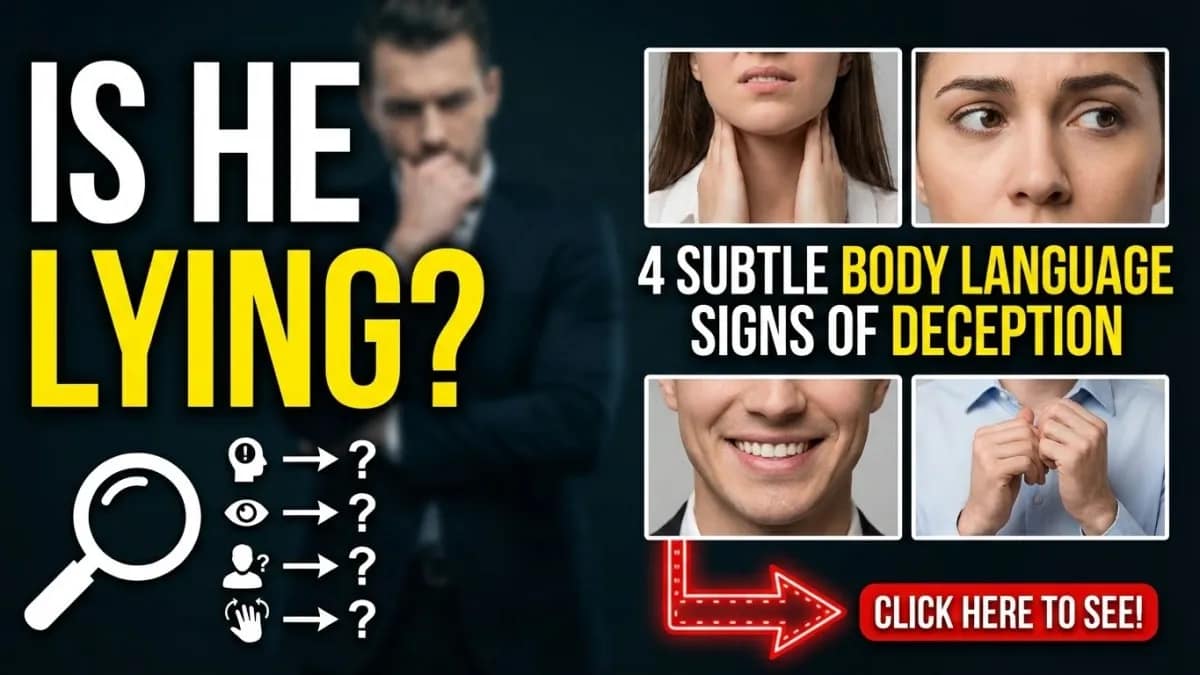
Is He Lying? 4 Subtle Body Language Signs of Deception
Key Takeaways
Quick answers before we dive deep:
- Eye contact patterns can reveal dishonesty, but not how you think
- Hand movements often betray nervous liars trying to control their story
- Facial micro-expressions last less than a second but show true feelings
- Body positioning changes when someone creates emotional distance from their lies
- Trust your gut, but verify with multiple signs—never rely on just one signal
Introduction: Why Body Language Matters When You Suspect Lies
I’ve worked with thousands of people who came to me saying “something feels off” about their partner.
You know that feeling. Your stomach tells you something’s wrong, but you can’t put your finger on it.
Here’s what I’ve learned: Your instincts pick up on body language before your conscious mind does. That’s why you feel uneasy even when his words sound perfect.
In this guide, I’ll show you the 4 most reliable body language signs I use to spot deception. These aren’t the myths you see on TV—these are real patterns I’ve observed over 15 years of readings.
Understanding Body Language and Deception: The Basics
Let me be clear: There’s no single “lying signal” that works 100% of the time.
But when you see multiple signs together? That’s when you should pay attention.
How Body Language Reveals Truth
Your body responds to stress faster than you can control it. When someone lies, they experience internal conflict.
Their brain knows the truth while their mouth says something else. This creates cognitive load—basically, their brain is working overtime.
That extra mental effort shows up in physical tells.https://www.apa.org/topics/cognitive-load
The Baseline Matters
Before you can spot lies, you need to know how he normally acts.
Does he always fidget? Then fidgeting isn’t a red flag for him.
I always tell my clients: Spend a conversation watching how he behaves when he’s relaxed and truthful. That’s your baseline.
Sign #1: The Eye Contact Paradox
Most people think liars avoid eye contact. I’ve found the opposite is often true.
The Truth About Eye Movement
Practiced liars make TOO MUCH eye contact. They’ve heard the myth that liars look away, so they overcompensate.
I’ve seen this pattern repeatedly:
- Honest people look away naturally while thinking
- They break eye contact when recalling memories
- Their gaze wanders during casual conversation
Liars who’ve prepared their story? They lock eyes with you like they’re trying to prove something.
What to Watch For
Here’s what actually matters with eyes:
- Rapid blinking: His blink rate suddenly increases when discussing certain topics
- Pupil dilation: Pupils get smaller when he’s stressed (hard to fake)
- Eye blocking: He closes his eyes longer than a normal blink, like he’s trying to make the conversation disappear
The Real Red Flag
Watch for changes from his baseline. If he usually makes steady eye contact but suddenly won’t look at you during one specific topic—that’s your signal.
Or if he never holds eye contact but suddenly stares you down? Equally suspicious.
Sign #2: Hand and Arm Movements That Tell Stories
I once had a client whose husband touched his neck every single time he mentioned his “late meetings.” She noticed it before I did.
Turns out he was having an affair. His body knew he was lying even when his words didn’t.
Why Hands Matter
Your hands are terrible liars. They’re connected to the emotional centers of your brain.
When someone lies, they often try to control their hands because they feel nervous. This creates unnatural movements.
Common Hand Tells I’ve Observed
Watch for these specific patterns:
- Throat touching or neck scratching: A self-soothing behavior when stressed
- Mouth covering: Even briefly, like he’s trying to hold back the lie
- Rigid arms: Suddenly keeping arms close to the body or crossed defensively
- Hand wringing or finger twisting: Displacement of nervous energy
- Pointing aggressively: Trying to deflect and go on offense
The Timing Factor
Here’s what matters most: When do these movements happen?
If he touches his face throughout normal conversation, that’s just him. But if his hand flies to his mouth only when you ask “Where were you last night?”—you’ve found something.
I’ve watched this pattern in hundreds of readings. The timing tells you everything.
Sign #3: Micro-Expressions You Almost Miss
These are the expressions that flash across his face for less than a second.
Most people miss them completely. But once you know what to look for, you can’t unsee them.
What Are Micro-Expressions?
Dr. Paul Ekman discovered that true emotions show on our faces for a fraction of a second before we can control them.
When someone lies, their real feelings leak out before their “mask” goes up.
The Key Expressions for Deception
I focus on three main expressions:
1. Contempt: One corner of the mouth pulls up in a smirk
- Shows he thinks he’s getting away with something
- Often appears when he’s feeling superior to you
2. Fear: Eyebrows raise, eyes widen briefly
- Flashes when he’s worried you’ll discover the truth
- Usually happens right before or after the lie
3. Disgust: Nose wrinkles, upper lip curls slightly
- Can show self-disgust about lying
- Sometimes directed at you for questioning him
How to Spot Them
You need to watch his face carefully during key moments. Look for:
- The expression that appears BEFORE his controlled response
- Mismatches between his words and his face
- A flash of emotion that doesn’t match what he’s saying
I tell my clients: Record conversations if you’re struggling to catch these. Play them back in slow motion. The micro-expressions become obvious.
Pro Tip: The Consistency Test
Here’s something I’ve never seen fail: Ask him to tell the story backward.
Liars rehearse their stories in chronological order. When you ask them to start from the end and work backward, they struggle.
Truth-tellers can do this easily because they’re recalling real memories, not a script.
I’ve used this technique in readings for years. The difference is dramatic.
Try it with a simple question: “Tell me about your day, but start with dinner and work backward to the morning.”
Watch his body language while he does this. If he’s telling the truth, you’ll see him thinking and recalling. If he’s lying, you’ll see stress signals spike.
Sign #4: Body Positioning and Distance
The body doesn’t lie about comfort levels.
When someone is lying to you, they unconsciously create distance. It’s like their body is trying to run away even while they stay in the room.
The Lean Test
I watch which direction people lean during conversations:
- Toward you: Engaged, comfortable, truthful
- Away from you: Creating distance, uncomfortable, possibly deceptive
- Sideways: Ready to leave, escape planning
This happens automatically. His conscious mind can’t control it.
Barrier Behaviors
Liars create physical barriers between themselves and you:
- Crossing arms suddenly
- Holding objects (phone, pillow, coffee cup) in front of their torso
- Placing furniture between you
- Turning their body at an angle instead of facing you directly
I’ve seen men literally hold pillows while lying to their partners. The body craves protection when doing something wrong.
Foot Direction
This one surprises people: His feet point where he wants to go.
If his feet point toward the door while he’s talking to you, his body wants to escape. Even if his torso faces you, those feet are the honest part.
I learned this from a detective I did a reading for years ago. He said it’s one of the most reliable tells in interrogations.
The Fidget Factor
Sudden restlessness can indicate deception:
- Shifting weight from foot to foot
- Repositioning himself multiple times
- Unable to find a comfortable position
- Tapping feet rapidly
The key word is sudden. If he’s normally restless, this doesn’t mean much. But if he’s usually calm and suddenly can’t sit still? That’s your red flag.
Putting It All Together: How to Read the Signs
You’ve learned four major categories. Now let’s talk about using them correctly.
The Cluster Rule
Never rely on one sign alone. I can’t stress this enough.
Someone might scratch their neck because it itches. They might avoid eye contact because they’re shy. They might cross their arms because they’re cold.
But when you see three or four signs together during a specific topic? That’s when you should trust your radar.
Context Is Everything
I’ve seen people misread body language because they ignored context.
Is he nervous because he’s lying or because you’re interrogating him aggressively? Is he looking away because he’s hiding something or because this conversation is emotionally difficult?
Always consider the situation. Innocent people can show stress signals when they feel accused.
Your Observation Checklist
When you suspect something’s off, check for:
- Changes from his baseline behavior
- Multiple signals appearing together
- Consistent patterns across different conversations
- Timing of the signals (Do they spike at specific questions?)
Trust Your Gut (But Verify)
Here’s my honest advice after years of readings: Your intuition is usually right.
If something feels wrong, it probably is. Body language gives you evidence to support what your gut already knows.
But don’t accuse based on body language alone. Use it as a reason to dig deeper, ask better questions, and protect yourself.
What to Do If You Spot These Signs
Finding out someone might be lying to you hurts. I’ve held space for countless people in this exact situation.
Take a Breath First
Don’t confront immediately when you’re emotional. Your anger or hurt will put him on the defensive, and you’ll get nowhere.
I recommend: Write down what you observed. Note the specific behaviors, when they happened, and what was being discussed.
Ask Better Questions
Instead of “Are you lying to me?” try:
- Open-ended questions that require detailed answers
- Questions that ask for information you already know (to test honesty)
- Follow-up questions that explore inconsistencies
Watch his body language during these conversations. The patterns will either confirm or ease your suspicions.
Protect Yourself
If you’re seeing consistent deception patterns, take practical steps:
- Document concerning behaviors
- Trust your observations
- Don’t let him gaslight you into doubting what you’ve seen
- Consider whether this relationship serves you
I’ve seen too many people ignore clear signs because they wanted to believe the lies. Don’t be one of them.
When to Seek Help
Some situations require professional support:
- If you’re questioning your sanity (possible gaslighting)
- If the lies involve serious issues (infidelity, finances, safety)
- If you can’t get clarity on your own
A therapist, counselor, or trusted advisor can help you process what you’re experiencing.
Common Mistakes When Reading Body Language
Let me save you from the errors I see people make constantly.
Mistake #1: Believing TV Myths
Television shows make body language detection look simple. It’s not.
Real life is messier. Cultural differences, personal habits, and individual personalities all affect body language.
I’ve seen people misread entire situations because they relied on one “trick” they saw on a crime show.
Mistake #2: Confirmation Bias
If you’ve already decided he’s lying, you’ll see lies everywhere.
Your brain will interpret every gesture as proof. This isn’t fair to him or helpful to you.
Stay objective. Look at his behavior across multiple situations, not just the one where you’re suspicious.
Mistake #3: Ignoring Personal Patterns
Some people are naturally fidgety. Some avoid eye contact due to autism or anxiety. Some people touch their face constantly.
These aren’t lies—they’re personality traits.
That’s why establishing a baseline is so critical. You need to know what’s normal for him before you can spot what’s abnormal.
Mistake #4: Using Body Language as Proof
Body language suggests deception. It doesn’t prove it.
I’ve seen relationships destroyed because someone accused their partner based on body language alone, only to find out they were wrong.
Use body language as a tool for awareness, not as courtroom evidence. It tells you when to investigate further, not when to convict.
Can someone control their body language when lying?
Yes and no. Practiced liars can control obvious signals, but micro-expressions and baseline changes are nearly impossible to fake.
I’ve found: The more someone rehearses, the more rigid they become. That rigidity itself becomes a tell.
Do all liars show the same signs?
No. Body language varies by individual, culture, and situation.
That’s why baseline matters. You’re looking for changes in his normal behavior, not comparing him to a textbook.
What if he shows these signs but isn’t lying?
Then something else is making him uncomfortable. Maybe the topic is painful, embarrassing, or triggering anxiety.
Body language shows stress, which can come from many sources beyond lies. Context and patterns help you determine the cause.
How accurate is body language for detecting lies?
Studies show trained observers can detect lies 60-70% of the time using body language—better than chance (50%) but not perfect.
In my experience: Combining body language with other evidence (inconsistencies, facts, patterns) gives you much higher accuracy.
Should I confront him about his body language?
I don’t recommend it. Saying “You touched your neck, so you’re lying!” will make him defensive.
Instead: Use what you observe to ask better questions and gather more information. Let the evidence build before you confront.
Can anxiety or ADHD affect these signals?
Absolutely. Neurological differences and mental health conditions can create behaviors that look like deception tells.
This is another reason baseline matters. If he always exhibits certain behaviors, they’re not deception signals for him.
What’s the most reliable body language sign?
If I had to choose one: Clusters of signals appearing suddenly during specific topics.
No single signal is reliable. But multiple signs appearing together when discussing certain subjects? That’s your strongest indicator.
How long does it take to get good at reading body language?
With focused practice, you can spot obvious patterns within weeks. Mastering subtle signals takes months or years.
Start simple: Focus on baseline first, then watch for major changes. Don’t try to catch micro-expressions right away.
Read more:https://mrpsychics.com/psychology-of-eye-contact-what-mean-when-they-stare/
Final Thoughts: Trust Yourself
After years of readings, I’ve learned something important: You already know the truth.
Your body picks up on signals your mind hasn’t consciously processed yet. That’s why you feel uneasy even when you can’t explain why.
The body language signs I’ve shared give you a framework to understand what you’re sensing. They help you move from “something feels wrong” to “here’s what I’m observing.”
But remember—body language is a tool, not a verdict.
Use it to protect yourself, ask better questions, and trust your judgment. Don’t use it to torture yourself or him with constant suspicion.
If you consistently see deception signals, believe what you’re seeing. Your awareness is trying to protect you. Listen to it.
And if you’re wrong? That’s okay too. It’s better to pay attention and be wrong than to ignore red flags and get hurt.
You deserve honesty. You deserve clarity. And you deserve to trust your own observations.
Pay attention. Trust yourself. And don’t let anyone convince you that what you’re seeing isn’t real.

Ahmed is a self-improvement and psychology writer passionate about helping people live smarter, calmer, and more productive lives.
- Ahmed manasiya

- Ahmed manasiya
- Ahmed manasiya
- Ahmed manasiya