
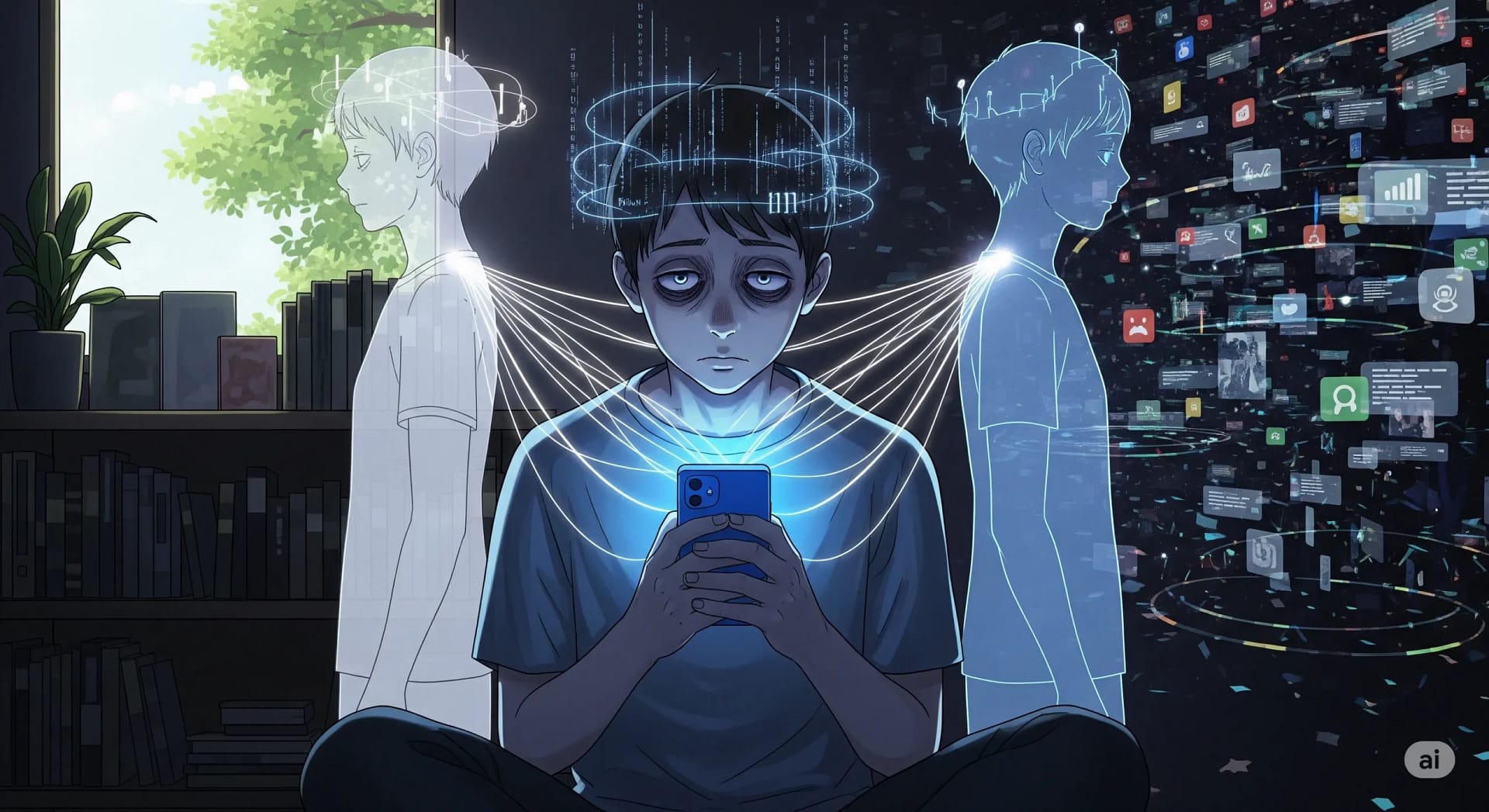
Your phone buzzes. Without thinking, you grab it.
Just checking, you tell yourself. One quick glance at that notification, maybe scroll through Instagram for a minute, then back to work.
Two hours later, you’re watching TikToks about cats who look like celebrities, wondering where the hell your afternoon went.
This isn’t a lack of willpower. This is your brain being hijacked.
Every tap, swipe, and notification is literally rewiring your neural pathways. Tech companies employ neuroscientists and behavioral psychologists to design apps that exploit your brain’s reward system—the same system that gets people hooked on cocaine.
Your phone isn’t just changing how you think. It’s changing how your brain works.
The Dopamine Hijack: Why Your Brain Can’t Resist
Let me explain what’s happening inside your skull every time you check your phone.
Your brain runs on dopamine—the “motivation molecule” that drives you to seek rewards. Every time you get a like, a comment, or even just see that little red notification badge, your brain releases a hit of dopamine.
But here’s the kicker: You don’t get dopamine from the reward itself. You get it from anticipating the reward.
That notification sound? Your brain releases dopamine before you even see what it is. The possibility of something good—a funny meme, validation from a friend, breaking news—floods your system with motivation to check.
This is intermittent reinforcement—the most addictive reward schedule known to psychology. It’s the same mechanism that makes gambling so addictive. Sometimes you get something good, sometimes you don’t. Your brain becomes obsessed with pulling that slot machine lever.
Social media platforms have perfected this system. They’re literally using casino psychology on your brain.
How Your Brain is Being Rewired (The Science Will Shock You)
Recent studies show just 72 hours of smartphone restriction can alter brain activity in dopamine and serotonin regions. That’s how fast your brain adapts to digital stimulation.
But when you’re constantly plugged in, here’s what’s happening:
1. Your Attention Span is Shrinking
Our attention spans have dropped from 12 seconds in 2000 to just 8 seconds today. That’s shorter than a goldfish.
Every notification fractures your focus. Even when you don’t respond to the ping, your brain starts generating “task-irrelevant thoughts”—wondering what that notification was about.
The brutal truth: Heavy social media users perform worse on cognitive tasks than moderate users. Your brain is literally losing its ability to sustain attention.
2. Your Memory System is Breaking Down
Why remember facts when you can Google them? Your brain is adapting by remembering where to find information instead of the information itself.
This isn’t just convenience—it’s cognitive outsourcing. Your brain is becoming dependent on external devices for basic memory functions.
3. Your Reward System is Broken
Constant dopamine hits from phones create what scientists call “dopamine deficit state”. Your brain downregulates dopamine receptors to cope with the flood, making you less able to experience pleasure from normal activities.
You need bigger and bigger digital hits to feel the same satisfaction. Meanwhile, real-world pleasures—conversations, nature, books—start feeling boring.
4. Your Brain Structure is Actually Changing
Heavy smartphone use reduces gray matter in the prefrontal cortex—the area responsible for decision-making and impulse control. You’re literally losing brain tissue in regions that help you make good choices.
The anterior cingulate cortex, involved in emotional regulation, also shrinks with excessive screen time. This makes you more susceptible to addiction and less able to manage emotions.
Scientists have found that excessive phone users show brain patterns similar to drug addicts.
The Notification Trap: How Your Brain Gets Hijacked
The average person checks their phone 96 times per day—once every 10 minutes. Most of the time, you don’t even realize you’re doing it.
Here’s why you can’t stop:
Phantom vibration syndrome: Your brain becomes so conditioned to expect notifications that you feel your phone buzzing when it isn’t.
Attentional residue: Even after putting your phone down, part of your brain keeps thinking about it. Just having your phone nearby reduces cognitive performance—even when it’s turned off.
FOMO-driven checking: Your brain interprets not knowing what’s happening as a potential threat. The uncertainty creates anxiety that only gets relieved by checking.
The Multitasking Myth That’s Destroying Your Brain
Multitasking is a lie. Your brain doesn’t multitask—it rapidly switches between tasks, and each switch has a cognitive cost.
When you’re trying to work while getting notifications, your brain is constantly interrupted. Studies show it can take up to 23 minutes to fully refocus after an interruption.
Heavy media multitaskers show:
- Worse performance on attention tasks
- Increased stress and frustration
- Shrinkage in areas responsible for maintaining attention
You think you’re being productive. You’re actually frying your brain’s ability to focus.
Social Media: The Digital Slot Machine
Social media platforms use every psychological trick in the book to keep you scrolling:
Variable ratio reinforcement: You never know when you’ll get a like or comment. This uncertainty keeps you checking constantly.
Social validation feedback loops: Every like triggers dopamine. You start chasing those hits like a drug.
FOMO and social comparison: Perfectly curated feeds make you feel like everyone else is living better lives, driving more engagement.
Infinite scroll: No natural stopping point means you can scroll forever without realizing how much time you’ve lost.
These aren’t bugs—they’re features. The goal is to maximize “time on platform” regardless of the cost to your mental health.
The Real Cost: What Digital Addiction is Stealing From You
Sleep destruction: Blue light from screens suppresses melatonin production. You stay up later, sleep worse, wake up tired.
Relationship damage: Face-to-face interactions release different neurochemicals than digital ones. Social media can’t replace real human connection.
Creativity death: Your brain needs boredom to generate creative insights. Constant stimulation kills the “aha!” moments that happen during mental downtime.
Decision fatigue: Every scroll, click, and swipe requires a micro-decision. By the end of the day, your decision-making capacity is fried.
Depression and anxiety: Heavy social media use is strongly linked to increased rates of depression, especially in teens and young adults.
How to Reclaim Your Brain (Digital Detox That Actually Works)
The good news: Your brain can recover. Neuroplasticity works both ways.
Immediate Actions:
Turn off all non-essential notifications. Your brain doesn’t need to know every time someone likes your photo from 2019.
Use grayscale mode. Removing color makes your phone less visually stimulating and reduces compulsive checking.
Create phone-free zones: Bedroom, dining table, first hour of the morning. Let your brain remember what it feels like to exist without digital stimulation.
Use app timers and restrictions. Most phones have built-in controls. Use them.
The 30-Day Reset:
Week 1: Cut social media usage by 50%. Notice the withdrawal feelings—anxiety, boredom, FOMO. This is your dopamine system recalibrating.
Week 2: Add analog activities. Read physical books, have phone-free conversations, take walks without podcasts. Your brain needs to remember non-digital rewards.
Week 3: Implement “batch processing” for digital tasks. Check email twice daily, not constantly. Same with social media.
Week 4: Notice the changes. Better sleep, improved focus, less anxiety. Your brain is healing itself.
Long-term Brain Protection:
Morning routine without phones: Give your brain 30-60 minutes of phone-free time after waking. This sets the tone for better focus all day.
Single-tasking practice: Do one thing at a time. When your brain starts craving stimulation, resist. You’re rebuilding focus muscles.
Regular digital sabbaths: 24 hours completely offline, weekly if possible. Your brain needs regular rest from digital stimulation.
Mindfulness training: Meditation literally rebuilds attention-related brain areas damaged by excessive screen time.
The Choice is Yours: Human or Cyborg?
Your phone is designed to be irresistible. Teams of PhD psychologists and data scientists work around the clock to make apps more addictive. They study your behavior, optimize for engagement, and profit from your attention.
You’re not weak for getting hooked. You’re human, and your brain is responding exactly as it evolved to.
But evolution didn’t prepare you for infinite scroll and intermittent reinforcement schedules. Your ancient reward system is being exploited by modern technology.
The question is: Do you want to be the user, or the used?
Every notification you turn off, every minute you spend phone-free, every time you choose real-world over digital—you’re literally rewiring your brain back to health.
Your attention is your life. Don’t let tech companies steal it from you.
The brain you save might be your own.
More:- 7 Thinking Patterns That Secretly Drain Your Energy
Ahmed Manasiya writes about psychology and digital wellness at MrPsychics.com. After spending years studying why smart people make terrible digital choices, he now helps others reclaim their attention and rewire their brains for focus. When he’s not writing, he’s probably reading a physical book with his phone in another room—and loving every minute of it.
What digital habit are you ready to break first? Share your biggest phone addiction struggle below—your honesty might be exactly what someone else needs to hear to start their own digital detox journey.
If this opened your eyes to what your phone is really doing to your brain, share it. Someone you care about is probably scrolling right now, wondering why they can’t focus anymore.

Ahmed is a self-improvement and psychology writer passionate about helping people live smarter, calmer, and more productive lives.
- Ahmed manasiya

- Ahmed manasiya
- Ahmed manasiya
- Ahmed manasiya