
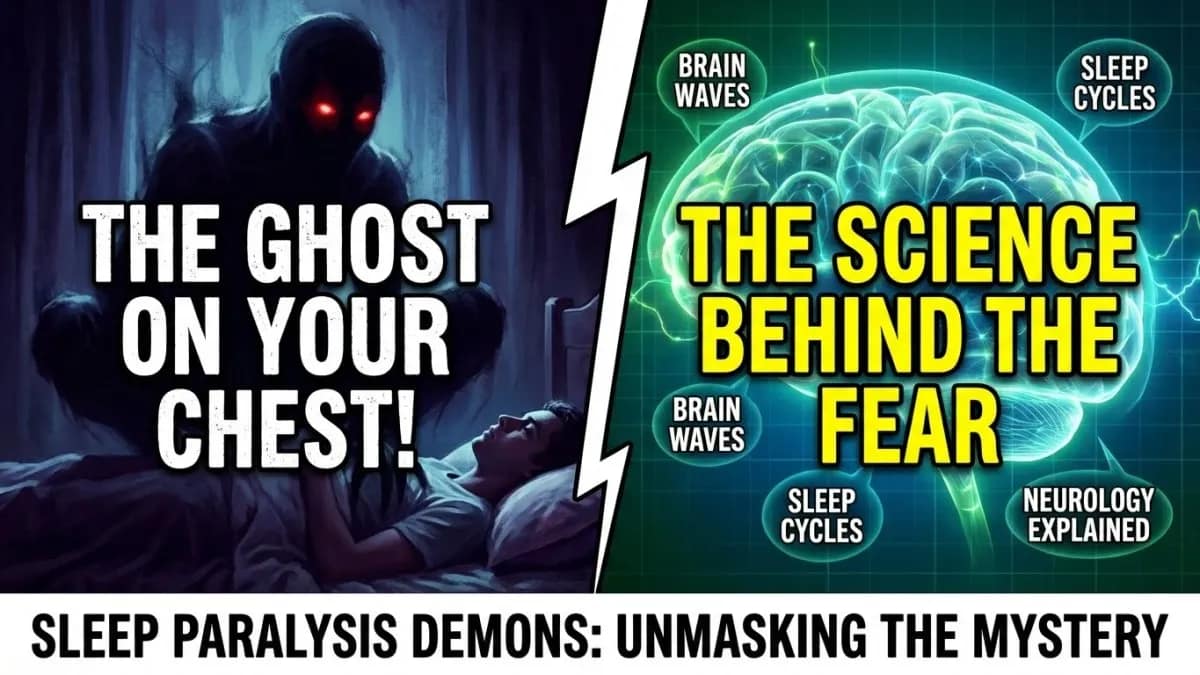
Sleep Paralysis Demons: The Science Behind the “Ghost” on Your Chest
Key Takeaways
What you need to know about sleep paralysis demons:
- Sleep paralysis happens when your brain wakes up but your body stays asleep
- The “demons” you see are hallucinations caused by your half-awake brain
- About 8% of people experience this at least once in their life
- It’s scary but completely harmless—you cannot die from sleep paralysis
- Stress, irregular sleep, and sleeping on your back make it more likely
Introduction: You’re Not Losing Your Mind
I’ve talked to hundreds of people who thought they were going crazy.
They wake up in the middle of the night. They can’t move. There’s a dark figure standing at the foot of their bed—or worse, sitting on their chest.
Some see old hags. Others see shadow people. A few see demons with red eyes.
Here’s what I tell them: You’re not being haunted. Your brain is playing tricks on you.
And science can explain exactly why.
What Is Sleep Paralysis?
Sleep paralysis is when you wake up but can’t move your body for a few seconds to a few minutes.
Your mind is awake. Your body is still asleep.
During normal sleep, your brain paralyzes your muscles so you don’t act out your dreams. This is called REM atonia.
But sometimes the timing gets messed up. You wake up before the paralysis wears off.
Common signs:
- Cannot move your arms, legs, or head
- Cannot speak or scream
- Feel pressure on your chest
- Sense that someone (or something) is in the room
- Feel intense fear or dread
- https://www.ninds.nih.gov/
Why Do People See “Demons”?
I’ve worked with clients who swear they saw the devil himself. But here’s what’s really happening.
When you’re in sleep paralysis, you’re stuck between waking and dreaming. Your brain is in a weird in-between state.
The Three Types of Hallucinations
1. Intruder Hallucinations
- You sense a threatening presence in the room
- You might see shadow figures or hear footsteps
- Your brain’s fear center (the amygdala) is overactive
2. Chest Pressure (Incubus Hallucinations)
- Feels like someone is sitting on you
- Hard to breathe
- This happens because your chest muscles are still paralyzed
3. Out-of-Body Experiences
- Feel like you’re floating
- Sense of falling or flying
- Your brain is confused about where your body is in space
Why Your Brain Creates Monsters
Your brain tries to explain what’s happening. It knows something is wrong.
You can’t move. You feel pressure. You’re terrified.
So your brain creates a story: “There must be something dangerous here.”
I’ve seen this pattern over and over. The “demon” is your brain’s attempt to make sense of a confusing physical experience.
The Cultural Connection
Here’s something fascinating: people around the world have reported sleep paralysis for centuries.
But they all describe it differently based on their culture.
Different cultures, same experience:
- Japan: Kanashibari—bound by invisible metal
- Egypt: The Jinn sitting on your chest
- Newfoundland: The “Old Hag” who visits at night
- Thailand: Phi Am—a ghost that holds you down
- Mexico: Se me subió el muerto (the dead climbed on me)
The experience is the same. The explanation changes based on what you believe.
If you grow up hearing stories about demons, you’ll see demons. If you hear about aliens, you might see aliens.
Your culture shapes your hallucination.
The Science: What’s Actually Happening in Your Brain
Let me break down what researchers have discovered.
The REM Sleep Connection
Sleep paralysis almost always happens during REM sleep (Rapid Eye Movement).
This is when you dream the most. Your brain is active but your body is shut down.
When you wake up too quickly from REM, your body doesn’t get the message to “turn back on.”
Brain Chemistry at Work
Scientists have found that sleep paralysis involves:
- Disrupted REM cycles that don’t transition smoothly
- Overactive amygdala (your fear center)
- Conflict between brain regions that control waking and sleeping
Your prefrontal cortex (logic center) is trying to wake up. But your pons (which paralyzes your muscles during REM) hasn’t released control yet.
It’s like two parts of your brain fighting for control.
Who Gets Sleep Paralysis?
I’ve noticed certain patterns in people who experience this more often.
You’re more likely to have sleep paralysis if you:
- Are between 15 and 35 years old
- Have irregular sleep schedules (shift workers, college students)
- Don’t get enough sleep regularly
- Sleep on your back
- Have high stress or anxiety
- Have a mental health condition like PTSD or panic disorder
- Have narcolepsy or other sleep disorders
- Use certain medications or substances
About 8% of the general population experiences sleep paralysis at least once. But for some groups, it’s much higher:
- 28% of students report it
- 35% of people with panic disorder experience it
- Up to 60% of narcolepsy patients deal with it regularly
Pro Tip: The “Wiggle Your Toe” Technique
Here’s something I teach everyone who struggles with sleep paralysis:
Don’t try to move your whole body. Focus on one small part.
When you realize you’re in sleep paralysis:
- Stay calm (easier said than done, I know)
- Focus all your energy on wiggling one toe or one finger
- Once you get that tiny movement, the rest of your body follows
I’ve had clients tell me this changed everything for them. Instead of panicking for minutes, they break out in seconds.
Also try: Hold your breath or change your breathing pattern. This sends a signal to your brain that something needs attention.
When Should You Worry?
Most sleep paralysis is harmless. Scary, yes. Dangerous, no.
But I tell people to see a doctor if:
- It happens multiple times per week
- You’re afraid to go to sleep because of it
- You feel extremely tired during the day (could be narcolepsy)
- It started after a head injury
- You have other symptoms like sudden muscle weakness when laughing or excited
Sleep paralysis itself won’t hurt you. But it might be a sign of a bigger sleep problem that needs treatment.
How to Prevent Sleep Paralysis
I’ve seen people almost completely stop their episodes by making a few changes.
What actually works:
Fix your sleep schedule
- Go to bed at the same time every night
- Wake up at the same time every morning (yes, even weekends)
- Get 7-9 hours of sleep
Change your sleep position
- Sleep on your side instead of your back
- Use pillows to keep yourself from rolling onto your back
Reduce stress
- Practice relaxation before bed (deep breathing, meditation)
- Write down worries before sleeping so they’re not bouncing around your head
- Exercise regularly (but not right before bed)
Avoid triggers
- Don’t use alcohol or drugs before bed
- Avoid heavy meals late at night
- Limit caffeine after 2 PM
- Reduce screen time before sleep
Create a better sleep environment
- Keep your bedroom cool (around 65-68°F)
- Use blackout curtains or an eye mask
- Remove electronics from the bedroom
- Use white noise if you’re sensitive to sounds
What to Do During an Episode
If you find yourself in sleep paralysis right now, here’s what helps:
Immediate steps:
- Remind yourself it’s temporary—it will end in seconds or minutes
- Don’t fight the paralysis—this makes the fear worse
- Focus on small movements (toe, finger, eyes, tongue)
- Control your breathing—slow, deep breaths calm your nervous system
- Try to relax into it—I know this sounds crazy, but fighting creates more panic
Some people find it helps to have a plan. Tell yourself: “If this happens, I’ll focus on my breathing and wiggle my toes.”
Having a strategy makes you feel less helpless.
Sleep Paralysis vs. Actual Medical Problems
I need to be clear about something: sleep paralysis is not a serious medical condition on its own.
But people sometimes confuse it with other things.
Sleep paralysis is NOT:
- A seizure (though they can look similar)
- A heart attack (even though your heart races)
- A stroke (you can move after it ends)
- An anxiety attack (though anxiety can trigger it)
How to tell the difference: Sleep paralysis always happens when falling asleep or waking up. It always involves paralysis. And you always fully recover within minutes.
If you have symptoms at other times, or if the paralysis doesn’t go away, call a doctor.
The Mind-Body Connection
Here’s what I’ve learned from years of working with people who experience this:
Your mental state affects your sleep paralysis.
When you’re stressed, anxious, or traumatized, your brain is on high alert. Your fear response is oversensitive.
This makes hallucinations more intense and more frightening.
I’ve had clients reduce their episodes by 80% just by:
- Starting therapy for anxiety
- Learning meditation techniques
- Processing traumatic experiences
- Getting their depression treated
Your mind and body aren’t separate. Taking care of your mental health takes care of your sleep.
Why Some People Have It Repeatedly
If you’re someone who gets sleep paralysis often, you might feel cursed.
But there are usually clear reasons why it keeps happening.
Common causes of frequent episodes:
- Chronic sleep deprivation—your brain is desperate for REM sleep
- Irregular schedule—shift work or constantly changing sleep times
- Untreated sleep apnea—interrupts your sleep cycles
- PTSD or trauma—keeps your brain in a hypervigilant state
- Genetic factors—sleep paralysis can run in families
The good news: most of these causes can be addressed.
I’ve worked with people who had sleep paralysis 5 times a week. After treating their sleep apnea or fixing their schedule, it dropped to once every few months.
Myths vs. Facts
Let me clear up some dangerous misinformation I see online.
MYTH: You can die from sleep paralysis FACT: No one has ever died from sleep paralysis itself. Your breathing continues automatically.
MYTH: Sleep paralysis means you’re being haunted FACT: It’s a well-documented medical phenomenon with clear biological causes.
MYTH: You need medication to stop it FACT: Most people improve with lifestyle changes alone. Medication is rarely needed.
MYTH: Sleep paralysis is rare FACT: About 1 in 12 people experience it. You’re not alone.
MYTH: It only happens to people with mental illness FACT: Healthy people get it too, especially with poor sleep habits.
Treatment Options That Actually Work
If lifestyle changes aren’t enough, here’s what doctors might recommend.
Medical treatments:
For frequent episodes:
- Antidepressants (SSRIs) can reduce REM sleep disruptions
- Treating underlying conditions (sleep apnea, narcolepsy)
- Cognitive Behavioral Therapy (CBT) for anxiety
For related sleep disorders:
- Sleep studies to check for apnea or other issues
- Medications for narcolepsy if diagnosed
- Treatment for restless leg syndrome
Most doctors start with the simplest fixes first. Medication is usually the last resort.
Living with Sleep Paralysis
If you’re dealing with this regularly, you need a support system.
What helps:
- Talk to people who understand (online communities exist)
- Educate your partner or roommate so they know what’s happening
- Keep a sleep diary to identify your triggers
- Don’t let fear of episodes ruin your sleep
I’ve seen people become so afraid of sleep paralysis that they develop insomnia. That makes everything worse.
The fear is often more disruptive than the episodes themselves.
The Bottom Line
Sleep paralysis demons aren’t real. But your experience is absolutely real.
Your brain is creating these visions because of a timing problem during sleep. It’s trying to protect you from a threat that doesn’t exist.
Remember:
- It’s temporary and harmless
- It happens to millions of people
- You can significantly reduce episodes with lifestyle changes
- Understanding what’s happening makes it less scary
I’ve seen countless people go from terrified to empowered once they understand the science.
Knowledge really does take away the fear.
Q: Can sleep paralysis hurt me or cause permanent damage?
No. Sleep paralysis is frightening but physically harmless. You cannot die from it and it doesn’t cause any lasting damage to your body or brain.
Q: Why do I only see scary things during sleep paralysis?
Your amygdala (fear center) is highly active during sleep paralysis. Your brain interprets the paralysis as a threat and creates frightening explanations. It’s almost impossible to have pleasant hallucinations because your fear response is in control.
Q: Is sleep paralysis the same as lucid dreaming?
No. In lucid dreaming, you know you’re dreaming and can often control the dream. In sleep paralysis, you’re awake but can’t move. Some people transition from sleep paralysis to lucid dreaming, but they’re different states.
Q: Can children get sleep paralysis?
Yes, but it’s less common in children than in teenagers and adults. If your child reports these symptoms, talk to their pediatrician. They might be having nightmares instead, which are different.
Q: Does sleeping on my back really make it more likely?
Yes. Studies show that sleeping on your back (supine position) significantly increases the chance of sleep paralysis. Try sleeping on your side if you experience frequent episodes.
Q: Are there any supplements that help prevent it?
There’s no magic supplement for sleep paralysis. However, magnesium and melatonin might help by improving overall sleep quality. Talk to your doctor before taking any supplements.
Q: Why does it feel like I’m being choked or crushed?
Your breathing muscles are partially paralyzed during REM sleep. When you’re aware of this paralysis, it feels like pressure on your chest or difficulty breathing. Your breathing is actually fine—it just feels restricted.
Q: Can sleep paralysis be a sign of something spiritual?
From a scientific perspective, sleep paralysis has clear biological causes. However, I respect that some people interpret their experiences through spiritual or cultural lenses. What matters most is that you find an explanation that helps you cope.
Q: Will it go away on its own?
For many people, sleep paralysis happens only a few times in their life and then stops. For others, it continues but becomes less frequent with age and better sleep habits. If it’s persistent, lifestyle changes usually help significantly.
Q: Should I wake my partner if I see them having sleep paralysis?
Yes, gentle touch or sound can help them wake fully and break the paralysis. Don’t shake them violently—just a light touch on the shoulder or saying their name usually works.
Read more:https://mrpsychics.com/why-do-we-forget-dreams-5-minutes-after-waking-up/

Ahmed is a self-improvement and psychology writer passionate about helping people live smarter, calmer, and more productive lives.
- Ahmed manasiya

- Ahmed manasiya
- Ahmed manasiya
- Ahmed manasiya