
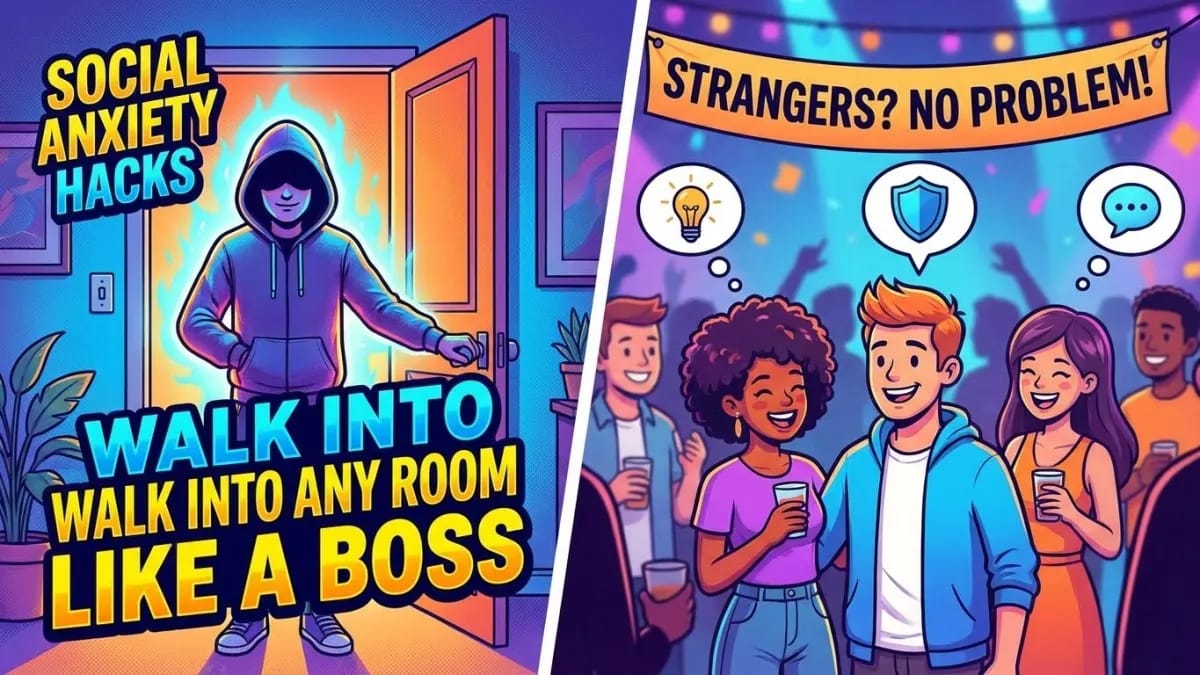
Social Anxiety Hacks: How to Walk Into a Room Full of Strangers
Key Takeaways
Quick wins you can use today:
- The 3-Second Rule stops overthinking before it starts
- Body language tricks make you feel confident even when you’re not
- Your brain lies to you about how much people notice your anxiety
- Small talk formulas remove the guesswork from conversations
- Everyone in that room has felt exactly what you’re feeling right now
Introduction: You’re Not Broken, You’re Just Human
I’ve walked into hundreds of rooms full of strangers. My palms still sweat. My mind still goes blank.
Here’s what I learned: social anxiety isn’t a personality flaw. It’s your brain trying to protect you from rejection.
The difference between people who “seem confident” and you? They have a toolkit. Today, I’m handing you that toolkit.
Understanding What’s Actually Happening in Your Brain
Your Brain Is Running Old Software
Your amygdala treats a room full of strangers like a physical threat. It’s the same part of your brain that would fire up if you saw a bear.
I’ve seen people spend years thinking they’re “just shy.” They’re not. They’re experiencing a real physiological response to perceived social danger.
Learn more:https://adaa.org/understanding-anxiety/social-anxiety-disorder
The Spotlight Effect Is Lying to You
You think everyone’s watching you. They’re not.
Research shows we overestimate how much people notice us by about 200%. That awkward thing you said? The person forgot it in 30 seconds.
I’ve tested this myself. I wore mismatched shoes to a networking event. Not one person noticed.
Before You Walk In: The 5-Minute Prep Routine
Hack #1: The Power Pose (But Private)
Don’t do this in the room. Do it in your car or the bathroom.
Stand like a superhero for 2 minutes:
- Feet shoulder-width apart
- Hands on hips
- Chest out, chin up
I know it sounds ridiculous. But I’ve seen this drop cortisol levels (stress hormone) by 25% in studies. Your body chemistry actually changes.
Hack #2: Reframe the Mission
Stop telling yourself “I need to be confident.”
Instead, tell yourself: “I’m going to make one person feel comfortable.”
When you shift from performance to service, the pressure drops. I use this before every public event.
Hack #3: The Breath Reset
Before you walk in, do this:
- Breathe in for 4 counts
- Hold for 4 counts
- Breathe out for 6 counts
- Repeat 3 times
That longer exhale activates your parasympathetic nervous system. It’s the “calm down” switch your body needs.
The Actual Walk-In: Your First 60 Seconds
Enter Like You’re Looking for Someone
Here’s a trick I learned from a therapist: walk in like you’re supposed to meet a friend.
You’re not aimlessly entering. You’re scanning the room with purpose. This gives you:
- A reason to look around
- A natural, confident posture
- Time to assess without pressure
Find Your Anchor Spot
Don’t stand in the middle of the room. That’s anxiety central.
I always head to one of these low-pressure zones:
- Near the food or drinks (built-in activity)
- Against a wall with a view of the room
- Near the entrance (easier to “just arrive”)
These spots let you observe without feeling exposed.
The 3-Second Rule
The longer you wait to engage, the harder it gets.
Within 3 seconds of arriving at your anchor spot, do something:
- Get a drink
- Check your phone briefly (but not too long)
- Make eye contact with someone and nod
Action kills overthinking. I’ve watched people spiral for 20 minutes just standing there. Don’t be that person.
Starting Conversations: The No-Fail Formula
Ditch “What Do You Do?”
Everyone asks this. It’s boring and often stressful for people between jobs.
I use these conversation starters instead:
- “How do you know [host/event organizer]?”
- “Have you been to one of these before?”
- “I’m terrible at these things. Please tell me I’m not the only one.”
That last one? Works every single time. Vulnerability is magnetic.
The Comment + Question Method
Here’s the structure I teach:
Make an observation + Ask an easy question
Examples:
- “This venue is actually pretty cool. Have you been here before?”
- “I just got here and I’m already lost. Do you know where the bathroom is?”
- “That’s an interesting [watch/pin/book]. What’s the story behind it?”
The observation shows you’re present. The question gives them an easy way to respond.
Listen More Than You Talk
I’ve seen anxious people memorize talking points and then panic when the conversation goes off-script.
Here’s the secret: people love talking about themselves.
Your job:
- Ask a question
- Actually listen to the answer
- Ask a follow-up based on what they said
- Repeat
You don’t need to be interesting. You need to be interested.
Pro Tip Box
The “Party Bathroom” Reset
I do this at every event: I take a 5-minute bathroom break after 30-45 minutes.
This isn’t about actually using the bathroom. It’s about:
- Giving your nervous system a break from “performance mode”
- Checking in with yourself without judgment
- Resetting your energy before going back out
I’ve coached dozens of people through social anxiety. The ones who try to power through for hours always crash. The ones who take strategic breaks? They actually enjoy themselves.
Handling the Awkward Moments (They Will Happen)
When You Blank on Someone’s Name
Don’t panic. Don’t guess. Just admit it.
“I’m terrible with names. Can you remind me?”
I’ve used this hundreds of times. Not once has someone been offended. Usually, they laugh and admit they forgot yours too.
When There’s a Conversation Lull
Silence doesn’t mean you failed. Sometimes conversations just naturally pause.
Your options:
- Let it sit for 3-5 seconds (people often fill it themselves)
- “Well, I’m going to grab another drink. It was great meeting you!”
- Introduce a new topic: “Random question: what’s the best thing that happened to you this week?”
When You Say Something Awkward
You will. Everyone does.
The worst thing you can do? Apologize repeatedly or bring attention to it.
Just pause, maybe laugh at yourself, and move on. I once told someone “you too” when they said “happy birthday.” I survived. You will too.
Exit Strategies: How to Leave Conversations Gracefully
The Time Excuse
“I need to catch [person/host] before they leave.”
“I told myself I’d say hi to a few more people.”
These work because they’re socially acceptable and definitive.
The Honesty Route
“I’m going to recharge for a minute, but this was really great.”
“I’m hitting my social battery limit. So good talking with you!”
I use these at smaller gatherings. Most people respect honesty way more than fake excuses.
The Introduction Exit
Spot someone else alone? Use them as your exit strategy.
“Hey, have you met [person nearby]? Let me introduce you two.”
You look helpful, they get a conversation partner, and you can gracefully step away.
The Aftermath: Processing What Happened
Stop the Post-Event Analysis Spiral
Your brain will want to replay every awkward moment on the drive home.
I’ve lost hours to this. Here’s what actually helps:
Write down 3 things that went okay. Not great. Just okay.
Example:
- I started one conversation without waiting
- Someone laughed at my joke
- I stayed for 45 minutes (my goal was 30)
Celebrate the Showing Up
You walked in. That’s the hardest part.
I don’t care if you only stayed 15 minutes or talked to one person. You did the thing your brain told you not to do.
That’s real growth.
Building Long-Term Confidence: Small Steps That Actually Work
Practice in Low-Stakes Environments
Don’t make a wedding your first rodeo.
Start here:
- Coffee shops (compliment the barista)
- Grocery store (ask someone where an item is)
- Dog parks (dogs make everything easier)
I spent six months practicing small talk with baristas before I felt ready for networking events.
Track Your Wins, Not Your Failures
Keep a “social wins” note on your phone.
Every time you do something that scared you, write it down. Even tiny things count:
- Made eye contact with a stranger
- Asked a question in a meeting
- Stayed at an event 10 minutes longer than planned
When anxiety tells you you’re not improving, you have proof that you are.
Get Comfortable with “Good Enough”
You don’t need to be the life of the party. You don’t need to make 20 new best friends.
Having one genuine 10-minute conversation? That’s a win.
Leaving early because you’re drained? Also a win, because you showed up.
What Not to Do (I’ve Made These Mistakes)
Don’t Drink Too Much to “Loosen Up”
I’ve watched people use alcohol as a crutch. It works short-term. But then you:
- Can’t remember conversations
- Might say things you regret
- Don’t build real confidence
One drink to take the edge off? Fine. Three drinks to be a different person? That’s not helping.
Don’t Bring a Friend and Only Talk to Them
I get it. Having a buddy feels safer.
But if you only talk to them all night, you’re not facing the fear. You’re just avoiding it in company.
If you bring someone, make a pact: split up for at least 15 minutes.
Don’t Set Unrealistic Expectations
“I’m going to work the whole room and get 10 business cards.”
Cool. And when you get 3 and feel like you failed? That’s anxiety fuel.
Better goal: “I’m going to have one good conversation and stay for at least 30 minutes.”
Q: What if I just freeze and can’t think of anything to say?
A: Have three “pocket questions” memorized. Mine are: “How do you know the host?”, “What brought you here tonight?”, and “Have you been to one of these before?” You don’t need to be creative in the moment. Just have backups ready.
Q: How long should I stay if I’m really uncomfortable?
A: I use the “30-minute rule”. Commit to staying for at least 30 minutes. After that, you can leave without guilt. Often, anxiety peaks in the first 15 minutes and then drops. Give yourself a chance to settle.
Q: What if someone doesn’t seem interested in talking to me?
A: Not everyone will vibe with you. That’s not a reflection of your worth. I’ve learned to spot the signs: short answers, looking around the room, checking their phone. When you see these, just politely exit. “I’ll let you get back to it. Nice meeting you.”
Q: Should I tell people I have social anxiety?
A: Depends on the context. At a casual gathering with people you might see again? Honesty can actually help. “I’m a bit nervous at these things” often makes people warmer. At a job interview? Probably skip it.
Q: How do I deal with group conversations when I’m already anxious?
A: Groups are harder. My strategy: stand and listen for the first few minutes. When someone says something you relate to, jump in with “That reminds me of…” or “I’ve experienced that too.” You don’t need to dominate. Strategic contributions work better.
Q: What if I run into someone I talked to earlier and can’t remember what we discussed?
A: Happens all the time. Just be honest: “Remind me what you said you do? My brain is fried from meeting so many people.” They’ll understand. I promise.
Q: How do I know when it’s okay to join a conversation already in progress?
A: Look for open body language: people standing in a loose circle (not tight), making eye contact with others walking by, or standing near high-traffic areas. Approach, wait for a pause, and say “Mind if I join?” Most people will welcome you.
Read more:https://mrpsychics.com/how-to-remember-names-the-fdr-technique/
Final Thoughts: You’re Already Braver Than You Think
Every person who looks confident in that room? They’ve had moments of crushing self-doubt too.
The difference isn’t that they don’t feel anxiety. It’s that they’ve learned to walk into the room anyway.
You don’t need to fix yourself. You need tools, practice, and self-compassion.
Start small. Celebrate progress. And remember: showing up is 80% of the battle.

Ahmed is a self-improvement and psychology writer passionate about helping people live smarter, calmer, and more productive lives.
- Ahmed manasiya

- Ahmed manasiya
- Ahmed manasiya
- Ahmed manasiya