
Spotting a Narcissist Co-Worker: 5 Red Flags to Watch
Key Takeaways
📌 Quick Summary:
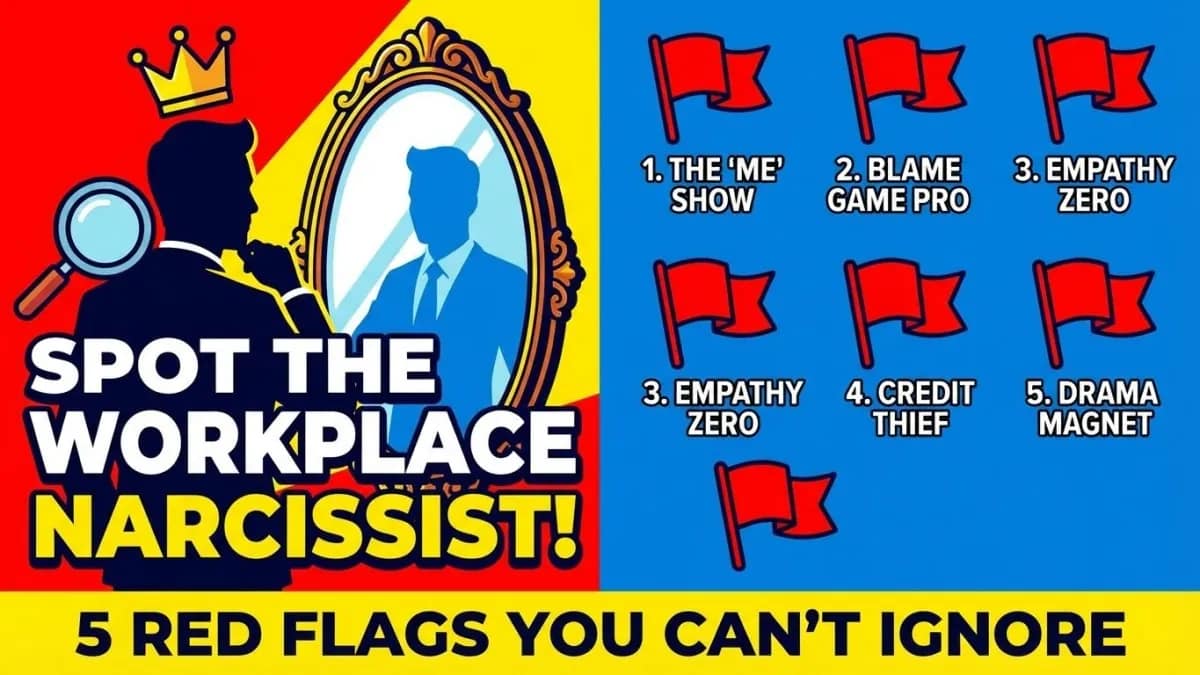
- Narcissist co-workers often take credit for your work and never admit mistakes
- They use charm and manipulation to get what they want from you
- Triangulation and gossip are their favorite workplace weapons
- They react with rage or silent treatment when criticized
- Setting firm boundaries is your best defense against their tactics
Reading Time: 8 minutes
Introduction: Why This Matters to You
I’ve worked with narcissists in three different jobs over my career. And let me tell you—it’s exhausting.
You start questioning yourself. You wonder if you’re overreacting. You feel drained after every interaction with them.
Here’s what I’ve learned: spotting the red flags early saves your mental health and your career. The sooner you recognize these patterns, the better you can protect yourself.
In this guide, I’ll show you the 5 biggest warning signs I’ve seen repeatedly. These aren’t just theories—these are real behaviors I’ve witnessed destroy team morale and push good people out of their jobs.
What Makes a Co-Worker a Narcissist? (Not Just Annoying)
Let’s clear something up first. There’s a difference between someone who’s confident and someone who’s a narcissist.
An annoying co-worker might brag occasionally or be selfish sometimes. A narcissist co-worker consistently shows a pattern of self-centered behavior that harms others.
The Core Traits You Need to Know:
- Lack of empathy – They genuinely don’t care how their actions affect you
- Need for constant admiration – Every conversation circles back to their achievements
- Sense of entitlement – Rules apply to everyone except them
- Exploitative behavior – They use people as stepping stones
I remember working with someone who checked every box. At first, I thought she was just ambitious. Six months later, three people had quit because of her.
Red Flag #1: They Take Credit for Your Work (Every Single Time)
This is the most common sign I’ve seen. And it’s infuriating.
You spend weeks on a project. You pour your heart into it. Then in the meeting, your narcissist co-worker presents it as their idea.
What This Looks Like:
- They say “I did this” when talking about team projects
- They conveniently “forget” to mention your contributions
- When praised, they don’t correct people or share credit
- They might even add small details to make it sound like they led everything
My experience: I once created an entire presentation deck. My co-worker added one slide, then told our boss it was “our project, but I handled most of the strategy.” That’s when I knew.
Why They Do This:
Narcissists need a constant supply of admiration. Your success threatens their image. So they steal it to maintain their superior position.
How to Protect Yourself:
- Document everything – Send emails summarizing your contributions
- CC your boss on important updates about your work
- Speak up immediately – “Actually, I developed that strategy” in the moment
- Keep a work journal with dates and achievements
Red Flag #2: They Never, Ever Admit They’re Wrong
I’ve never met a narcissist who could say “I made a mistake” and mean it.
When something goes wrong, they have an excuse ready. Or better yet—they blame you.
The Blame Game Looks Like:
- “I would have finished, but you didn’t give me the files on time” (you sent them a week ago)
- “The client didn’t like it because the brief was unclear” (the brief was crystal clear)
- “I didn’t know we had a deadline” (it was discussed in three meetings)
- Rewriting history to make themselves look good
Real example: A narcissist colleague once sent an email to the wrong client. When it caused problems, she claimed I gave her the wrong email address. I had to forward my original email—with the correct address—to prove otherwise.
The Deflection Technique:
When cornered, they don’t apologize. They:
- Turn it around on you (“Why are you being so sensitive?”)
- Play the victim (“Everyone is always attacking me”)
- Get aggressive (“This is ridiculous, I’m not discussing this”)
What You Should Do:
- Don’t engage in circular arguments – You won’t win
- Keep records of conversations and decisions
- Stay calm – Their goal is to make you look emotional
- Loop in HR or management if it affects your work quality
💡 Pro Tip: The “Gray Rock” Method
Here’s something that saved me countless times: become boring to them.
Narcissists feed on emotional reactions. They want drama, attention, and engagement.
When you become “gray”—giving minimal emotional responses—they lose interest and move to easier targets.
How to do it:
- Keep answers short and factual
- Don’t share personal information
- Show no emotion when they try to provoke you
- Be polite but distant
I started using this with a narcissist manager. Within two weeks, she stopped trying to engage me in her drama. It works.
Red Flag #3: They Use Charm as a Weapon (Then Switch It Off)
This confused me for the longest time. How can someone be so nice one minute and so cold the next?
That’s the trick. Narcissists are often charming when they want something from you.
The Pattern I’ve Noticed:
Phase 1 – Love Bombing:
- They compliment you excessively
- They act like your best friend at work
- They share “secrets” to create false intimacy
- They make you feel special and valued
Phase 2 – The Switch:
- Once they get what they need, the warmth disappears
- They become cold, dismissive, or even hostile
- They treat you like you’re invisible
- The compliments stop completely
Phase 3 – Manipulation:
- They use the relationship they built to ask for favors
- They guilt-trip you (“After everything I’ve done for you…”)
- They make you feel like you owe them
A Story That Illustrates This:
I worked with someone who invited me to lunch weekly, asked about my family, and seemed genuinely interested in my career.
Then I was assigned to a project she wanted. Overnight, she stopped talking to me. She told our boss I was “difficult to work with.” The charm was strategic, not real.
How to Spot Fake Charm:
- Watch if they’re equally nice to people who can’t help them
- Notice if the kindness disappears after they get what they want
- See if they trash-talk others behind their backs
- Check if their compliments always have a request attached
Red Flag #4: They Create Drama and Triangulation
Triangulation is a fancy word for a simple tactic: playing people against each other.
Narcissists love being at the center of workplace drama. They thrive on it.
What Triangulation Looks Like:
- They tell Person A that Person B criticized them (even if it’s not true)
- They share “confidential” information to create mistrust
- They position themselves as the “middle person” who’s trying to help
- They compare employees to make people compete
Example from my workplace: A narcissist co-worker told me, “Sarah said you’re not pulling your weight on the project.” She told Sarah I said Sarah was being too controlling. Neither was true. She wanted us to fight so she could look good to the boss.
Other Drama-Creation Tactics:
- Gossip disguised as concern – “I’m worried about John, he seems overwhelmed…”
- Victim stories – “Can you believe what they did to me?”
- False emergencies – Creating urgent situations that need their “heroic” intervention
- Public callouts – Criticizing others in meetings to look superior
Why This Is Dangerous:
It destroys team cohesion. I’ve seen entire departments fall apart because one narcissist spent months creating divisions.
Protect Yourself:
- Verify information before reacting – “That’s interesting, let me talk to them directly”
- Don’t participate in gossip sessions
- Document when they pit people against each other
- Build direct relationships with teammates so lies don’t work
Red Flag #5: They Can’t Handle Criticism (At All)
The fastest way to identify a narcissist? Give them constructive feedback.
Their reaction will tell you everything you need to know.
The Two Common Reactions:
Reaction 1 – Narcissistic Rage:
- They explode with anger
- They attack your character or competence
- They make threats (subtle or direct)
- They storm off or have a dramatic outburst
Reaction 2 – The Silent Treatment:
- They completely shut down communication
- They ice you out for days or weeks
- They turn cold and professional
- They punish you by withholding information or cooperation
Real Example:
I once told a narcissist teammate that his email tone came across as harsh to clients. It was gentle feedback, privately given.
He didn’t speak to me for three weeks. He stopped inviting me to meetings. He went around me on projects. All because of one polite suggestion.
Why They React This Way:
Narcissists have extremely fragile egos. Criticism—even constructive—feels like a personal attack on their entire identity.
They can’t separate “my work needs improvement” from “I’m a failure as a person.”
How Normal People React:
For comparison, a confident person says:
- “Thanks for pointing that out”
- “I didn’t realize, I’ll work on it”
- “Can you give me an example so I can improve?”
See the difference?
What to Do:
- Expect retaliation – Be prepared for backlash
- Don’t apologize for valid feedback
- Document the interaction in case they escalate
- Involve your manager if the reaction is extreme
How to Protect Your Sanity (Practical Strategies)
Now that you know the red flags, let’s talk about survival strategies. Because sometimes you can’t quit or transfer immediately.
Boundary-Setting Techniques:
Professional distance is your friend:
- Keep conversations work-focused only
- Don’t share personal information
- Decline social invitations
- Use the “Gray Rock” method (see Pro Tip above)
Documentation everything:
- Save emails and messages
- Keep a log of interactions
- Note dates, times, and witnesses
- Create a paper trail of your contributions
Communication tactics:
- Use email instead of verbal conversations (creates records)
- CC relevant people on important updates
- Confirm verbal agreements in writing
- Stay factual, never emotional
When to Escalate:
You need to go to HR or management when:
- The behavior affects your job performance
- You’re being blamed for their mistakes consistently
- They’re creating a hostile work environment
- You have documented evidence of patterns
I’ve been there. I waited too long once because I thought I could handle it. Don’t make my mistake. Escalate when you have clear evidence.
Taking Care of Yourself:
Working with a narcissist is emotionally draining. You need to:
- Talk to friends or a therapist about what you’re experiencing
- Set clear work/life boundaries (don’t check emails at home)
- Practice stress-reduction techniques
- Remember: their behavior is not about you
The Bottom Line: Trust Your Gut
Here’s what I want you to remember most: if someone consistently makes you feel small, confused, or drained—trust that feeling.
You’re not overreacting. You’re not too sensitive. You’re not imagining it.
I’ve talked to dozens of people who worked with narcissists. We all said the same thing: “I knew something was wrong, but I doubted myself.”
Don’t doubt yourself.
The red flags are real. The patterns are real. Your discomfort is valid.
Your Action Plan:
- Identify which red flags match your situation
- Document the behaviors you’re experiencing
- Set boundaries using the strategies above
- Seek support from trusted colleagues, friends, or professionals
- Know your options – Can you transfer? Report to HR? Start job searching?
You deserve to work in an environment where you’re respected. Don’t let one narcissist steal your joy or confidence.
Can narcissists change their behavior at work?
In my experience, rarely. True narcissistic personality disorder involves deeply ingrained patterns. While someone might temporarily adjust their behavior (especially if their job is threatened), lasting change requires intensive therapy—and most narcissists don’t think they need it.
Should I confront a narcissist co-worker directly?
I generally advise against it. Direct confrontation often leads to retaliation, gaslighting, or escalation. It’s better to set boundaries, document issues, and work through proper channels like HR or management.
How do I deal with a narcissist boss?
This is harder because of the power dynamic. Focus on: documenting everything, building relationships with other leaders, keeping your work visible to higher-ups, and honestly—updating your resume. A narcissist boss can severely limit your career growth.
What’s the difference between confidence and narcissism?
Confident people can admit mistakes, celebrate others’ success, accept criticism, and don’t need constant validation. Narcissists need perpetual admiration, can’t handle being wrong, and view others’ success as a threat.
Will reporting them to HR actually help?
It depends on your company culture and how well you’ve documented the behavior. HR exists to protect the company, so they’ll act if there’s clear evidence of harassment or policy violations. Go in with specific examples, dates, and patterns—not just feelings.
Can therapy help me deal with a narcissist co-worker?
Absolutely. A therapist can help you: process the emotional impact, develop coping strategies, recognize gaslighting, set healthy boundaries, and decide whether to stay or leave. I wish I’d started therapy earlier when dealing with my narcissist colleague.
Is it worth staying in a job with a narcissist?
Only you can answer that. Consider: Is it temporary? Can you transfer? Is the damage to your mental health worth it? Are there enough positives to balance the negatives? I’ve seen people successfully ride it out short-term, but long-term exposure takes a serious toll.
How do I stop a narcissist from taking credit for my work?
Proactive documentation is key. Send regular email updates to your manager about your projects. Present your own work in meetings when possible. If they steal credit publicly, politely correct the record immediately: “I appreciate that you’re highlighting the project—I developed the strategy and I’m glad to walk through my approach.”
Read more:https://mrpsychics.com/how-to-say-no-to-extra-work-without-sounding-lazy/
Final Thought: You’ve got this. Recognizing these red flags is the first step to protecting yourself. Trust yourself, set your boundaries, and don’t let anyone make you feel small.
Have you dealt with a narcissist co-worker? What red flags did you notice first? Your experience could help someone else reading this.

Ahmed is a self-improvement and psychology writer passionate about helping people live smarter, calmer, and more productive lives.
- Ahmed manasiya

- Ahmed manasiya
- Ahmed manasiya
- Ahmed manasiya