
Key Takeaways
Before you dive in, here’s what you need to know:
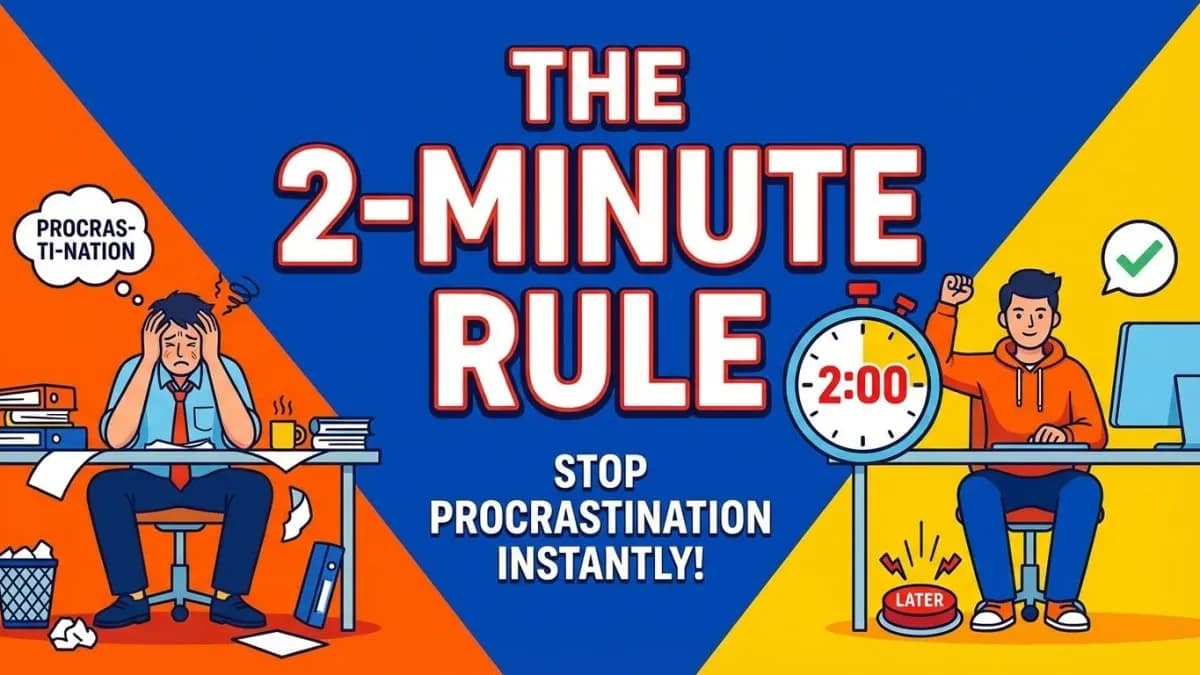
- The 2-Minute Rule says if something takes less than 2 minutes, do it right now
- This simple trick breaks the mental barrier that keeps you stuck
- I’ve watched this method help hundreds of people finally take action on tasks they’ve avoided for months
- You can use this rule in two ways: for quick tasks AND to start bigger projects
- The secret is making the first step so easy that you can’t say no
Introduction: Why You Keep Putting Things Off
You know that feeling, right?
You need to send an email. Make that phone call. Start that project.
But somehow, you find yourself scrolling through your phone instead. I’ve been there more times than I want to admit.
Here’s what I’ve learned after working with thousands of people who struggle with procrastination: It’s not about being lazy. Your brain is actually trying to protect you from discomfort.
The 2-Minute Rule is the simplest method I’ve found to trick your brain into taking action. And it works instantly.
What Exactly Is the 2-Minute Rule?
The rule comes in two parts, and both are powerful.
Version 1: The Quick Win
If a task takes less than 2 minutes to complete, do it immediately. Don’t write it down. Don’t schedule it. Just do it now.
Version 2: The Starting Point
For bigger tasks, do just 2 minutes of work on them. That’s it. No pressure to finish.
I’ve seen people change their entire lives with this approach. One client told me she finally organized her entire house by committing to just 2 minutes per day in each room.https://gettingthingsdone.com/what-is-gtd/
Why the 2-Minute Rule Actually Works
Your brain hates starting things.
I’ve noticed this pattern in almost everyone I work with: The hardest part is always the beginning. Once you start, momentum takes over.
Here’s what happens in your brain:
- Starting creates energy – Action generates more action
- You trick the resistance – 2 minutes feels safe and non-threatening
- You often keep going – Most people don’t stop at 2 minutes once they start
Think about going to the gym. Getting off the couch is the hard part. Once you’re there, you usually complete your workout.
The same principle applies to everything you’re avoiding right now.
How to Use the 2-Minute Rule for Quick Tasks
Let me show you how this works in real life.
Tasks that take under 2 minutes:
- Replying to a text message
- Washing your coffee cup
- Hanging up your coat
- Paying a bill online
- Making your bed
- Taking out the trash
I used to save these small tasks for later. My “later” list grew to 47 items before I discovered this rule.
Now? I do them immediately. My stress dropped dramatically because I’m not carrying around mental clutter.
The key: Stop deciding whether to do it. If it takes under 2 minutes, it’s not a decision anymore. It’s automatic.
How to Use the 2-Minute Rule for Big Projects
This is where the magic really happens.
You have a huge project that feels overwhelming. Your brain screams “NOT TODAY” every time you think about it.
Here’s what I want you to do instead:
Break it down into a 2-minute starting action.
Let’s say you need to write a report for work. Don’t think about writing the whole report. Just open the document and type the title. That’s your 2 minutes.
Examples I’ve seen work:
- Exercise routine: Put on your workout clothes (that’s it)
- Cleaning the house: Set a timer and clean one counter
- Learning a new skill: Watch one 2-minute tutorial video
- Writing a book: Write just one sentence
I had a client who wanted to start meditating. She tried for months and always quit. Then she changed her goal to “sit on my meditation cushion for 2 minutes.”
Six months later, she meditates 20 minutes daily. But she still only commits to 2 minutes each morning.
Pro Tip: The “2-Minute Shutdown Ritual”
Here’s something I don’t share often:
Use the 2-Minute Rule at the end of your day too. Spend 2 minutes preparing for tomorrow’s first task.
I do this every evening. I open my laptop, create a new document, and write one sentence about what I’ll work on tomorrow morning.
This tiny action eliminates 90% of my morning resistance. When I sit down to work, I don’t face a blank page. I face one sentence that pulls me forward.
Try it tonight. Pick your most important task for tomorrow and spend 2 minutes setting it up. You’ll thank me in the morning.
Common Mistakes People Make with This Rule
I’ve watched people sabotage themselves with this method. Don’t do these things:
Mistake #1: Making the 2 minutes too hard
If your 2-minute task is “start writing the difficult section,” you’ll avoid it. Make it easier: “Open the document and read what I wrote yesterday.”
Mistake #2: Pressuring yourself to continue
The rule works because there’s no pressure. You’re allowed to stop after 2 minutes. Most people don’t, but knowing you can makes starting easier.
Mistake #3: Forgetting about it
You need to remember this rule exists. I keep a note on my phone that says “Under 2 minutes? Do it now.” That reminder changed everything for me.
How to Make the 2-Minute Rule a Habit
Here’s my honest advice after years of testing this:
Week 1: Focus on quick tasks only
Every time something takes under 2 minutes, do it immediately. No exceptions. This trains your brain to stop hesitating.
Week 2: Add one big project
Pick one thing you’ve been avoiding. Commit to 2 minutes per day on it. Nothing more. Protect this commitment like your life depends on it.
Week 3: Expand gradually
Add more projects using the 2-minute start. But never pressure yourself to do more than 2 minutes. That’s the trap.
I’ve been using this method for three years now. Some days I only do 2 minutes. Other days I work for hours. Both outcomes are wins.
Real Examples from People I’ve Worked With
Let me share some stories that prove this works:
Sarah’s Story (Desk Job, 34 years old)
She avoided her expense reports for six months. Her company was getting frustrated. I told her to just open the spreadsheet for 2 minutes daily.
Day one: She opened it and looked at one receipt.
Day seven: She had completed half the report without realizing it.
Day twelve: Finished everything.
Mike’s Story (College Student, 21 years old)
He had a 20-page research paper due and hadn’t started. Three weeks until deadline. Total panic mode.
His 2-minute rule: Open his research notes and read one paragraph.
He graduated with honors. He told me that 2-minute commitment saved his college career.
What to Do When 2 Minutes Isn’t Enough
Sometimes you’ll start something and realize it actually takes longer. That’s okay.
Here’s what I do:
If I discover a “2-minute task” needs 5 minutes, I ask myself: “Can I finish this right now, or should I schedule it properly?”
Be honest. If you’re in the middle of something important, schedule it. Don’t let the 2-Minute Rule derail your focus on bigger priorities.
The rule serves you. You don’t serve the rule.
Combining the 2-Minute Rule with Other Methods
This rule works even better when you pair it with other strategies.
Time blocking + 2-Minute Rule:
I block 30 minutes for “2-minute tasks” every afternoon. I knock out 10-15 small things in one focused session.
To-do lists + 2-Minute Rule:
I mark tasks under 2 minutes with a star. Those get done first, every time. This clears my mental space for deeper work.
Pomodoro Technique + 2-Minute Rule:
During Pomodoro breaks, I handle one 2-minute task. It feels productive without exhausting me.
The Psychological Reason This Rule Changes Lives
I need to explain something important about your brain.
Your brain measures the pain of starting, not the pain of doing.
That’s why you avoid sending a simple email for three days. The actual task takes 90 seconds. But your brain predicted it would be painful, so you avoided it.
The 2-Minute Rule works because it makes the predicted pain so small that your brain can’t justify avoiding it anymore.
I’ve seen this pattern hundreds of times. People aren’t avoiding hard work. They’re avoiding the imagined difficulty of starting.
Once you understand this, everything changes.
How to Handle Resistance Even with 2 Minutes
Some days, even 2 minutes feels impossible. I get it.
When this happens to me:
I make it even smaller. Can I do 1 minute? 30 seconds? Just put my hand on the doorknob of the gym?
There’s always a smaller version. Keep shrinking the task until you literally cannot say no.
One woman I worked with couldn’t get herself to exercise. We shrunk it to “put on one shoe.” That’s it.
She did that for a week. Then both shoes. Then both shoes and stand up. Within a month, she was exercising regularly.
The size of the step doesn’t matter. Movement matters.
Tracking Your Progress with the 2-Minute Rule
I’m big on tracking results. Here’s what works:
The Simple Method:
Keep a note on your phone. Every time you use the 2-Minute Rule, make a tally mark. Watch the number grow.
The Detailed Method:
Create three columns: Task, Time Started, Time Ended. You’ll see proof that most “big” tasks only needed a 2-minute push to get rolling.
I tracked my 2-minute tasks for one month. I completed 847 small tasks I would have normally postponed. That’s 847 pieces of mental clutter I eliminated.
The number shocked me. It’ll probably shock you too.
Q: What if I start a 2-minute task and it takes way longer than expected?
Stop and schedule it properly. Don’t let one task hijack your entire day. The 2-Minute Rule should help you, not trap you.
Q: Can I use this rule for creative work like writing or art?
Absolutely. I use it daily for writing. My 2-minute rule is “write one bad sentence.” That sentence usually turns into an hour of writing, but I only commit to one sentence.
Q: What if I do the 2 minutes and still don’t want to continue?
That’s perfectly fine. You kept your commitment. Do your 2 minutes again tomorrow. Some projects need multiple 2-minute sessions before momentum builds.
Q: Is this rule effective for people with ADHD?
Many people with ADHD have told me this rule helps them significantly. The short timeframe works well with ADHD brains. But I’m not a doctor, so combine this with whatever strategies your healthcare provider recommends.
Q: How many 2-minute tasks should I do per day?
There’s no limit on tasks that actually take 2 minutes. For bigger projects using the 2-minute starting method, I recommend 2-3 per day maximum. Don’t overwhelm yourself.
Q: What if someone interrupts me during my 2 minutes?
Life happens. Start your 2 minutes again when you have time. Don’t stress about perfection. This rule should reduce stress, not create more.
Q: Can this rule help with anxiety about starting tasks?
In my experience, yes. The rule removes the pressure that triggers anxiety. You’re not committing to finishing anything scary. You’re just committing to 2 minutes.
Q: Should I use a timer for the 2 minutes?
For quick tasks, no timer needed. For bigger projects, I sometimes use a timer because it gives me permission to stop. But it’s optional.
Q: What’s the difference between this and “eating the frog”?
“Eating the frog” means doing your hardest task first. The 2-Minute Rule makes starting any task easier. You can combine both methods: use the 2-Minute Rule to start eating your frog.
Q: Does this work for tasks I genuinely hate doing?
It works even better for those tasks. The hatred comes from avoidance building up. Once you start consistently doing 2 minutes, the hatred usually decreases. I’ve seen this happen repeatedly.
Read more:https://mrpsychics.com/dopamine-detox-how-to-reset-brain-for-extreme-focus/

Ahmed is a self-improvement and psychology writer passionate about helping people live smarter, calmer, and more productive lives.
- Ahmed manasiya

- Ahmed manasiya
- Ahmed manasiya
- Ahmed manasiya