
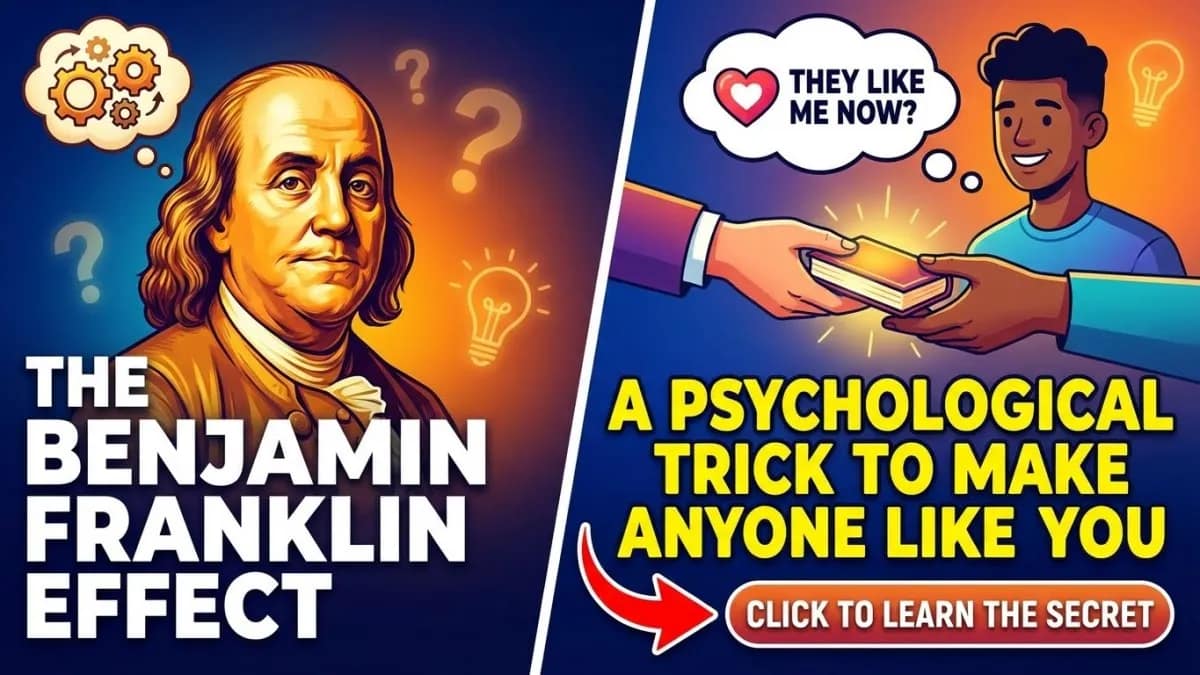
The “Benjamin Franklin Effect”: A Psychological Trick to Make Anyone Like You
Key Takeaways
What you’ll learn in this post:
- The Benjamin Franklin Effect makes people like you more when they do you a favor (not the other way around)
- This works because our brains justify our actions by changing how we feel about people
- You can use this at work, in relationships, and in everyday social situations
- The key is asking for small, specific favors that feel meaningful
- This technique has helped me turn skeptical colleagues into genuine supporters
What Is the Benjamin Franklin Effect?https://www.gutenberg.org/files/20203/20203-h/20203-h.htm#IV
Here’s something that sounds backward: When someone does you a favor, they end up liking you more.
Most people think it works the opposite way. They believe doing favors for others makes those people like them. But I’ve watched this play out hundreds of times, and the reverse is actually true.
Benjamin Franklin discovered this in the 1700s. He had a rival in the Pennsylvania legislature who openly disliked him. Instead of trying to win him over with gifts or compliments, Franklin did something clever.
He asked his rival to lend him a rare book.
The rival agreed. They started talking. Within weeks, they became lifelong friends. Franklin later wrote that the man “ever after manifested a readiness to serve me on all occasions.”
Why Does This Actually Work?
I’ve seen this principle transform professional relationships that seemed dead in the water. But why does it work?
Your Brain Hates Contradictions
Your mind constantly tries to make sense of your actions. Psychologists call this cognitive dissonance.
Here’s what happens inside your head:
- You do someone a favor
- Your brain asks: “Why did I help this person?”
- The answer: “I must like them. That’s why I helped.”
Your brain literally changes your feelings to match your behavior. I’ve experienced this myself when helping difficult clients—I end up genuinely caring about their success.
We Justify Our Investments
When you invest time or energy into someone, you develop a stake in them. Your brain doesn’t want that investment to feel wasted.
Think about it this way:
- You spend 20 minutes helping a coworker
- Your brain wants that time to mean something
- So it decides: “They must be worth my time”
- Result: You now view them more favorably
I’ve watched new managers use this accidentally. They ask team members for input, and suddenly those team members become their biggest advocates.
: It Creates a Connection
Asking for a favor shows vulnerability. You’re admitting you need help. This breaks down social barriers faster than small talk ever could.
When someone helps you, they’ve participated in your story. You’re no longer strangers—you’re collaborators.
Pro Tip Box
Pro Tip: The favor needs to feel meaningful but not burdensome. Ask for something that takes 5-15 minutes and uses the person’s specific skills or knowledge. “Could you recommend a good tax accountant?” works better than “Can you borrow me a pen?” It also works better than “Can you help me move this weekend?”
How to Use the Benjamin Franklin Effect (Real Examples)
I’m going to share tactics I’ve personally used and seen work. These aren’t theories—they’re battle-tested approaches.
At Work With Difficult Colleagues
Let’s say someone at work seems cold or dismissive toward you. Here’s what I do:
Ask for their expertise on something specific.
- “I noticed you’re great at Excel. Could you show me how you created that pivot table?”
- “You have a knack for client presentations. Would you mind reviewing mine?”
- “I’m struggling with this data analysis. Do you have 10 minutes to give me your perspective?”
The key word is “you”—make it about their unique skills. I turned a hostile coworker into a mentor using exactly this approach. Within three months, she was recommending me for projects.
In Your Personal Relationships
This works with friends, neighbors, even your in-laws.
Ask for small, meaningful help:
- “I’m trying to eat healthier. What’s that recipe you mentioned?”
- “Could you recommend a good podcast? I trust your taste.”
- “I’m learning about gardening. Mind if I ask you a few questions?”
I was new to a neighborhood once and felt isolated. I started asking neighbors for advice about local restaurants, repair people, and hiking trails. Within six months, I had genuine friendships. They felt invested in my success because they’d contributed to it.
When Networking or Building Professional Connections
Here’s where most people mess this up. They try to give value first at networking events. Sometimes that works, but I’ve found asking for small favors works faster.
Try these approaches:
- “I’m researching your industry. Would you mind if I asked you two questions about your experience?”
- “I read your article on marketing. Could you clarify one point that confused me?”
- “I’m considering a career shift. Could I get your take on something?”
After someone helps you, always follow up. Tell them how their advice worked out. This completes the psychological loop and deepens the connection.
Common Mistakes That Ruin This Technique
I’ve made these mistakes myself. Learn from my errors.
Asking for Too Much, Too Soon
Don’t ask someone to review your entire business plan when you’ve just met them. That’s not a favor—it’s a burden.
Start small:
- First favor: 5-10 minutes of their time
- Second favor (weeks later): 15-20 minutes
- Build from there
I once asked a busy executive for a 30-minute call before building any rapport. She said no, and I never got another chance. Start smaller than you think you need to.
Not Making It Feel Voluntary
If someone feels obligated or pressured, the effect backfires. They’ll resent you instead of liking you more.
Use phrases like:
- “No pressure at all, but…”
- “Only if you have time…”
- “Feel free to say no…”
This gives them permission to decline, which paradoxically makes them more likely to help.
Forgetting to Express Genuine Gratitude
This isn’t manipulation—it’s relationship building. Thank them sincerely and specifically.
Instead of: “Thanks!”
Say: “Thank you so much for taking time to explain that. Your insight about X completely changed how I’m thinking about this.”
I always send a follow-up message the next day reiterating my thanks. People remember how you make them feel.
The Science Behind Why This Works So Well
Researchers have tested this repeatedly. The results always surprise people.
The Original Studies
In 1969, psychologists Jon Jecker and David Landy ran an experiment. Participants won money in a quiz.
Three groups:
- Group 1: Researcher asked if they’d return some money (to help him personally)
- Group 2: Secretary asked if they’d return money (to help the department)
- Group 3: Nobody asked them for anything
Later, participants rated how much they liked the researcher. Group 1 liked him most—even though he’d asked them to give back their winnings.
The people who did him a personal favor liked him significantly more than those who kept all their money.
Why It Beats Traditional Approaches
I’ve tried building relationships by doing favors for others. It works sometimes, but it’s hit-or-miss.
Here’s why asking for favors is more reliable:
- Doing favors for others: They might feel indebted or guilty, which creates distance
- Asking for favors: They feel capable and valued, which creates connection
When you ask someone for help, you’re telling them: “I trust you. I value your skills. I see you as someone worth knowing.”
That’s a powerful message.
When NOT to Use This Technique
I need to be honest: this doesn’t work in every situation.
Don’t Use It as Pure Manipulation
If you’re faking interest just to get something from someone, people will sense it. I’ve seen salespeople try this as a sleazy tactic. It fails.
Use this when:
- You genuinely want to build a relationship
- You actually value their input
- You’ll appreciate their help
Your intentions matter. People have good BS detectors.
Avoid It When Someone Is Overwhelmed
If your coworker is drowning in deadlines, don’t ask them for favors. You’ll look tone-deaf.
Read the situation:
- Are they stressed or busy?
- Do they seem open to conversation?
- Is this a good time?
I once asked my boss for advice during their busiest week of the year. Bad move. Timing matters as much as technique.
Don’t Keep Score
If you’re tracking favors like debts, you’re missing the point. This is about building genuine connection, not collecting IOUs.
The moment it feels transactional, the magic disappears.
Advanced Ways to Apply This Principle
Once you understand the basics, you can get more sophisticated.
The Follow-Up Favor
After someone helps you once, ask for a second (slightly bigger) favor later. This deepens the relationship progressively.
Example progression:
- Week 1: “Could you recommend a good project management tool?”
- Week 3: “That tool you suggested was perfect. Mind if I ask how you organize your weekly tasks?”
- Week 6: “Your organizational system inspired me. Would you be open to grabbing coffee to discuss productivity strategies?”
Each favor builds on the last. I’ve built mentorships this way that lasted years.
Ask for Advice, Not Just Help
Advice requests are powerful because they position the other person as an expert.
Instead of: “Can you send me that file?”
Try: “What’s your approach to organizing these files? I’m trying to improve my system.”
I’ve seen junior employees win over senior leaders simply by asking thoughtful questions that acknowledge expertise.
Create Opportunities for Others to Help You
Sometimes you don’t need to directly ask. You can mention a challenge you’re facing and let people offer help.
In casual conversation:
- “I’m trying to figure out the best way to…”
- “I’ve been stuck on this problem…”
- “I’m exploring options for…”
People love solving problems. When they volunteer advice, the Benjamin Franklin Effect kicks in even stronger because they initiated it.
Real Stories: How This Changed My Relationships
Let me share three times this technique completely shifted my life.
The Job Interview That Became a Job Offer
I was interviewing at a company where the hiring manager seemed skeptical of my background. Instead of overselling myself, I asked her: “What’s the biggest challenge your team is facing right now?”
She spent 15 minutes explaining their problems. Then I asked: “Given what you’ve told me, what skills matter most in this role?”
By the end, she was selling me on the position. She’d invested time explaining her needs, which made her brain decide I must be worth that investment. I got the offer.
The Neighbor Who Became a Friend
I moved to a new city where I knew nobody. My neighbor seemed friendly but distant. One day, I knocked on his door and said: “I’m trying to find a good local coffee shop. You’ve lived here a while—where do you go?”
He gave me recommendations. A week later, I asked about hiking trails. Within two months, we were having regular dinners. He told me later: “I felt like I was part of helping you settle in here.”
That’s the Benjamin Franklin Effect in action.
The Client Who Was Ready to Fire Me
Early in my career, a client was unhappy with my work. Instead of getting defensive, I said: “I clearly missed the mark here. You understand this industry better than I do. Could you help me understand what success looks like from your perspective?”
She spent an hour explaining her vision. As she talked, her frustration melted away. By investing that time in me, she became invested in my success. She didn’t fire me—she became one of my biggest advocates.
How to Practice This Starting Today
Don’t overthink this. Start small and build from there.
Your Week 1 Challenge
Pick one person and ask for one small favor this week.
It could be:
- A coworker: “Could you explain how you handled that situation?”
- A neighbor: “Do you have a recommendation for [local service]?”
- An online connection: “I saw your post about X. Could you point me toward a good resource?”
That’s it. Just one favor from one person.
What to Do After They Help You
Step 1: Thank them immediately and specifically
Step 2: Use their advice or suggestion
Step 3: Follow up in a few days to let them know the outcome
Step 4: Look for an opportunity to ask a second (small) favor in the future
This creates a positive cycle that builds genuine relationships.
Track Your Progress
I keep a simple note on my phone where I write down:
- Who I asked for help
- What I asked for
- How they responded
- How the relationship changed over time
You’ll be amazed at the patterns you notice. This isn’t manipulation—it’s relationship science.
Q: Isn’t this manipulative?
Not if you’re genuine. Asking for help when you actually need it isn’t manipulation—it’s human connection. I only use this technique when I genuinely value someone’s input. If your intent is to exploit people, yes, that’s manipulative. If your intent is to build real relationships, this is just smart social psychology.
Q: What if someone says no to my favor request?
That’s fine! Remember, the favor must feel voluntary. Some people will say no, and that’s their right. Thank them anyway and move on. I’ve had people decline favors who later became friends through different interactions. Don’t take it personally.
Q: How big should the favor be?
Start with something that takes 5-15 minutes and uses their specific knowledge or skills. Too small (borrowing a pen) doesn’t create enough investment. Too large (helping you move) feels burdensome. The sweet spot is meaningful but manageable.
Q: Can this work in romantic relationships?
Yes, but be careful. In new relationships, asking for small advice or recommendations works great. In established relationships, overusing this technique can make you seem needy. Use it occasionally when you genuinely need their expertise or perspective.
Q: How long does it take to work?
I’ve seen attitude shifts happen immediately after someone does you a favor. But building a genuine relationship takes time. Plan on 3-6 interactions over several weeks or months. This isn’t a quick trick—it’s a relationship-building strategy.
Q: What if I don’t need any favors from this person?
You can almost always find something to ask about. People love sharing their expertise, experiences, or recommendations. Ask about their work process, their favorite tools, their perspective on an industry trend, or their advice on a challenge you’re facing. Get creative.
Q: Does this work on everyone?
No technique works on everyone. Some people are naturally resistant to helping others. Some are too busy. Some won’t like you regardless of what you do. That’s okay. This works often enough that it’s worth using, but don’t expect a 100% success rate.
Q: Can I use this technique multiple times with the same person?
Absolutely! In fact, research shows that each subsequent favor strengthens the relationship more. Just make sure you’re spacing them out appropriately and showing genuine gratitude each time. I have mentors I’ve been asking favors from for years—our relationships have only deepened.
Read more:https://mrpsychics.com/how-to-spot-a-manipulator-in-5-minutes/
Final Thoughts
The Benjamin Franklin Effect has changed how I build relationships. Instead of trying to impress people or do things for them, I simply ask for their help.
This works because it taps into something fundamental about human psychology: we like people we’ve invested in.
Start with one small favor this week. Ask someone for advice, a recommendation, or their perspective on something. Thank them genuinely. Watch what happens.
I’ve seen this technique turn strangers into friends, skeptics into supporters, and cold professional relationships into genuine partnerships.
The beauty of this approach is that everybody wins. They feel valued for their expertise. You get helpful advice. And you both build a real connection in the process.
Try it. I think you’ll be surprised at how well it works.

Ahmed is a self-improvement and psychology writer passionate about helping people live smarter, calmer, and more productive lives.
- Ahmed manasiya

- Ahmed manasiya
- Ahmed manasiya
- Ahmed manasiya