
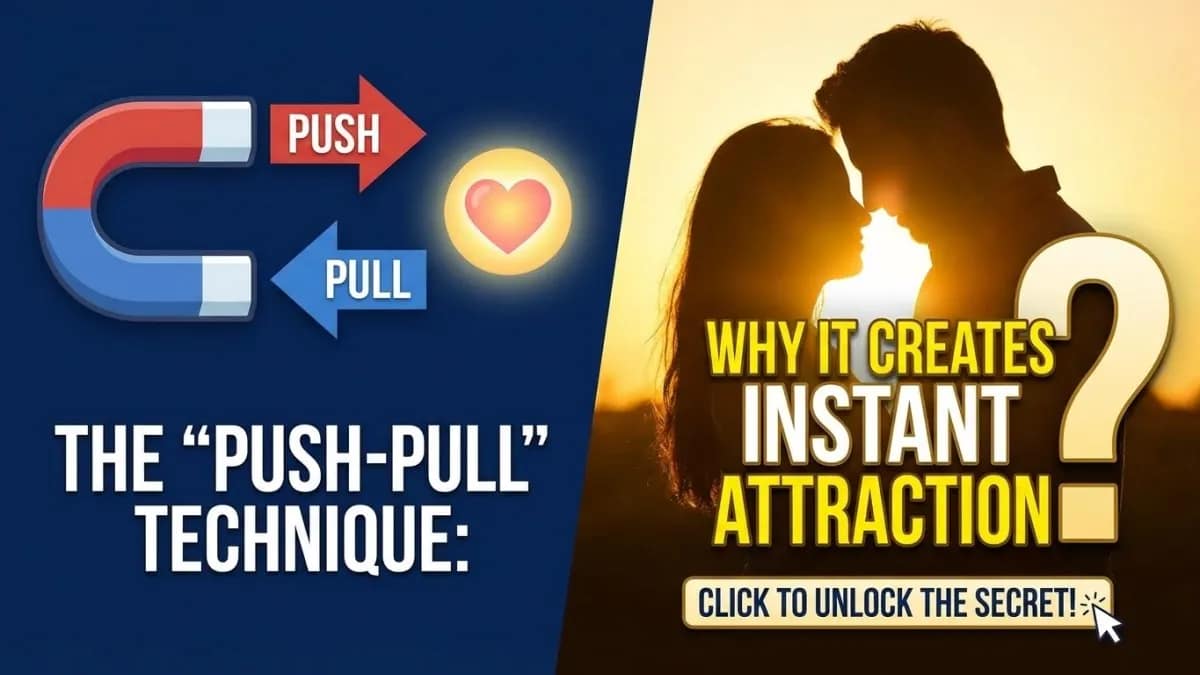
The “Push-Pull” Technique: Why It Creates Instant Attraction
Key Takeaways
What you’ll learn in this post:
- The push-pull technique balances giving attention and pulling back to create emotional tension
- It works because humans naturally chase what feels slightly out of reach
- When done right, it builds attraction without playing cruel mind games
- The technique fails when you overuse it or come across as manipulative
- Timing and authenticity matter more than following a strict formula
Introduction: Why Some People Are Magnetic (And Others Aren’t)
I’ve spent years studying human behavior and attraction patterns. One thing always stands out: the most magnetic people aren’t the nicest or the meanest.
They’re the ones who keep you guessing just a little bit.
You know that person who compliments you, then seems distracted? Who shows interest, then pulls back? That’s push-pull in action. And yes, it drives people crazy (in a good way).
Let me show you exactly how it works and why your brain can’t resist it.
What Is The Push-Pull Technique?
Push-pull is a dating and social technique where you alternate between showing interest (pull) and creating distance (push).
Think of it like this:
- Pull = compliment, attention, warmth, moving closer
- Push = teasing, challenge, creating space, showing independence
Here’s a simple example:
“You seem really interesting (pull)… though I bet you’re trouble (push).”
The technique creates emotional tension. Your brain doesn’t know whether to relax or try harder. That uncertainty? That’s what sparks attraction.
Learn more:https://www.psychologytoday.com/us/basics/attraction
The Psychology: Why Push-Pull Works On Our Brains
I’ve seen this play out hundreds of times. People don’t fall for someone who’s always available. They fall for someone who feels valuable.
Here’s what happens in your brain:
1. The Scarcity Principle When something feels rare or hard to get, we want it more. A person who’s always there loses mystery. A person who comes and goes? We chase them.
2. Dopamine Spikes Your brain releases dopamine (the reward chemical) when you experience unpredictability. Slot machines work the same way. You never know when the next “win” is coming, so you keep playing.
3. The Challenge Factor Humans are wired to value what we work for. When someone is too easy to win over, our brains think: “This must not be very valuable.”
I’ve watched confident people become insecure around someone using push-pull. It’s not because they’re weak. It’s because our brains are hardwired this way.
Real Examples Of Push-Pull In Action
Let me show you how this looks in real conversations.
Example 1: Text Messages
❌ Without push-pull: “I miss you so much! When can I see you again? I’ve been thinking about you all day!”
✅ With push-pull: “Had fun yesterday (pull). Don’t get used to me being so nice though (push) 😏”
Example 2: In-Person Conversation
❌ Without push-pull: “You’re so beautiful. I love everything about you. You’re perfect.”
✅ With push-pull: “You’ve got great style (pull). Let me guess… you spent three hours picking that outfit (push/tease).”
Example 3: Planning Dates
❌ Without push-pull: “I’m free whenever you are! Just tell me when and I’ll be there!”
✅ With push-pull: “Tuesday works for me (pull). But I’ve got plans Wednesday and Thursday, so you’ll have to wait until next week if Tuesday doesn’t work (push/scarcity).”
See the difference? The push-pull versions show interest while maintaining independence and value.
Pro Tip: The 70/30 Rule
Here’s something most dating advice gets wrong: Push-pull isn’t about being 50/50 hot and cold.
The ratio should be 70% pull, 30% push.
Why? Because you want the other person to feel mostly good around you. The “push” is just a small spike of tension that makes the “pull” feel more rewarding.
I’ve seen too many people ruin attraction by pushing too hard. They think being distant and cold is attractive. It’s not. It’s just confusing and exhausting.
Use push-pull to add flavor, not to be the whole meal.
The Dark Side: When Push-Pull Becomes Manipulation
Let me be direct with you. Push-pull can be toxic if you use it wrong.
Red flags that you’re crossing the line:
- You’re using it to control someone’s emotions
- You push to make them feel bad about themselves
- You’re being hot and cold to punish them
- You have no genuine interest—you just like the power
I’ve seen relationships destroyed by people who turned push-pull into emotional abuse. They’d shower someone with love, then go cold for days. That’s not attraction building. That’s psychological manipulation.
The healthy version of push-pull shows you’re interested but independent. The toxic version makes someone feel worthless unless they’re chasing you.
Know the difference.
How To Use Push-Pull Without Being A Jerk
Here’s how I teach people to use this ethically:
1. Be Genuine Don’t fake disinterest if you’re actually very interested. Instead, show interest while maintaining your own life and boundaries.
2. Make The “Push” Playful Teasing should make both of you laugh. If your push feels mean or hurtful, you’ve gone too far.
3. Don’t Overdo It Use push-pull in the early attraction phase. Once you’re in a relationship, constant push-pull just creates insecurity and anxiety.
4. Watch Their Response If someone seems hurt or confused by your push-pull, stop. Some people have anxious attachment styles and this technique can trigger real pain for them.
5. Have Real Interest Push-pull only works if you actually like the person. If you’re just playing games, they’ll feel it eventually.
Common Mistakes People Make With Push-Pull
I’ve coached hundreds of people on attraction. Here are the biggest mistakes I see:
Mistake #1: Pushing Too Hard Too Fast You just met someone and you’re already going cold? That’s not mysterious. That’s just weird.
Mistake #2: Pulling Too Much If you never push at all, you become the “nice guy/girl” who gets friend-zoned. No tension = no attraction.
Mistake #3: Being Inconsistent For No Reason Push-pull should feel natural, not random. Don’t ignore someone for three days because you read it in a book. That’s just rude.
Mistake #4: Using It On The Wrong People Some people have anxious attachment and will spiral when you pull away. Know your audience.
Mistake #5: Forgetting To Actually Connect Push-pull creates attraction, but vulnerability creates connection. You need both for a real relationship.
When Push-Pull Works Best
This technique isn’t for every situation. Here’s when it’s most effective:
- Early dating stages (first few dates, initial attraction)
- When someone is losing interest (a small push can reignite curiosity)
- With naturally confident people (they enjoy the playful tension)
- In flirty, casual conversations (not serious relationship discussions)
When to avoid it:
- In established relationships (it creates unnecessary drama)
- With people who have anxious attachment styles
- During serious or vulnerable conversations
- When someone is already insecure about your interest
The Science Behind The Attraction Spike
Let me get a bit technical for a moment.
Studies on intermittent reinforcement show that unpredictable rewards create stronger behavioral responses than consistent rewards.
In one famous study, rats pressed a lever more frantically when they didn’t know if food would come out. When food came every time, they pressed casually.
Humans work the same way in relationships. I’ve seen people obsess over someone who texts back inconsistently, while ignoring someone who always responds immediately.
This isn’t because people want to be treated badly. It’s because our brains are wired to chase uncertainty more than certainty.
Push-pull taps into this hardwiring.
Building Long-Term Attraction Without Games
Here’s what nobody tells you: push-pull is a short-term attraction tool.
For long-term relationships, you need different skills:
- Consistent communication
- Emotional availability
- Vulnerability and trust
- Shared values and goals
I’ve seen couples try to keep the “spark” alive by playing push-pull games five years into marriage. It doesn’t work. At that point, it just feels like emotional distance.
Use push-pull to create initial attraction. Use authenticity to build something real.
Q: Is push-pull the same as playing hard to get?
Not exactly. Playing hard to get is mostly “push” (acting disinterested). Push-pull balances showing genuine interest with maintaining independence. You’re not faking disinterest—you’re showing you have a life outside of them.
Q: How long should I wait before texting back?
There’s no magic number. The goal isn’t to follow a formula. It’s to actually be busy with your own life. If you naturally take an hour to respond because you’re doing things, that’s authentic. If you’re staring at your phone timing your response, you’re playing games.
Q: Will push-pull work on everyone?
No. People with secure attachment styles might enjoy the playful tension. People with anxious attachment might feel hurt and confused. People with avoidant attachment might pull away entirely. Know who you’re dealing with.
Q: Can women use push-pull on men?
Absolutely. Attraction psychology works the same regardless of gender. In fact, I’ve seen women use this technique with even more success because society teaches men to chase.
Q: What if I push too hard and they lose interest?
Then pull back in. Send a genuine message showing interest. Something like: “Hey, I’ve been a bit distant. I actually really enjoyed our conversation the other day.” Most people appreciate honesty.
Q: Is it manipulative?
It can be. If you’re using it to control someone or hurt them intentionally, yes. If you’re using it to create playful tension while being genuinely interested, no. The difference is in your intention.
Q: How do I know if it’s working?
They’ll engage more, initiate contact, ask questions about your life, and seem more curious about you. If they’re pulling away or seem hurt, it’s not working.
Q: Should I use push-pull in a serious relationship?
Use it sparingly. A little playful teasing is fine. But constantly creating emotional distance in a committed relationship builds resentment, not attraction.
Read more:https://mrpsychics.com/crossed-arms-psychology-are-they-angry-or-just-cold/
Final thought: Push-pull is powerful because it mirrors the natural rhythm of healthy attraction. You’re interested, but you’re not desperate. You’re engaged, but you’re not consumed.
Master that balance, and you’ll never struggle with attraction again.

Ahmed is a self-improvement and psychology writer passionate about helping people live smarter, calmer, and more productive lives.
- Ahmed manasiya

- Ahmed manasiya
- Ahmed manasiya
- Ahmed manasiya