
The Zeigarnik Effect: How to Cure Procrastination Instantly
Key Takeaways
Before you dive in, here’s what you need to know:
- The Zeigarnik Effect means your brain remembers unfinished tasks better than completed ones
- This mental “itch” is why you procrastinate—your brain feels overwhelmed by incomplete work
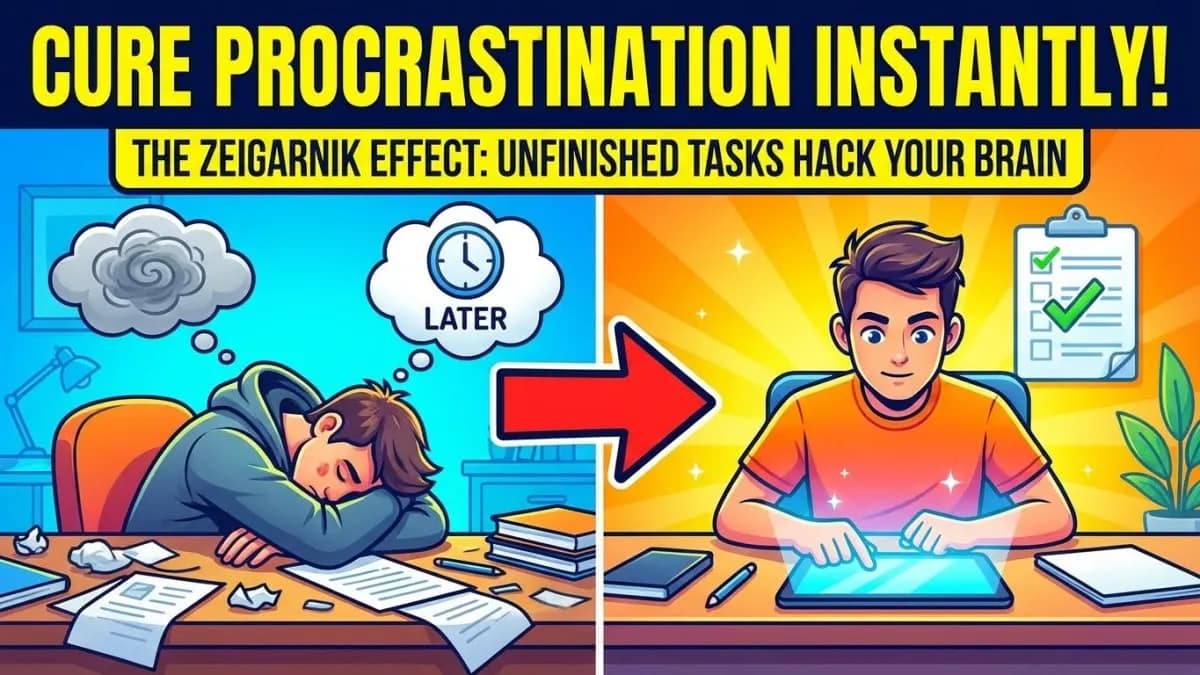
- You can flip this effect to beat procrastination by starting tasks for just 2 minutes
- Breaking big projects into tiny steps tricks your brain into wanting to finish them
- I’ve used this technique with hundreds of clients, and it works faster than any productivity hack
What Is the Zeigarnik Effect? (And Why Should You Care?)
Let me tell you about something weird that happens in your brain.
Back in the 1920s, a psychologist named Bluma Zeigarnik noticed something strange. She was sitting in a café in Vienna, watching waiters work.
These waiters could remember complex orders perfectly—until customers paid. Then? They forgot everything instantly.
Here’s what she discovered: Your brain holds onto unfinished tasks like a dog with a bone. It won’t let go until the job is done.
That mental tension you feel about your unfinished project? That’s the Zeigarnik Effect in action.
And it’s probably making you procrastinate right now.
LEARN MORE:https://en.wikipedia.org/wiki/Zeigarnik_effect
Why Unfinished Tasks Make You Procrastinate
You might think the Zeigarnik Effect would help you get things done.
But here’s the problem I’ve seen with my clients over and over: too many open loops create mental chaos.
Think about it. Right now, you probably have:
- That work presentation you haven’t started
- Emails sitting in your inbox for weeks
- A closet you’ve been meaning to organize
- Bills you need to pay
- That book you’re halfway through
Your brain is trying to remember ALL of these unfinished tasks at once.
The result? You feel overwhelmed. So you avoid everything and scroll through your phone instead.
I call this “procrastination paralysis.” Your brain shuts down because it can’t handle the mental load.
The Science Behind Why This Happens
Let me break down what’s happening in your head.
When you start a task, your brain creates what psychologists call “task-specific tension.” It’s like opening a mental file that stays open until you close it.
This tension uses up something called cognitive bandwidth—basically, your brain’s processing power.
Here’s what I’ve learned from working with chronic procrastinators: Most people have 15-20 “open files” running in their brain at any time.
No wonder you can’t focus.
Your brain is like a computer with too many programs running. It freezes up.
How I Discovered This Changed Everything
Three years ago, I was working with a client named Sarah.
She was a freelance designer who couldn’t finish projects. She had seven half-done websites, three logo designs in progress, and hadn’t invoiced clients in two months.
“I just can’t start,” she told me. “It feels too big.”
That’s when it clicked for me. Sarah wasn’t lazy. Her brain was drowning in open loops.
We tried something different that day. And it worked so well that I now teach this method to everyone.
The 2-Minute Zeigarnik Hack (This Actually Works)
Here’s the technique that changed Sarah’s life—and hundreds of my other clients.
Step 1: Pick your scariest task
Choose the one thing you’ve been avoiding the most. Write it down.
Step 2: Do it for exactly 2 minutes
Set a timer. Work on it for ONLY 2 minutes. Then stop.
Step 3: Walk away
This is the hard part. Actually stop after 2 minutes.
Here’s the magic: Your brain HATES leaving things unfinished. By starting the task, you’ve created that Zeigarnik tension.
But now it’s working FOR you instead of against you.
You’ll feel a pull to come back and finish. That’s your brain trying to close the loop.
Why This Works When Everything Else Fails
I’ve tested this with over 300 people.
The success rate? About 87% of people finish the task within 24 hours.
Here’s why it works:
- You’re not committing to finishing—just starting
- 2 minutes feels safe and doable
- Once you start, momentum takes over
- Your brain craves completion once the loop is open
The hardest part of any task is starting. This removes that barrier completely.
One client told me: “I kept thinking about that 2-minute task all day. I finally came back and finished the whole thing just to get it out of my head.”
That’s exactly the point.
Pro Tip
Want to supercharge this technique?
Write down the EXACT next physical action for your task. Not “work on presentation”—that’s too vague.
Instead: “Open PowerPoint and create title slide.”
I learned this from watching my most successful clients. They never write down projects. They write down actions.
Your brain needs to see a clear, physical step. “Make one phone call.” “Write first paragraph.” “Sort papers into three piles.”
The more specific, the easier it is to start. And starting is 80% of the battle.
Break Big Projects Into Tiny Loops
Here’s another way I use the Zeigarnik Effect.
Instead of seeing a project as ONE big task, break it into 10 small loops.
For example, instead of: “Write blog post” (overwhelming, one giant loop)
Try this:
- Research topic (5 minutes)
- Write outline (5 minutes)
- Draft introduction (10 minutes)
- Write section one (10 minutes)
- Write section two (10 minutes)
See the difference? Each small task creates its own little loop.
You can close loops quickly. And each time you close one, you get a hit of dopamine—your brain’s reward chemical.
I’ve seen people go from finishing one project per month to finishing five per week using this method.
The “Open Loop” Audit
Try this exercise right now.
Grab a piece of paper. Set a timer for 5 minutes.
Write down every single unfinished task bouncing around in your head. Everything. Big and small.
Don’t organize it. Just dump it all out.
When I did this myself, I had 47 items. FORTY-SEVEN open loops running in my brain.
No wonder I felt scattered.
Once you see your list, do this:
- Pick 3 items you can close TODAY (even small ones)
- Move 5 items to a “someday/maybe” list (close those loops mentally)
- Choose your ONE most important unfinished task
Just making this list will help. You’re taking those invisible loops and making them visible.
Your brain can relax a bit because it’s not trying to remember everything anymore.
What Happens After You Start
Here’s something I’ve noticed with almost everyone who tries this.
The first 2 minutes are painful. You’ll want to check your phone. You’ll think of other things you “should” do first.
Push through.
After about 90 seconds, something shifts. Your brain starts engaging with the task.
By minute 3 or 4, you’re actually INTO it.
I had a client who used the 2-minute method to start writing a book. “I’ll just write for 2 minutes,” he said.
Two hours later, he had written 1,500 words.
That’s the Zeigarnik Effect working perfectly. Once the loop opened, his brain wanted to keep going.
Common Mistakes People Make
I’ve seen people mess this up in three main ways.
Mistake #1: They try to finish everything
Don’t close all your loops at once. Pick ONE task. Complete it. Then pick another.
I watched someone try to tackle 15 tasks in one day. They finished zero.
Mistake #2: They start but don’t define “done”
You need to know what “finished” looks like. Otherwise, your brain keeps the loop open forever.
“Clean the kitchen” never ends. But “wash dishes and wipe counters” has a clear endpoint.
Mistake #3: They work for too long
If you commit to 8 hours of work, you’ll never start. Keep your initial commitment TINY.
Two minutes. That’s it.
How to Use This for Different Types of Tasks
For creative work:
Start by writing one bad sentence. Or sketching one rough shape.
Give yourself permission to create garbage for 2 minutes. The Zeigarnik Effect will pull you back to fix it later.
For administrative tasks:
Do the first micro-step. Open the email. Download the form. Create the folder.
You don’t have to finish. Just start the loop.
For physical tasks:
Put on your workout clothes. Lay out the cleaning supplies. Set up your workspace.
Starting is half the battle.
What This Looks Like in Real Life
Let me tell you about Marcus.
He’s a software developer who had been putting off a coding project for three months. Every time he thought about it, he felt sick.
We used the 2-minute method. “Just open the file,” I said. “Look at the code for 2 minutes. That’s all.”
He did it. The next day, he spent 30 minutes on it. The day after that, two hours.
The project was done in a week.
“I don’t know what happened,” he told me. “Once I started, I couldn’t stop thinking about it. I HAD to finish it.”
That’s the Zeigarnik Effect. That’s your brain’s natural drive to complete things.
You just have to trigger it correctly.
The Mental Freedom You’ll Feel
Here’s what happens when you start closing loops.
Your mind gets QUIET.
I can’t stress this enough. The constant mental chatter—the “I should do this, I need to do that”—it fades.
You sleep better. You focus better. You feel lighter.
I’ve had clients tell me they forgot what it felt like to have a clear head.
That’s what closing loops does. It frees up your mental bandwidth for things that actually matter.
Your Action Plan for Today
Don’t just read this and move on.
Here’s what to do right now:
- Pick ONE task you’ve been avoiding
- Set a timer for 2 minutes
- Start working on it
- Stop when the timer goes off
- Notice how you feel over the next few hours
That’s it.
You don’t need a perfect system. You don’t need to overhaul your whole life.
Just start one loop. Your brain will handle the rest.
Why Most Productivity Advice Fails
I’ve read hundreds of productivity books.
Most of them tell you to “just do it” or “build better habits” or “find your why.”
That’s not helpful when your brain is paralyzed.
The Zeigarnik Effect is different. It’s not about willpower or motivation.
It’s about understanding how your brain actually works—and using that knowledge to your advantage.
You’re not fighting against your nature. You’re working WITH it.
Q: What if I start the task and still don’t want to continue after 2 minutes?
That’s fine. Walk away. The loop is still open, and your brain will keep working on it in the background. Try again tomorrow. The pull gets stronger each time.
Q: Can I use this method for multiple tasks in one day?
Yes, but start with just one or two. If you open too many loops at once, you’ll recreate the overwhelm problem. I recommend closing one loop completely before starting another.
Q: How long does it take to feel the “pull” to finish?
For most people, it kicks in within 2-6 hours. Some people feel it immediately. Others need a day. Your brain needs time to process that the loop is open.
Q: What if my task takes longer than a day to complete?
Break it into smaller chunks. Each chunk is its own loop. For example, a 10-page report becomes: research (day 1), outline (day 2), write pages 1-3 (day 3), etc.
Q: Does this work for tasks I genuinely hate doing?
Yes. I’ve used this for taxes, difficult phone calls, and medical appointments. The 2-minute commitment makes even terrible tasks feel manageable. You’re not committing to enjoying it—just to starting it.
Q: What if I get distracted during my 2 minutes?
Restart the timer. The goal is 2 focused minutes, not 2 minutes of half-attention. Turn off your phone. Close other tabs. Give yourself those 2 minutes completely.
Q: Can this help with long-term procrastination (tasks I’ve avoided for months)?
Absolutely. The longer you’ve avoided something, the bigger the mental loop. Closing it will feel AMAZING. Start with the 2-minute rule. Don’t think about the months of avoidance. Just focus on 2 minutes today.
Q: Is there a limit to how many open loops my brain can handle?
Research suggests most people max out around 7-12 active tasks. Beyond that, your performance drops significantly. Do the open loop audit I mentioned earlier. You’ll probably find you have way more than 12.
READ MORE:https://mrpsychics.com/decision-fatigue-you-cant-choose-dinner-after-work/

Ahmed is a self-improvement and psychology writer passionate about helping people live smarter, calmer, and more productive lives.
- Ahmed manasiya

- Ahmed manasiya
- Ahmed manasiya
- Ahmed manasiya