
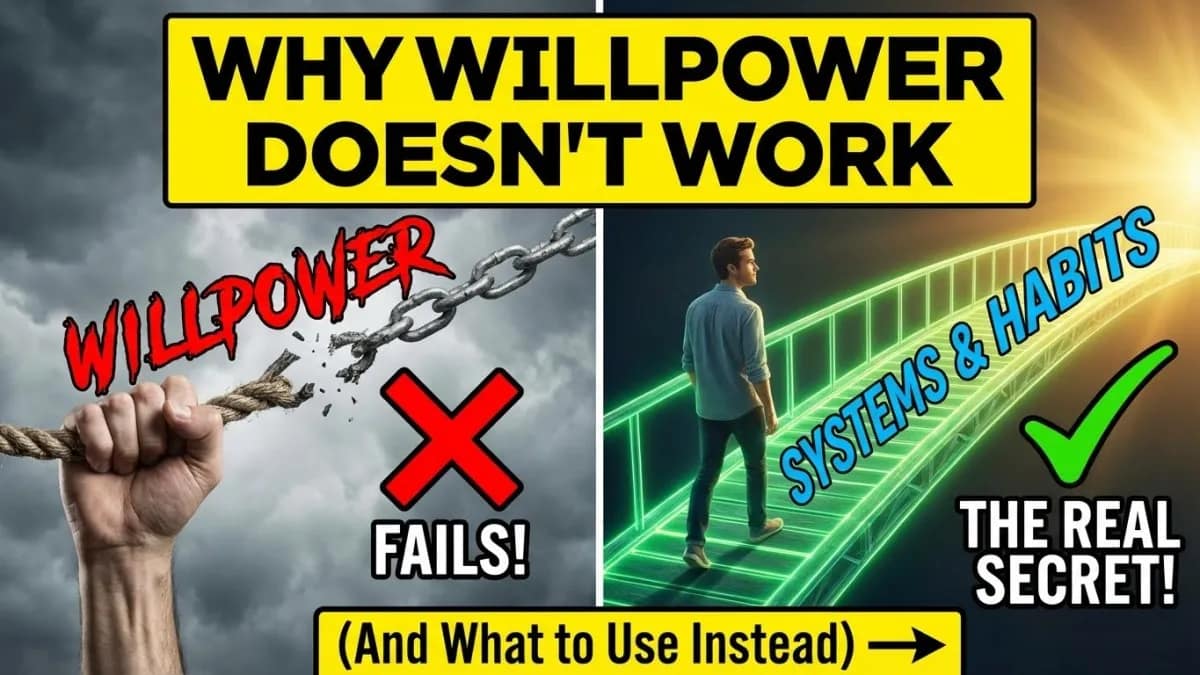
Why Willpower Doesn’t Work (And What to Use Instead)
Key Takeaways
Here’s what you need to know:
- Willpower is a limited resource that runs out quickly, especially when you’re stressed or tired
- Your environment controls most of your decisions—not your self-control
- Systems and habits beat willpower every single time
- Small changes to your surroundings create big changes in your behavior
- You don’t need more discipline—you need better strategies
Introduction: The Willpower Myth I Believed for Years
I used to think I just needed more self-control.
Every January, I’d make big promises. I’d wake up early. Eat healthy. Exercise daily.
By February, everything fell apart. And I blamed myself.Research shows that 80% ohttps://health.usnews.com/f New Year’s resolutions fail by February
But here’s what I learned after working with hundreds of people trying to change their lives: willpower isn’t the answer. It’s actually setting you up to fail.
Let me show you why—and what actually works instead.
What Is Willpower, Really?
Willpower is your brain’s ability to resist temptation and make hard choices.
Think of it like a battery. Every time you:
- Resist eating that donut
- Force yourself to exercise
- Stop yourself from checking your phone
- Make any difficult decision
You drain that battery a little more.
The problem? This battery is tiny. And it doesn’t recharge until you sleep.
The 3 Reasons Willpower Always Fails
1. Willpower Runs Out Every Single Day
I’ve seen this play out hundreds of times.
Someone eats perfectly all day. They resist snacks at work. They meal-prep a healthy dinner.
Then at 9 PM, they demolish an entire bag of chips.
Why? Their willpower battery died. This isn’t weakness—it’s biology.
Studies show that people make worse decisions as the day goes on. Judges grant fewer pardons before lunch. Dieters break their diets at night.
Your self-control is strongest in the morning and weakest when you’re tired.
2. Stress Destroys Your Self-Control
When you’re stressed, your brain enters survival mode.
I remember working with a client who was perfect with his diet—until work got intense. Then every good habit vanished.
Here’s what happens:
- Stress hormones flood your system
- Your brain craves quick energy (sugar and carbs)
- Decision-making becomes harder
- You default to old patterns
Trying to use willpower when stressed is like trying to run a marathon with a broken leg.
3. Your Environment Is Stronger Than Your Discipline
This is the big one most people miss.
If you keep ice cream in your freezer, you’ll eat it. Not because you’re weak. Because proximity beats willpower 100% of the time.
I tested this myself. When I kept cookies on my counter, I ate 3-4 per day. When I moved them to the basement, I ate maybe one per week.
Same person. Same willpower. Different result.
Your surroundings make your decisions for you—whether you realize it or not.
What to Use Instead: The 4 Strategies That Actually Work
Strategy 1: Design Your Environment
Stop fighting yourself. Make the right choice the easy choice.
Here’s how I do this:
- I put my workout clothes next to my bed (so I see them first thing)
- I deleted social media apps from my phone (can’t scroll if it’s not there)
- I prep healthy snacks on Sunday (grab-and-go beats cooking when hungry)
Your turn: Look at one habit you want to change. How can you make it easier or harder based on your space?
Remove temptation instead of resisting it.
Strategy 2: Build Systems, Not Goals
Goals are what you want. Systems are how you get there.
I’ve watched people set the same weight loss goal for 5 years straight. They never build a system to support it.
Example:
- Goal thinking: “I want to lose 20 pounds”
- System thinking: “I’ll walk for 20 minutes after breakfast every day”
The system removes the daily decision. You don’t need willpower—you just follow your routine.
Start small:
- Want to read more? Read one page before bed
- Want to save money? Auto-transfer $10 to savings every Friday
- Want to eat better? Order groceries online (removes impulse buys)
Strategy 3: Use Implementation Intentions
This is a fancy term for a simple idea: decide in advance.
Instead of “I’ll exercise more,” say: “I’ll walk for 15 minutes at 7 AM on Monday, Wednesday, and Friday.”
When you pre-decide, you don’t waste willpower choosing.
I use this for everything:
- “When I feel stressed, I’ll take 3 deep breaths”
- “If someone offers me cake at work, I’ll say ‘I already ate'”
- “When I finish dinner, I’ll immediately start the dishes”
The “if-then” or “when-then” format removes the mental struggle.
Strategy 4: Make It Automatic with Habit Stacking
Attach new habits to existing ones.
Your brain already has strong patterns. Piggyback on them.
I wanted to take vitamins daily. I kept forgetting. Then I put the bottle next to my coffee maker.
Now I take vitamins while my coffee brews. No thinking required.
The formula: “After I [current habit], I will [new habit].”
Examples:
- After I pour my morning coffee, I’ll write three things I’m grateful for
- After I brush my teeth at night, I’ll lay out tomorrow’s clothes
- After I sit down at my desk, I’ll put my phone in a drawer
Pro Tip: The Two-Minute Rule
Here’s something most people never learn:
If a habit takes less than two minutes, do it immediately.
I’ve seen people spend 10 minutes debating whether to do the dishes. Just do them—it takes 2 minutes.
Why this works:
- You build momentum
- You avoid decision fatigue
- Small wins create motivation for bigger tasks
The goal isn’t perfection. It’s removing the mental barrier that drains your willpower before you even start.
Real-Life Example: How I Changed My Morning Routine
I used to snooze my alarm 5 times every morning.
I’d tell myself, “Tomorrow I’ll wake up on time.” I tried for months. Failed every single time.
Then I stopped relying on willpower:
- I put my alarm across the room (had to get up to turn it off)
- I set my coffee maker on a timer (smelled coffee when I woke up)
- I put my workout clothes in the bathroom (changed immediately after washing my face)
Within a week, I was waking up 30 minutes earlier. No extra discipline needed.
The environment did the work for me.
Common Mistakes People Make (And How to Avoid Them)
Mistake 1: Trying to Change Too Much at Once
I’ve watched people try to:
- Start a new diet
- Begin exercising
- Wake up earlier
- Quit smoking
All at the same time. They last maybe 3 days.
Fix: Change ONE thing. Make it automatic. Then add the next thing.
Mistake 2: Relying on Motivation
Motivation is like the weather—it comes and goes.
Don’t wait to “feel like it.” Build systems that work even when you don’t want to.
Fix: Create routines that require zero motivation to start.
Mistake 3: Not Tracking Progress
What gets measured gets improved.
I keep a simple calendar. Every day I do my habit, I mark an X. I just don’t want to break the chain.
Fix: Use a habit tracker app or a simple paper calendar.
The Science Behind Why This Works
Your brain is lazy. That’s not an insult—it’s efficient.
The brain uses about 20% of your body’s energy. It’s always looking for shortcuts.
When you create systems and change your environment, you work with your brain instead of against it.
Key research findings:
- People eat 30% less when they use smaller plates
- You’re 80% more likely to exercise if your gym is less than 5 minutes away
- Simply seeing healthy food increases consumption by 70%
Your choices aren’t really choices—they’re reactions to your environment.
How to Start Today: Your 3-Step Action Plan
Step 1: Pick ONE Habit
Don’t try to fix everything. What’s one change that would make the biggest difference?
Write it down right now.
Step 2: Remove One Obstacle
What makes this habit hard? How can you eliminate that barrier?
If you want to eat better, throw out the junk food tonight. If you want to wake up earlier, move your alarm across the room.
Step 3: Create an If-Then Plan
“When [trigger happens], I will [do this action].”
Be specific. Write it down. Put it somewhere you’ll see it.
Q: Doesn’t willpower matter at all?
Yes, but it’s overrated. Willpower is useful for short bursts—like saying no to a single cookie. But it fails for long-term change. Use it to set up your environment, then let the environment do the heavy lifting.
Q: How long does it take to build a new habit?
The old “21 days” myth is wrong. Research shows it takes an average of 66 days for a behavior to become automatic. But this varies—simple habits form faster than complex ones. Focus on consistency, not a specific timeline.
Q: What if I mess up and break my habit?
You will mess up. Everyone does. The key is getting back on track immediately. Missing once is a mistake. Missing twice is the start of a new pattern. Never miss twice in a row.
Q: Can I use these strategies for big goals like starting a business?
Absolutely. Break the big goal into small daily systems. Instead of “start a business,” your system might be “work on business plan for 30 minutes every morning before work.” The system moves you forward without requiring massive willpower.
Q: How do I stay consistent when life gets chaotic?
This is where systems really shine. When chaos hits, your automatic habits keep running. They’re your safety net. Start with habits so small they’re impossible to skip—even on your worst days.
Q: What if my environment is controlled by others (like at work or at home with family)?
Focus on what you can control. You might not control the office snack drawer, but you can pack your own snacks. You can’t make your family eat differently, but you can prep your own meals. Small zones of control compound over time.
Q: Is this just about habits, or does it work for one-time decisions too?
Great question. The strategies work for everything. For one-time decisions, use implementation intentions. “When I get my tax refund, I will immediately transfer 50% to savings.” Pre-deciding removes the willpower drain when the moment arrives.
READ MORE:https://mrpsychics.com/the-zeigarnik-effect-how-to-cure-procrastination/
Final Thoughts: The Freedom in Giving Up Willpower
Here’s the truth nobody tells you: giving up on willpower is liberating.
You’re not broken. You’re not lazy. You’ve just been using the wrong tool.
I’ve seen people transform their lives not by becoming more disciplined, but by becoming smarter about their environment and systems.
Start small. Change one thing today. Build from there.
You don’t need superhuman self-control. You just need better strategies.

Ahmed is a self-improvement and psychology writer passionate about helping people live smarter, calmer, and more productive lives.
- Ahmed manasiya

- Ahmed manasiya
- Ahmed manasiya
- Ahmed manasiya